Australia-Vanuatu Agreement: New Security Deal Blocks Foreign Military Bases
Canberra and Vanuatu sign a broad economic and security partnership aimed at strengthening regional cooperation and limiting military expansion in the Pacific.
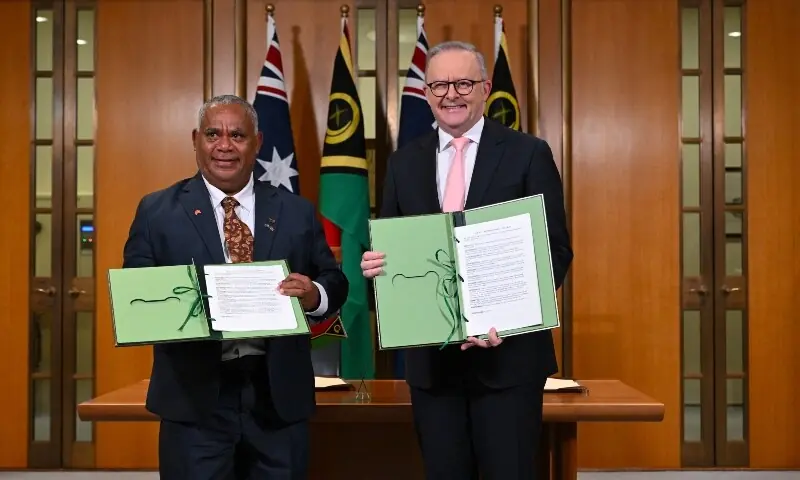
Australia and Vanuatu leaders sign a new economic and security partnership in Canberra.
Australia and Vanuatu have signed a wide-ranging economic and security agreement that prevents the establishment of foreign military bases in the Pacific island nation, marking a significant development in regional strategic relations.
The agreement, known as the Nakamal Agreement, was signed in Canberra by Australian Prime Minister Anthony Albanese and Vanuatu Prime Minister Jotham Napat.
Under the arrangement, Australia will provide support worth approximately $345 million while expanding cooperation across infrastructure, policing, maritime security and economic development.
A central provision of the agreement commits Vanuatu to preventing its territory from being used for foreign military bases or military infrastructure.
Speaking after the signing ceremony, Prime Minister Albanese said the agreement would provide greater certainty regarding regional security while reinforcing sovereignty and cooperation between both countries.
Prime Minister Napat described the agreement as balanced and said it would protect both collective and national interests while reaffirming Vanuatu’s commitment to limiting the militarisation of infrastructure.
The agreement comes amid growing strategic competition across the South Pacific, where China has expanded economic and security engagement in recent years.
China has previously supported infrastructure development in Vanuatu, including expansion work at the port in Luganville, a project that generated attention in Australia and the United States because of concerns about possible future military use. China and Vanuatu have consistently stated the project was intended for civilian and tourism purposes.
Beyond security measures, the agreement outlines cooperation in ports, digital systems, aviation and energy infrastructure, while requiring such developments to remain protected from foreign interference and military use.
The arrangement also strengthens Australia’s role in supporting Vanuatu’s policing sector through training, equipment, maritime cooperation, cyber security and intelligence coordination.
Although the agreement limits foreign military infrastructure, it does not prevent Vanuatu from maintaining economic partnerships with other countries. However, Vanuatu agreed to consult Australia when engaging with third-party partners on major initiatives.
Analysts said the agreement reflects continued competition for influence in the Pacific region while acknowledging Vanuatu’s longstanding approach of maintaining relationships with multiple international partners.
The agreement also includes provisions intended to support mobility and economic opportunities for Vanuatu citizens, including closer cooperation on travel and employment links with Australia.