Why Uzbekistan Investment Rules Are Drawing Global Attention?
Reforms announced at the Khiva entrepreneurs’ dialogue focus on investment support, exports, regulatory changes and regional business development.
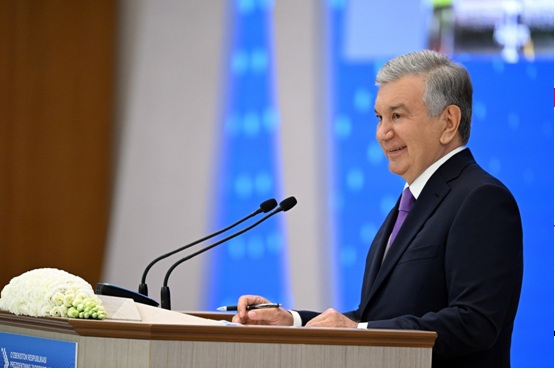
Uzbekistan President Shavkat Mirziyoyev addresses entrepreneurs during the Khiva dialogue.
By: Sadriddin Suyarov
Dunyo IA
Tashkent: Uzbekistan is seeking to strengthen its position as a predictable destination for international business following a series of measures announced by President Shavkat Mirziyoyev at an open dialogue with entrepreneurs in Khiva, Khorezm Region.
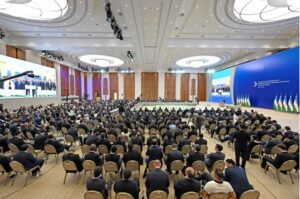
The Uzbekistan investment agenda discussed at the August 18 dialogue included measures covering business finance, exports, regulation, technology and regional development. The presidential office said the event brought together entrepreneurs from across the country, with around 25,000 business representatives joining from district-level studios.
The initiatives reflect the government’s stated effort to improve the business environment and expand opportunities for domestic and foreign investors. Officials also linked the measures to export growth, private-sector development and greater integration with international markets.
Expanding Access to Finance
The government announced additional support for businesses through credit guarantees and financing programmes. According to the published measures, the State Fund for Entrepreneurship Support will place greater emphasis on services and medium-sized businesses.
The government also announced a further $100 million allocation for credit guarantees. In addition, a programme for high-growth companies will provide grants and preferential financing of up to 10 billion soums, according to the official account of the reforms.
These measures are intended to improve access to capital for growing businesses and create opportunities for innovative and technology-focused companies.
CAP Seeks Nationwide Checks to Ensure Qualified Pharmacists at Medical Stores
Export and Investment Opportunities
The Khiva dialogue also placed strong emphasis on helping businesses reach international markets. The government said it would cover up to 50 percent of eligible expenses for companies seeking to place products on major international electronic trading platforms.
The broader programme also includes measures aimed at reducing administrative pressure on businesses. Official announcements include plans for a three-year moratorium on certain inspections of small businesses, along with changes to licensing and permitting procedures.
The government has also announced a principle under which, from next year, disputes between businesses and the state would apply a “presumption in favour of the entrepreneur” until wrongdoing is established in court.
Focus on Green Growth
Uzbekistan is also linking its economic reforms with green-development initiatives. The government has outlined support for energy-efficient technologies and renewable energy projects.
The measures described in the source material include tax incentives, accelerated depreciation and tariff preferences for qualifying investments. The government has also discussed developing a national certification system for green products to facilitate access to international markets.
Regional Development and Khorezm
Holding the dialogue in Khiva also highlighted the government’s focus on expanding economic activity beyond the capital.
Khorezm has attracted significant foreign investment in recent years. Uzbekistan’s presidential office said the region had received $4 billion in foreign investment over a relatively short period, while small businesses accounted for 72 percent of its economy and 81 percent of exports.
The government has outlined plans for special regimes supporting pharmaceutical, textile and IT clusters. It also aims to connect regional businesses more closely with transport and logistics corridors linking Central Asia with markets in the Middle East, South Asia and Europe.
Special economic zones are another part of the strategy. The government plans to provide infrastructure and utility networks in advance so that investors can begin projects with essential facilities already in place.
Building a More Predictable Business Environment
The Khiva dialogue forms part of Uzbekistan’s broader effort to reform its business environment. According to the presidential office, 84 laws and 861 decrees and resolutions have been adopted over five years in response to issues raised through the open dialogue process.
The government has also reported a significant expansion in business financing. Official figures presented at the dialogue show that the credit portfolio allocated to businesses has almost tripled over five years to 450 trillion soums.
For international companies, the announced measures could create new opportunities in areas including technology, manufacturing, services, exports and regional infrastructure. However, the practical impact of the reforms will depend on their implementation and enforcement across Uzbekistan.
The Khiva dialogue therefore represents another step in Uzbekistan’s continuing programme to reshape its business and investment framework and deepen its engagement with international markets.