Ship Attack Reported in Strait of Hormuz as Iran-Related Energy Risks Grow
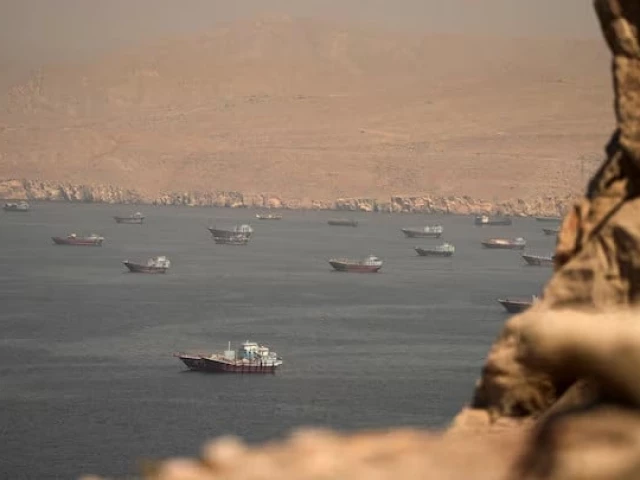
A vessel travels through the Strait of Hormuz amid rising security concerns and disruptions to regional energy routes.
A projectile struck a vessel in the Strait of Hormuz on Sunday, according to a report received by the UK Maritime Trade Operations (UKMTO).
The incident adds to growing concerns over energy supplies as the Middle East conflict continues to disrupt major oil and shipping routes.
UKMTO, a British navy-affiliated maritime security agency, said it received a report of a projectile hitting a vessel while it was travelling through the strategic waterway.
The agency said the extent of the damage remained unknown. It also had no immediate information about the crew’s condition.
Hormuz Attack Raises Energy Concerns
The latest incident came a day after Saudi Arabia temporarily shut its East-West oil pipeline.
Saudi authorities took the step after a drone attack. Baghdad and Riyadh both said the attack originated in Iraq, where Iranian-backed militias operate.
Meanwhile, the widening conflict has already pushed energy prices higher. Brent crude returned above $100 a barrel during the past week.
The 1,200-kilometre East-West pipeline crosses the Arabian Peninsula. It has provided Saudi Arabia with an alternative export route while fighting has restricted shipping through the Strait of Hormuz.
The pipeline has carried between 4 million and 5 million barrels of oil per day. That represents roughly 4% to 5% of global oil supply.
As a result, the pipeline has helped reduce the impact of disruptions affecting other Gulf oil and gas exporters.
Saudi Pipeline Attack Causes Damage
No group immediately claimed responsibility for the attack on the pipeline.
Satellite images showed black smoke rising from an area south of Medina. Saudi authorities reported injuries and damage but continued to assess the impact.
The Saudi Foreign Ministry did not provide details about any effect on oil exports.
US President Donald Trump, who was visiting Ireland, said Iran was probably responsible for the attack.
Separately, Saudi Civil Defence reported another incident in the Jazan region on Saturday.
Patel Hospital Holds CME Session on Plastic Surgery Beyond Aesthetics
The agency said a Houthi projectile injured two people. It also damaged several buildings, including a mosque.
Saudi Arabia Seeks US Military Support
Oil markets have faced further pressure as fighting spreads across key regional routes.
The United States and Iran have both attacked tankers during the conflict. At the same time, Iran-aligned Houthi forces in Yemen have advanced along the Red Sea.
The developments could extend disruption across another major energy route.
Saudi Arabia now faces growing security pressure from the Houthi advance. The situation has also created a difficult choice for Washington.
According to three sources cited by Reuters, Saudi Crown Prince Mohammed bin Salman spoke with Trump on Thursday.
The Saudi leader reportedly asked for US military assistance against the Houthis.
The sources said Washington would not directly intervene for now. However, the United States would provide intelligence support.
Trump confirmed that he had spoken with the Saudi crown prince.
He also said the Houthis had contacted his administration. According to Trump, the group asked Washington not to become directly involved in the conflict.
Houthis Reportedly Seize Perim Island
Four Yemeni government sources told Reuters that Houthi forces seized the strategic island of Perim on Friday.
The island sits in the middle of the Bab el-Mandeb Strait. The waterway connects the Red Sea with the Gulf of Aden.
The strait serves as another critical route for global energy and commercial shipping.
The reported Houthi advance could therefore add further pressure to an already disrupted regional shipping network.
Iran Plays Down Prospects for Talks
Diplomatic efforts to end the conflict have made little progress.
The United States and Iran have not held new talks since a June agreement collapsed within weeks.
Ebrahim Azizi, head of Iran’s parliamentary National Security Committee, said dialogue would have little value without agreement on Iran’s conditions.
Iran’s Foreign Ministry also announced a planned meeting with Gulf Arab states in Oman on Monday.
The meeting will include discussions about the future of the Strait of Hormuz.
However, a senior Iranian official told Reuters that expectations for a major breakthrough remained low.
The official spoke on condition of anonymity. He said Oman had initiated the meeting to discuss several issues, including the strait.
However, he said the meeting was not expected to produce a signed agreement.
Iran Demands Recognition of Its Hormuz Role
According to Iran’s Tasnim news agency, an agreement on routes through the Strait of Hormuz between Iran and Oman will be presented during Monday’s meeting.
Iraq will also attend the discussions.
However, the strait would not fully reopen unless Iran’s conditions were met, according to a source cited by Tasnim.
Iran reportedly wants recognition of its control over the waterway. Tehran also wants the authority to collect fees from ships using the strait.
Washington opposes those demands.
Oman controls the opposite side of the waterway. The country says it is negotiating with the support of other regional states.
Global Energy Markets Remain on Alert
The latest ship incident and Saudi pipeline shutdown have increased uncertainty across global energy markets.
The Strait of Hormuz remains one of the world’s most important energy corridors. Any prolonged disruption could affect oil prices, tanker movements and energy costs worldwide.
Moreover, the conflict now involves several major shipping routes. The Strait of Hormuz, Bab el-Mandeb and Saudi Arabia’s alternative oil infrastructure have all faced growing security risks.
For now, governments and energy markets remain focused on whether the conflict will further disrupt the movement of oil and gas.
Any additional attacks on tankers, pipelines or strategic waterways could place fresh pressure on global energy supplies.