ICE Arrests Surge Under Trump as Non-Criminal Immigrants Make Up Majority
ICE arrests have reached record levels under the second Trump administration, with newly obtained data showing that a majority of those detained had no criminal record.
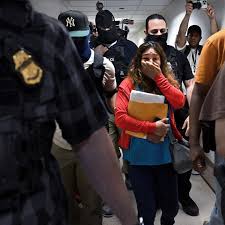
ICE arrests rise as US immigration enforcement expands under the Trump administration.
Exclusive By: Kanwal Abidi
Washington, D.C.
U.S. Immigration and Customs Enforcement (ICE) has recorded more than 50,000 arrests in both July and August. The figures mark consecutive monthly records during the second Trump administration.
However, the data challenge the administration’s repeated claim that immigration enforcement is primarily focused on people with criminal records.
According to data obtained by the Deportation Data Project, 55 percent of those arrested had no interaction with law enforcement. Another 24 percent had faced charges but were never convicted.
Arrest Strategy Draws Political Questions
The figures have raised concerns among some Republicans in Congress.
Rep. Maria Elvira Salazar, a Florida Republican, urged the administration to distinguish between people who pose serious public safety threats and non-criminal immigrants.
FFC Holds Farmer Incentive Program Prize Distribution Ceremony in Kasur
The data also point to a broader shift in enforcement. Increasingly, ICE appears to be arresting people who are already known to immigration authorities.
These include immigrants with pending asylum cases or applications to adjust their legal status.
Aaron Reichlin-Melnick, a senior fellow at the American Immigration Council, said the figures indicate an expansion of mass deportation operations.
He argued that enforcement is moving beyond people with criminal histories and toward broader arrest targets as the administration seeks to meet its stated goals.
DHS Claims Face Scrutiny
The Department of Homeland Security has continued to claim that around 70 percent of people arrested by ICE have criminal records.
However, immigration policy analysts dispute that figure.
Reichlin-Melnick said the 70 percent claim has not reflected ICE data since May 2025. He also argued that government data released over the past year contradict the department’s statement.
At the same time, senior administration officials have offered different explanations for the enforcement strategy.
Homeland Security Secretary Markwayne Mullin recently said immigration authorities would pursue people regardless of whether they had a criminal background. He argued that entering the United States illegally was itself a violation of the law.
Border czar Tom Homan similarly acknowledged in July that roughly half of those arrested were non-criminals.
Multiple Enforcement Tactics Drive Arrests
Several enforcement methods appear to be contributing to the rise in arrests.
These include street arrests, immigration court interactions and mandatory check-ins. More recently, arrests at airports have also become part of the strategy.
David Bier, director of immigration studies at the Cato Institute, said multiple tactics are now operating at the same time.
He also pointed to increased resources and overtime spending as factors behind the growing number of arrests.
Meanwhile, Democratic lawmakers have criticised what they describe as a quieter approach to immigration enforcement.
Rep. Pramila Jayapal, the top Democrat on the House Judiciary immigration subcommittee, said the administration had reduced the visibility of operations following backlash against highly publicised raids.
Immigrants Already in the System Targeted
Immigration advocates say some of those arrested are already complying with government requirements.
Reichlin-Melnick said arrests have included people appearing for immigration-related appointments and individuals at airports.
He also cited cases involving visa overstays linked to delays in government processing.
According to him, people already known to authorities can be easier to locate. Therefore, they may become targets when officials seek to increase arrest numbers.
The development has raised questions about how immigration enforcement is being measured and what constitutes success under the administration’s mass deportation strategy.
Detention Without Final Removal Orders
The growing number of arrests has also drawn attention to immigrants who do not yet have final removal orders.
A final removal order is issued after an immigration judge determines that a person should be deported.
David Bier said an increasing share of detainees are being held while continuing to challenge their immigration cases.
He warned that the strategy could result in more people being detained without final removal orders.
The debate comes as the Trump administration continues to expand immigration enforcement resources and pursue its broader mass deportation agenda.
The surge has also generated resistance in states such as Florida, where immigrant communities include both naturalised citizens and people without legal status.