
Hub Water Crisis Deepens as Industries Warn of Shutdowns and Job Losses
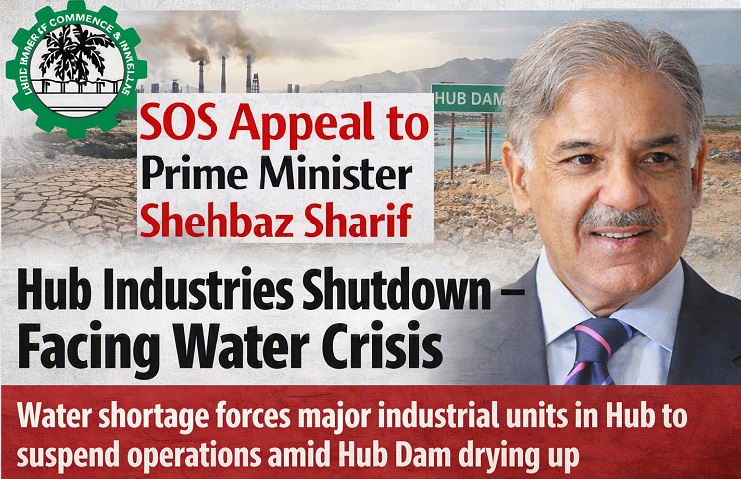
Industries in Hub face growing disruption as water shortages threaten production and jobs.
The Hub Water Crisis is deepening, with industrial leaders warning that factories could suspend operations within weeks if supplies do not improve. The Hub Chamber of Commerce & Industry has appealed to Prime Minister Shehbaz Sharif for urgent action.
CBD Punjab accelerates mega projects as CEO demands quality and timely completion
Former Hub Chamber president Ismail Suttar and President Yakoob H. Karim said the shortage threatens industrial production, agriculture and the livelihoods of thousands of workers.
They described Hub as the industrial backbone of Balochistan and warned that prolonged water shortages could force factories to reduce or stop production. Such a situation, they said, would also hurt employment, exports, investment and government revenue.
The chamber leaders said Hub contributes more than Rs7 billion annually to the national exchequer. They argued that continued disruption could therefore have consequences beyond the district.
According to the chamber, Hub relies primarily on the Hub Dam for its water supply, while Karachi has access to several sources. They said the current allocation gives Hub 36.7 per cent of available water and Karachi 62.3 per cent.
The chamber has questioned whether the existing formula reflects Hub’s current needs. When the allocation system was established in the 1980s, Hub had a population of around 20,000, five industrial units and about 1,000 acres of cultivated land.
The situation has changed significantly since then. Chamber officials said Hub’s population has now crossed one million, while the number of industrial units has increased to about 300. Cultivated land has also expanded to more than 25,000 acres.
They argued that the decades-old allocation formula has failed to keep pace with this growth.
The chamber also highlighted what it called a contradiction in the current situation. The Hub Dam is reportedly close to full capacity after recent monsoon rains. Its spillway gates could be opened again if water levels rise further, potentially affecting nearby villages.
Yet residents, farmers and industries in Hub continue to report shortages.
Industrial units have allegedly received less water than required for nearly two months. Some factories are operating below capacity, while others have already reduced production.
The chamber warned that continued shortages could lead to widespread factory closures and rising unemployment.
Suttar said repeated appeals had been made to the relevant authorities. He added that officials had cited the training of the newly appointed project director as one reason for delays in addressing the situation.
The shortage is also affecting ordinary residents. Chamber representatives said hundreds of thousands of people are struggling to secure drinking water. Many residents cannot afford the high cost of private water tankers, particularly in low-income communities.
The chamber has asked the prime minister to direct the Water and Power Development Authority (Wapda) to release additional water for Hub immediately.
It also called for a comprehensive review of the existing water-sharing formula. The chamber wants future allocations to reflect current population levels, agricultural needs and industrial demand.
Business leaders said a sustainable system could help prevent repeated shortages and provide greater certainty for industries and communities.
They warned that failure to act quickly could turn the shortage into a wider economic and humanitarian crisis, affecting factories, agriculture, employment and thousands of households across Hub.