SpaceX Rocket Believed to Strike Moon, Creating New Crater in Rare Lunar Impact
A discarded Falcon 9 rocket stage is thought to have collided with the Moon, giving scientists a rare opportunity to study the effects of artificial impacts on the lunar surface.
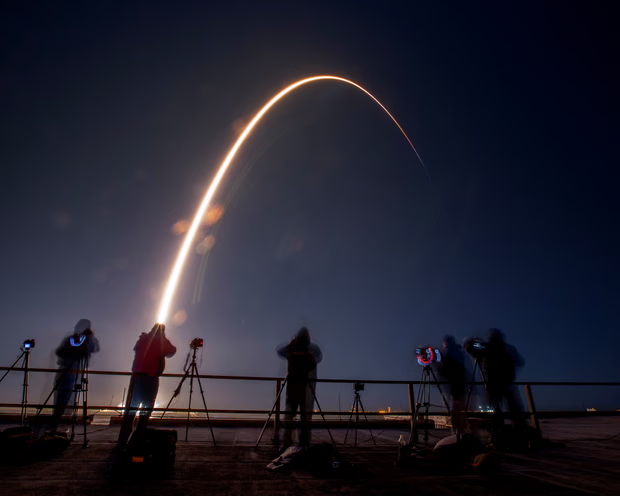
A discarded SpaceX Falcon 9 rocket stage is believed to have struck the Moon.
A discarded SpaceX Rocket stage is believed to have crashed into the Moon after drifting through space for more than a year, marking a rare artificial impact that scientists say poses no risk to Earth but could provide valuable insights into lunar geology and space debris management.
The four-tonne rocket stage, roughly the size of a building, was part of a SpaceX Falcon 9 launch that carried a lunar lander developed by Firefly Aerospace in January 2025. Astronomers predicted the uncontrolled rocket body would strike the Moon at around 5,400 mph (8,690 km/h), generating a fresh crater and sending a plume of lunar dust high above the surface.
NASA Expects a New Lunar Crater
SpaceX Rocket tracking data indicated the impact was expected at approximately 6:35 a.m. BST. Although professional and amateur astronomers monitored the event using powerful telescopes, the impact could not be immediately confirmed because the predicted collision site was located near the Moon’s visible edge.
NASA estimates the collision could create a crater measuring around 60 feet (18 metres) wide and 12 feet (4 metres) deep, while ejecting dust and rock across the surrounding lunar landscape. The US space agency plans to compare before-and-after images of the impact site to improve understanding of artificial collisions and refine methods for tracking objects in deep space.
NASA spokesperson Jimi Russell said the impact presents no danger to Earth, adding that scientists hope to gather valuable data from the event to support future lunar exploration.
Starbucks Korea Faces Police Raid After ‘Tank Day’ Campaign Sparks Defamation Probe
Why the Rocket Never Returned to Earth
Unlike many launch vehicles that burn up in Earth’s atmosphere after completing their missions, the Falcon 9 second stage remained in space because the January 2025 lunar mission required additional thrust to send Firefly Aerospace’s lander toward the Moon.
After exhausting its fuel, the rocket stage became uncontrollable and drifted through space alongside thousands of other pieces of orbital debris. Astronomers only determined this year that gravitational forces and solar activity had gradually altered its trajectory, placing it on a collision course with the Moon.
SpaceX’s Director of NASA Science and Dragon Programmes, Julianna Scheiman, said the unexpected impact resulted from a combination of solar activity and gravitational influences that redirected the rocket stage toward the lunar surface.
Scientists See Research Opportunity
Astronomers believe the impact could provide useful scientific data despite raising renewed concerns over the growing problem of space debris.
Bill Gray, creator of widely used astronomical tracking software, described the collision as a potentially valuable research event while noting it also highlights the need for better disposal of unused spacecraft components.
Researchers expect observations from the impact to improve understanding of how artificial objects interact with the lunar surface and how future missions can be managed more responsibly.
Space Debris Remains a Growing Challenge
Uncontrolled impacts on the Moon remain uncommon but are not unprecedented. A Chinese rocket stage struck the lunar surface in 2022 after completing a test mission, while NASA intentionally crashed a rocket stage into the Moon in 2009 to study material ejected during the collision.
Several lunar landing missions have also ended in crashes, including Russia’s Luna-25 mission in 2023, India’s Chandrayaan-2 lander in 2019 and Israel’s Beresheet spacecraft, which also crashed in 2019 carrying microscopic tardigrades among its payload.
NASA and SpaceX have confirmed they are discussing new strategies to reduce the likelihood of similar unintended lunar impacts in future missions, as international space agencies place greater emphasis on responsible space traffic and debris management.