Livoltek Deploys Landmark 2.35MWh BESS Project at Hub Salt Refinery, Advancing Industrial Clean Energy in Pakistan
Web Desk May 6, 2026Karachi: Livoltek has announced a major milestone in Pakistan’s renewable energy sector with the deployment of a 2.35MWh Battery Energy Storage System (BESS) integrated with a 1.44MW solar photovoltaic (PV) system at the Hub Salt Refinery in Sindh.
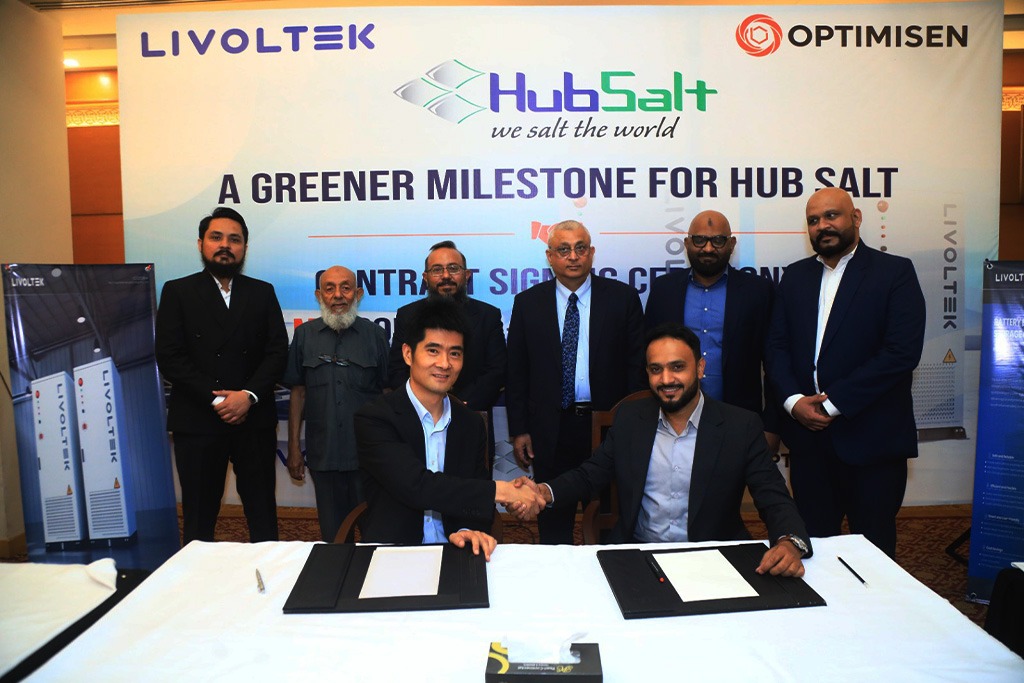
Karachi: Livoltek has announced a major milestone in Pakistan’s renewable energy sector with the deployment of a 2.35MWh Battery Energy Storage System (BESS) integrated with a 1.44MW solar photovoltaic (PV) system at the Hub Salt Refinery in Sindh.
Trump Orders Temporary Pause in Hormuz Escort Mission as Iran Talks Show Progress
The project, formalized through a strategic Memorandum of Understanding (MoU) and an EPC agreement between Hub Salt and Optimisen, marks Livoltek’s first high-capacity BESS installation in Pakistan and highlights its expanding presence in South Asia’s clean energy market.
Under the agreement, Optimisen will serve as the Engineering, Procurement, and Construction (EPC) partner, combining technical expertise with Livoltek’s advanced energy storage technologies. The initiative aims to transition the refinery from a diesel-dependent off-grid system to a hybrid solar-plus-storage energy model, improving sustainability, reducing fuel costs, and enhancing operational efficiency.
The system is designed as an advanced off-grid hybrid solution, featuring lithium-based energy storage, intelligent Energy Management Systems (EMS), and real-time monitoring capabilities. It enables peak load management, energy shifting, backup power support, and grid stabilization functions. Its modular structure allows for future expansion, while built-in safety and thermal management systems ensure reliability in industrial conditions.
According to project details, the installation is expected to displace approximately 360,000 liters of diesel annually, reducing Pakistan’s reliance on imported fuel and contributing to foreign exchange savings. It is also projected to cut over 2,000 tons of carbon dioxide emissions each year—equivalent to planting more than 90,000 trees.
The project may also allow Hub Salt to participate in international carbon credit markets under standards such as Verra and Gold Standard, further enhancing its sustainability profile.
Industry stakeholders described the initiative as a significant step toward industrial energy transition in Pakistan, combining renewable generation with advanced storage systems to improve energy resilience and reduce environmental impact.
Livoltek officials stated that the company plans to expand its BESS footprint in Pakistan, targeting around 20MW of storage capacity deployments within the year.
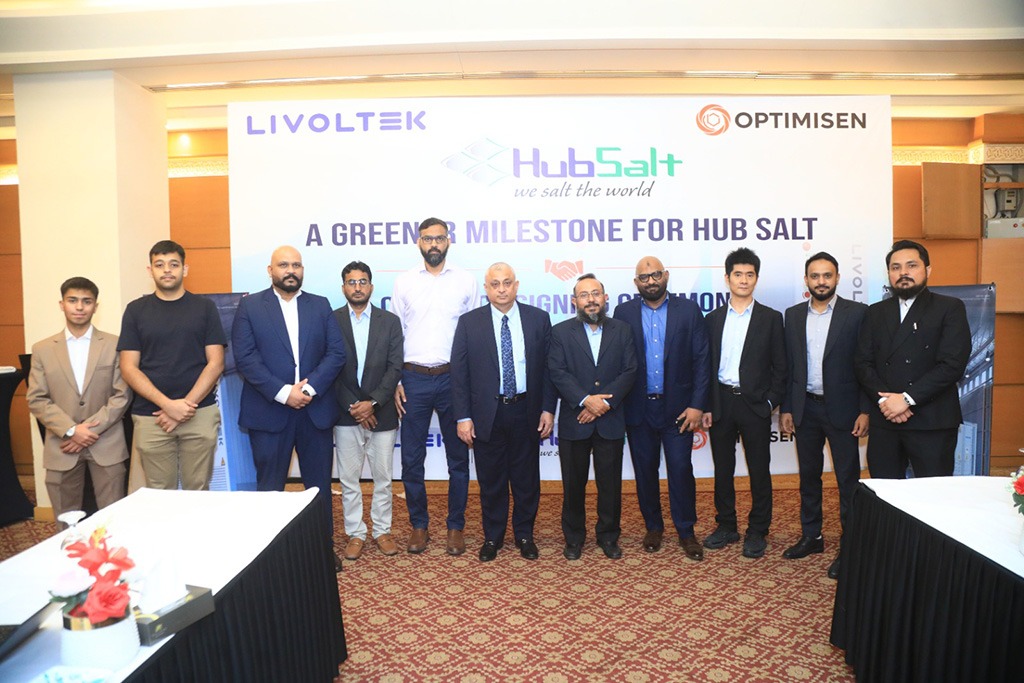
Hub Salt management said the project represents a strategic shift away from diesel-based power generation toward cleaner and more efficient energy systems, aligning with broader goals of energy security and reduced fuel imports.
Optimisen highlighted the project as one of its most advanced EPC undertakings, emphasizing its role in setting new benchmarks for industrial-scale renewable energy integration in the country.
The collaboration is being viewed as a model for future industrial energy projects, demonstrating how solar power and battery storage can work together to deliver reliable, cost-effective, and environmentally responsible energy solutions in Pakistan.