Pakistan’s Western Frontier Faces Persistent Instability Amid Converging Security Pressures
Pakistan’s Western Frontier Faces Persistent Instability Amid Converging Security Pressures
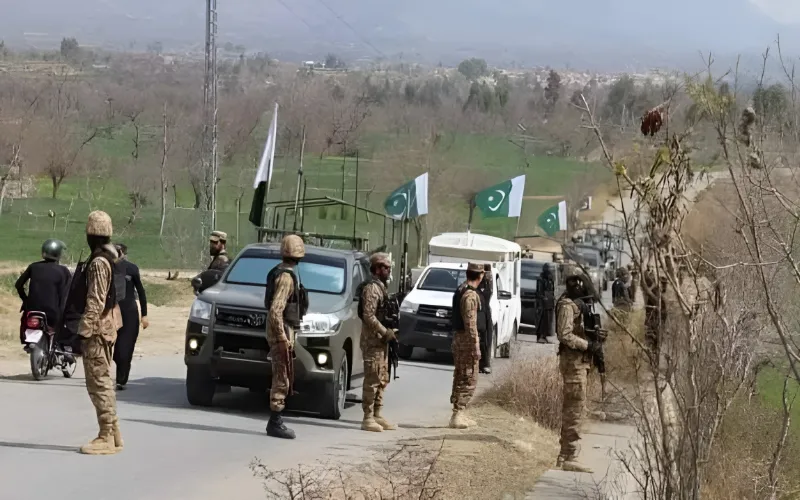
ISLAMABAD: Pakistan’s western frontier is increasingly evolving into a structurally volatile security environment, shaped by overlapping insurgencies, cross-border dynamics, and wider regional tensions, analysts say.
Trump Weighs Iran Deal Proposal, Warns of Possible Renewed Strikes
What was once considered a geographically contained issue along the Durand Line has transformed into a complex, interconnected system. Militant networks, internal security challenges, and developments in Afghanistan now interact in ways that continuously reinforce instability rather than isolate it.
At the centre of this shifting landscape remains the presence of the Tehreek-e-Taliban Pakistan, whose alleged sanctuaries across the border continue to pose a direct challenge to Pakistan’s internal security. While Afghan Taliban authorities face constraints in dealing with such groups due to ideological and historical linkages, the divergence has strained bilateral dynamics.
Pakistan’s response has gradually shifted from a defensive counterinsurgency posture to a more proactive strategy involving targeted cross-border actions aimed at deterring militant activity. However, experts caution that while such measures may disrupt networks temporarily, they fall short of addressing the structural drivers of militancy.
The challenge is further compounded by insurgent activity in Balochistan, where groups such as the Baloch Liberation Army and the Balochistan Liberation Front continue to operate. Although not formally aligned with the TTP, these groups create parallel pressure points that strain state capacity.
Overlaying these internal dynamics are broader geopolitical tensions involving Iran, the United States, and Israel. Developments in the Strait of Hormuz, a key global energy corridor, add an economic dimension to Pakistan’s security concerns by influencing fuel costs and financial stability.
Analysts describe the current situation as one of “managed instability,” where violence persists at a controlled level without escalating into full-scale conflict. Cross-border strikes, insurgent attacks, and diplomatic engagements form a recurring cycle that mitigates but does not resolve underlying tensions.
Looking ahead, experts warn of the risk of convergence—where multiple stress factors align simultaneously, such as a major militant attack, intensified insurgency in border regions, and external geopolitical shocks. Such a scenario could significantly test Pakistan’s institutional capacity across security, economic, and governance domains.
The consensus among analysts is that while military measures remain necessary for immediate deterrence, long-term stability depends on deeper structural reforms. These include strengthening governance in peripheral regions, improving intelligence capabilities, enhancing economic resilience, and pursuing sustained diplomatic engagement focused on verifiable outcomes.
In this evolving environment, stability is increasingly seen not as a fixed end-state but as a continuously managed process requiring adaptation to shifting internal and external pressures.