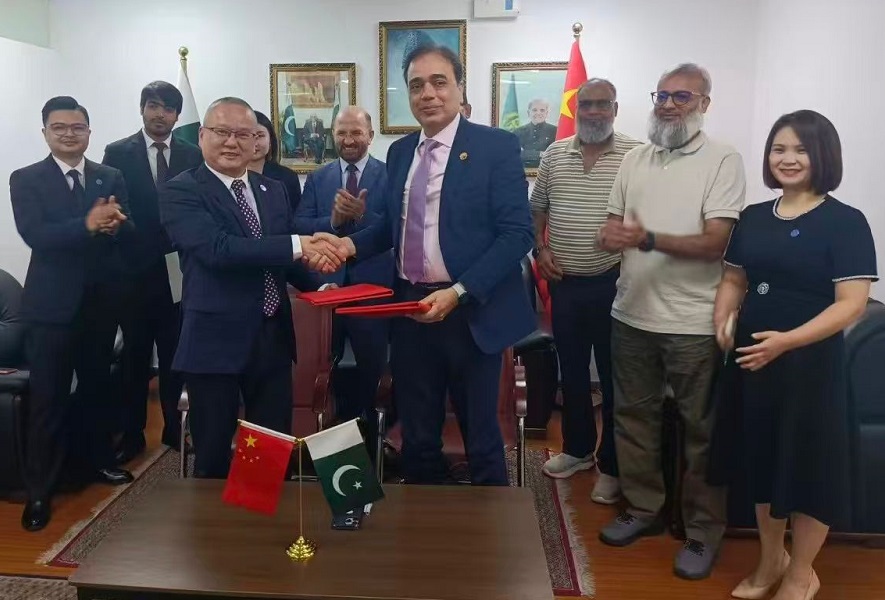
GUANGZHOU, April 23, 2026: The Federation of Pakistan Chambers of Commerce and Industry (FPCCI) and the Guangzhou Chamber of Commerce and Industry have signed a Memorandum of Understanding (MoU) aimed at strengthening bilateral trade and investment cooperation between Pakistan and China, marking a significant step forward in deepening economic ties.
MCB Bank Posts Strong Q1 2026 Results with Rs 12.8 Billion Profit and 90% Dividend Amid Robust Core Income Growth
The agreement was formalized during a high-level meeting at the Consulate General of Pakistan in Guangzhou, where FPCCI Senior Vice President Saquib Fayyaz Magoon and Guangzhou Chamber Chairman Richard Wu signed the document in the presence of senior officials and business representatives.
Under the MoU, both organizations agreed to establish dedicated arbitration desks to facilitate the swift resolution of commercial disputes, a move expected to enhance investor confidence and improve the ease of doing business between the two countries. The agreement also focuses on boosting trade volumes, reducing barriers, and promoting stronger institutional collaboration.
Pakistan’s Consul General Sardar Mohammad and Commercial Attaché Mohammad Imran hosted the signing ceremony, which was attended by a delegation of leading Pakistani industrialists and traders representing multiple sectors.
Speaking on the occasion, Magoon reaffirmed that China remains Pakistan’s most reliable economic partner and emphasized Islamabad’s continued support for Beijing’s vision of inclusive global growth through international cooperation.
Chairman Wu highlighted China’s outward-looking economic strategy, driven by high-tech transfer and overseas investment, and expressed strong interest among Chinese enterprises in establishing industrial ventures in Pakistan. He identified renewable energy, information technology, and agriculture as priority sectors for future collaboration.
In a key announcement, Wu revealed that a landmark Business-to-Business (B2B) Investment Conference will be held in Lahore on May 9–10. The event will bring together Chinese investors and Pakistani counterparts to explore opportunities in home appliances, electrical equipment, industrial machinery, and energy storage.
The MoU is expected to open new avenues for trade expansion, investment inflows, and joint ventures, further strengthening the long-standing strategic partnership between Pakistan and China.