

Introduction
War is often discussed emotionally in political discourse, yet in strategic studies it has a clear technical definition and measurable indicators of victory and defeat. When examined through the lens of military science and international relations, the current Iran conflict demonstrates how the erosion of military capability determines the practical end of war, even if sporadic violence continues afterward.
Understanding this distinction is essential for analyzing the trajectory of the Iran war and the likely post-war environment that may resemble fragmented conflicts seen previously in countries such as Afghanistan, Iraq, or Libya.
Defining War in Strategic Terms
War is an armed conflict between states conducted by organized military forces in pursuit of political objectives. The classical definition articulated by the Prussian strategist Carl von Clausewitz remains the most widely cited in strategic studies:
“War is the continuation of politics by other means.”
Modern political science further defines war as sustained organized violence between state actors resulting in significant military operations and casualties. International research frameworks such as the Correlates of War Project classify war as conflict producing more than 1,000 battle-related deaths annually between organized armed forces.
Therefore, the defining features of war include:
1 Organized armed forces
2 Sustained military engagement
3 Strategic objectives
4 State-level command structures
Once the ability of one side to sustain organized military operations collapses, the war is effectively lost even if violence continues in other forms.
The Iran War: Military Capability Degradation
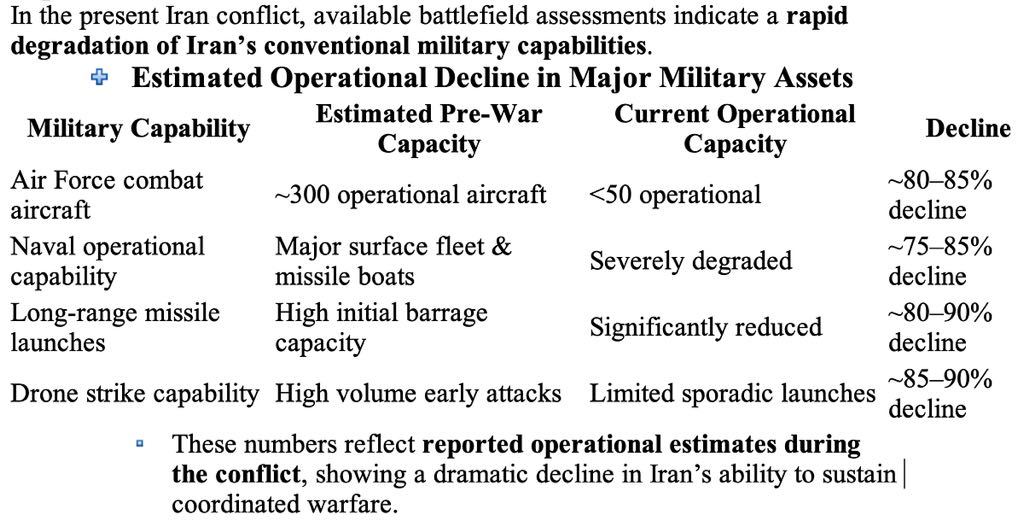
In the present Iran conflict, available battlefield assessments indicate a rapid degradation of Iran’s conventional military capabilities.
Estimated Operational Decline in Major Military Assets
Military Capability
Estimated Pre-War Capacity
Current Operational Capacity
Decline
Air Force combat aircraft
~300 operational aircraft
<50 operational
~80–85% decline
Naval operational capability
Major surface fleet & missile boats
Severely degraded
~75–85% decline
Long-range missile launches
High initial barrage capacity
Significantly reduced
~80–90% decline
Drone strike capability
High volume early attacks
Limited sporadic launches
~85–90% decline
These numbers reflect reported operational estimates during the conflict, showing a dramatic decline in Iran’s ability to sustain coordinated warfare.
Decline in Missile and Drone Attacks
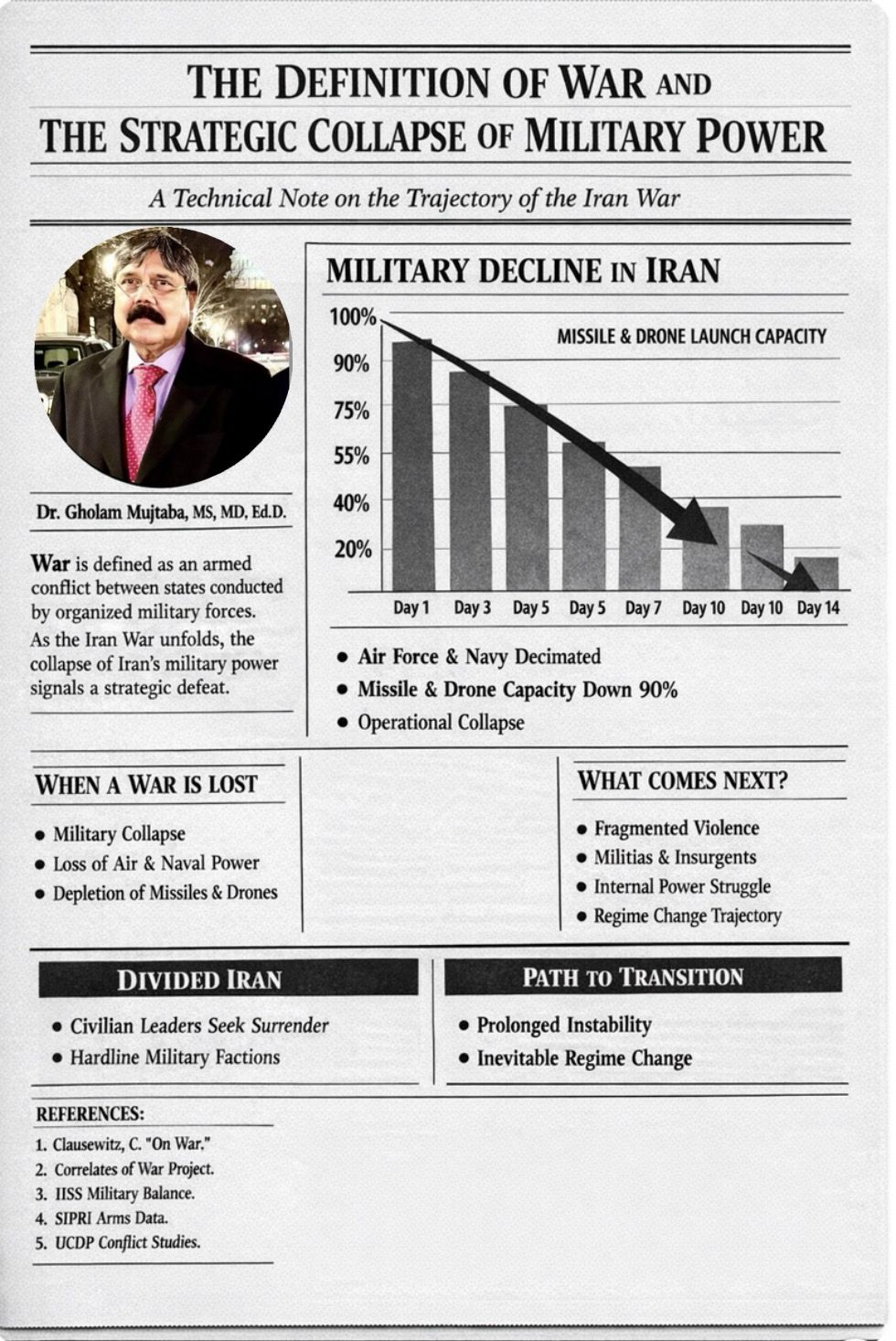
The most measurable indicator of battlefield exhaustion has been the rapid reduction in missile and drone launches.
Estimated Daily Launch Capacity During the War
Day of War Missile / Drone Launch Capacity
————————————————
Day 1 ?????????????????????? 100%
Day 3 ???????????????? 75%
Day 5 ??????????? 55%
Day 7 ???????? 40%
Day 10 ???? 20%
Day 14 ?? 10%
Strategic Interpretation
This decline demonstrates a classic attrition trajectory, where:
• Early stages involve maximum retaliatory capacity
• Mid-stage reflects depletion of stockpiles
• Late stage shows sporadic launches by surviving units
Such a curve historically precedes the operational end of interstate warfare.
When Is a War “Lost”?
From a strategic perspective, a state loses a war when it can no longer sustain organized military resistance.
Key indicators include:
1 Collapse of air superiority
2 Loss of naval control
3 Destruction of command infrastructure
4 Depletion of missile and drone capabilities
In the Iran conflict, two of the three primary conventional pillars—air force and navy—appear largely neutralized, leaving only residual missile and drone capabilities.
This condition resembles what military analysts refer to as “terminal operational degradation.”
The Post-War Phase: From War to Fragmented Violence
Even after conventional defeat, violence often continues through non-state actors, militias, or ideological groups.
Historical precedents include:
• Afghanistan after Soviet withdrawal
• Iraq following regime collapse
• Libya after the fall of Gaddafi
In such environments:
• Central authority weakens
• Regional militias emerge
• Sporadic violence replaces organized warfare
Thus, the formal end of war does not necessarily bring immediate peace.
Internal Divide Within Iran
Another critical factor shaping the endgame is the internal division between political and ideological factions.
Evidence suggests two emerging camps:
1. Civilian and pragmatic leadership
• Likely to favor negotiated surrender or ceasefire
• Concerned about economic collapse and regime survival
2. Hard-line ideological factions
• Revolutionary Guard–aligned elements
• Motivated by ideological resistance rather than strategic calculation
This civil–military tension complicates any immediate transition following battlefield defeat.
The Trajectory Toward Regime Transition
Based on classical war theory and historical precedent, three phases are likely:
Phase 1 – Military Collapse
Conventional military capabilities degrade to unsustainable levels.
Phase 2 – Internal Political Fracture
Divisions emerge between pragmatic and ideological factions.
Phase 3 – Gradual Regime Transition
Change may occur through:
• internal political restructuring
• elite negotiations
• external diplomatic pressure
A peaceful regime transformation may take time, but the trajectory toward systemic change becomes increasingly inevitable once military defeat is established.
Conclusion
War, by definition, is organized armed conflict between states conducted by structured military forces. When those forces are destroyed or rendered ineffective, the war is effectively lost—even if isolated violence persists.
The current Iran conflict appears to be approaching that threshold. The decimation of conventional military capabilities and the dramatic decline in missile and drone operations suggest that Iran’s ability to sustain interstate warfare is nearing exhaustion.
However, history teaches that the end of war often marks the beginning of a more complex phase of internal instability, where political fragmentation and sporadic violence may replace conventional conflict.
The coming months will therefore determine whether Iran experiences a controlled political transition or a prolonged period of fragmented unrest similar to other post-conflict states.
References
1 Clausewitz, Carl von. On War. Princeton University Press.
2 Correlates of War Project, University of Michigan Conflict Dataset.
3 International Institute for Strategic Studies (IISS). Military Balance Reports.
4 Stockholm International Peace Research Institute (SIPRI). Global Arms and Conflict Data.
5 United Nations Charter, Article 2(4), prohibition of use of force.
6 Freedman, Lawrence. Strategy: A History. Oxford University Press.
7 RAND Corporation. Missile Warfare and Modern Conflict Analysis.
8 Uppsala Conflict Data Program (UCDP). Armed Conflict Database.
https://medium.com/@greetmujtaba/the-definition-of-war-and-the-strategic-collapse-of-military-power-e96c0ed8ff13 (https://medium.com/@greetmujtaba/the-definition-of-war-and-the-strategic-collapse-of-military-power-e96c0ed8ff13)