Supercomputers: China Overtakes US to Claim World’s Fastest Machine
HONG KONG: China has reclaimed the top spot in global supercomputing after LineShine, a high-performance system powered entirely by domestically developed chips, took first place in the latest TOP500 ranking.
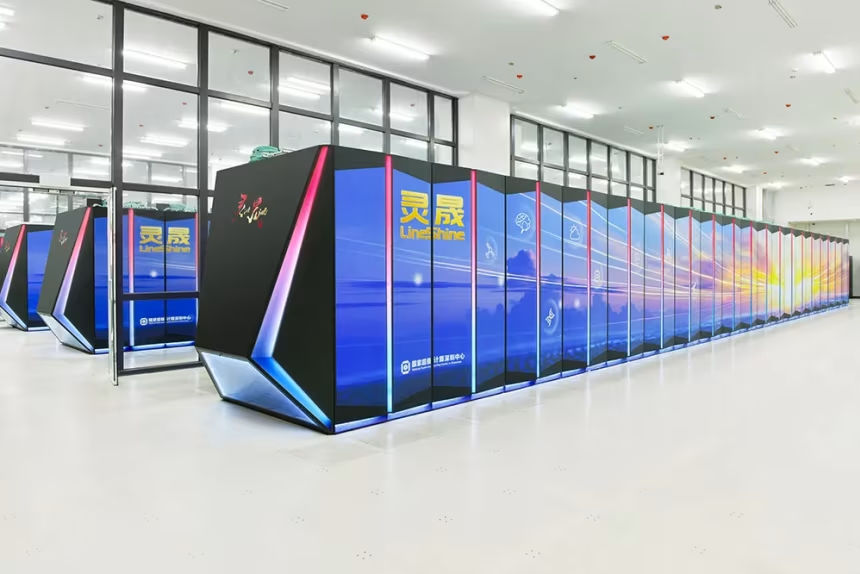
China’s LineShine becomes the world’s fastest supercomputer.
HONG KONG: China has reclaimed the top spot in global supercomputing after LineShine, a high-performance system powered entirely by domestically developed chips, took first place in the latest TOP500 ranking.
The machine at China’s National Supercomputing Center in Shenzhen pushed the US-based El Capitan into second place and became the world’s most powerful supercomputer for the first time since 2017. The latest biannual ranking released on Tuesday showed LineShine delivered computing speeds about 20% higher than its American rival.
Supercomputers handle complex calculations at extraordinary speeds and support drug development, climate forecasting, AI training and advanced scientific simulations.
The result underscores the intensifying competition between China and the United States over advanced technologies. In recent years, Washington has expanded export controls to limit China’s access to cutting-edge semiconductors and AI technologies with potential military uses.
China’s National Supercomputing Center said LineShine emerged from breakthroughs across critical technological barriers and showed progress toward an independent hardware and software ecosystem.
Unlike many leading supercomputers today, LineShine relies entirely on conventional CPUs rather than specialised graphics processing units (GPUs). US firms, including Nvidia, dominate the GPU market and supply most of the chips that power AI systems.
Since 2022, US restrictions have pushed China to develop alternatives. Chinese technology firms have since increased investment in domestic innovation to reduce their reliance on foreign chip supplies.
Last year, Chinese AI startup DeepSeek drew international attention after it released an AI model that delivered strong performance while using far fewer advanced chips.
At the TOP500 award ceremony in Hamburg, LineShine chief designer Lu Yutong said the system moved beyond the conventional CPU-GPU hybrid architecture and now uses a fully domestic computing infrastructure, including processors and high-bandwidth memory.
Officials said LineShine already supports research in climate modelling, engineering, drug discovery, neuroscience and artificial intelligence.
Industry experts, however, warned against treating the ranking as a direct measure of AI dominance.
Andrew Rohl, director at Australia’s National Computational Infrastructure, described the achievement as technically significant but said TOP500 rankings mainly assess traditional scientific computing performance rather than modern AI capability.
He added that several powerful AI systems run by major US technology companies and defence facilities do not appear in the ranking because of commercial and security concerns.
El Capitan remains in second place, followed by other American systems in Tennessee and Illinois, while Germany also holds a place among the highest-ranked machines. Italy, Switzerland and Japan also remain in the global top ten.