Pakistan Diplomacy Seeks to Revive US-Iran Talks Under Islamabad MoU, Foreign Office Says
Islamabad urges restraint as tensions escalate across the Middle East, reaffirming its efforts to bring Washington and Tehran back to negotiations.
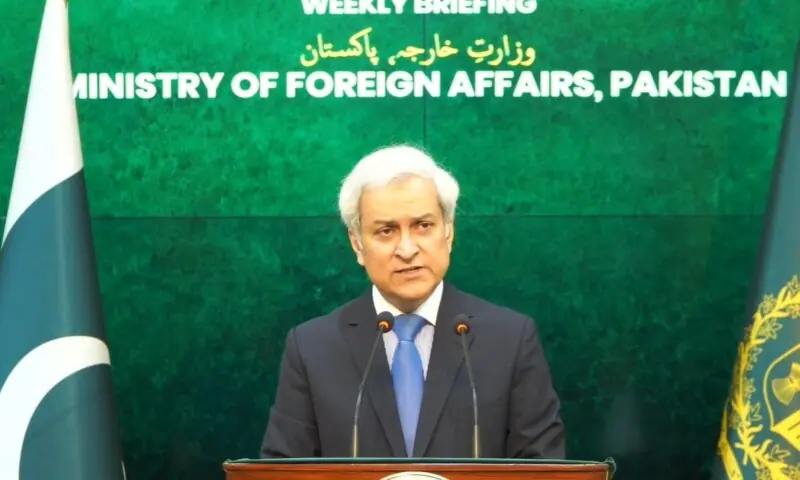
Foreign Office spokesperson Tahir Andrabi addresses the weekly media briefing in Islamabad.
ISLAMABAD: Pakistan Diplomacy remains focused on bringing the United States and Iran back to the negotiating table under the Islamabad Memorandum of Understanding (MoU), the Foreign Office (FO) said on Thursday.
Speaking at the weekly press briefing, Foreign Office spokesperson Tahir Andrabi said Pakistan remained concerned about the fragile security situation in the Middle East despite a brief period of relative calm.
He said the recent lull had raised hopes for a lasting ceasefire and a return to diplomatic engagement.
GTA 6 Trailer 3 Could Arrive in August as Insider Hints at Major Rockstar Reveal
Pakistan Reaffirms Support for Dialogue
Andrabi stressed that dialogue and diplomacy remain the only viable path to resolving the crisis.
“We welcome all efforts aimed at sustaining the cessation of hostilities and the resumption of dialogue between Iran and the United States,” he said.
He added that Pakistan continues to engage with all relevant parties to help ease tensions.
Islamabad Working to Revive MoU
The spokesperson said Pakistan was doing its “utmost” to bring both countries back to the framework of the Islamabad MoU.
He said the objective was to remove outstanding issues in line with the agreement’s spirit and the Pakistan-Qatar Joint Statement issued on June 22.
Andrabi also urged Washington and Tehran to exercise maximum restraint and honour their commitment to resume technical-level talks under the understanding.
Strait of Hormuz Remains a Key Concern
According to the FO, negotiations continue to normalize the security situation, particularly in the Strait of Hormuz, while supporting broader de-escalation efforts across the region.
The Islamabad MoU, signed on June 18, followed weeks of diplomatic engagement. It aimed to reopen the Strait of Hormuz and reduce regional tensions through a 60-day negotiation process.
Renewed Fighting Disrupts Peace Efforts
The diplomatic process suffered a setback after renewed hostilities erupted on July 7.
Iran targeted commercial vessels in the Strait of Hormuz, including a Qatari liquefied natural gas tanker, accusing the United States of violating the understanding.
The incident triggered multiple rounds of US strikes on Iranian military facilities.
The conflict has since widened, with Yemen’s Houthi rebels imposing a naval blockade on Saudi Arabia and attacks spreading to additional regional targets.
On Wednesday, explosions struck a natural gas loading facility in Egypt, while a US-owned floating storage tanker reportedly came under drone attack.
The United States and Saudi Arabia also carried out joint strikes against Iran-backed armed groups in Iraq in response to attacks on American forces and Saudi oil infrastructure.
On Thursday, the United States launched fresh strikes on Iran after Tehran targeted American military bases in Jordan.
Pakistan has continued to call for restraint and renewed diplomacy, saying negotiations remain the best path toward lasting regional stability.