Pakistan Budget Strategy Addresses Geopolitical Risks Says Muhammad Aurangzeb
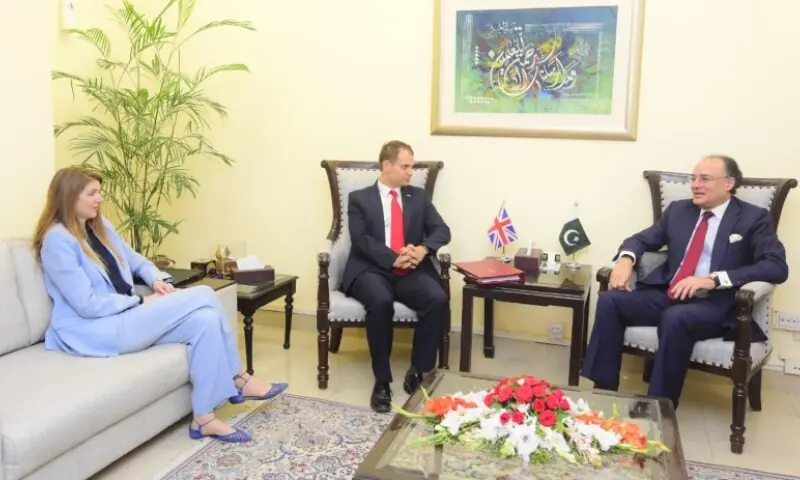
Pakistan and UK officials meet in Islamabad to discuss economic reforms and regional stability.
Muhammad Aurangzeb said Pakistan’s economic planning and fiscal assumptions remain prepared for external and geopolitical risks. He made these remarks during a meeting with Hamish Falconer at the Finance Division in Islamabad. The discussion focused on regional developments, economic reforms, and future cooperation between Pakistan and the United Kingdom.
Moreover, the Muhammad Aurangzeb remarks reflected the government’s broader effort to maintain macroeconomic stability. According to the official statement, planning also considered possible second-order effects from prolonged regional uncertainty. Therefore, policymakers continue to monitor conditions that may influence investment, trade, and growth.
Murad Ali Shah Highlights Pakistan-Philippines Cooperation at Independence Day Event
Muhammad Aurangzeb Economic Reform Agenda
During the meeting, Muhammad Aurangzeb outlined priorities linked to the budget for 2026–27. He stated that the government remains focused on preserving economic recovery while accelerating structural reforms.
Furthermore, he explained that reform measures aim to support durable and inclusive growth. According to the briefing, authorities continue efforts to strengthen institutional performance and improve long-term economic resilience. Therefore, fiscal policy remains connected to broader reform objectives.
Pakistan UK Economic Cooperation Talks
The meeting included senior officials from both countries as well as Jane Marriott. Discussions covered opportunities to deepen Pakistan–UK economic engagement and institutional cooperation.
Moreover, both sides exchanged views on economic competitiveness and governance improvements. The dialogue also explored ways to strengthen development partnerships. Therefore, cooperation remains an important element of future economic planning.
Muhammad Aurangzeb Regional Stability Remarks
Muhammad Aurangzeb referred to recent regional developments and highlighted easing tensions following the understanding between the United States and Iran. He stated that Pakistan supports dialogue and peaceful conflict resolution.
Furthermore, he noted that prolonged instability can influence economic confidence, energy markets, supply chains, and emerging economies. Therefore, regional stability remains relevant to economic outcomes.
Pakistan Fiscal Modernisation Measures
The government also shared updates on institutional and fiscal reforms. According to the statement, measures include improved revenue mobilisation and stronger compliance mechanisms. Authorities are also expanding digital systems across tax administration.
Moreover, technology integration, centralised processing, and digital invoicing remain key priorities. Therefore, the reform agenda seeks to increase transparency and reduce operational inefficiencies.
Structural Reforms and Public Sector Changes
The discussions further covered Pakistan’s structural reform programme. Topics included privatisation, rightsizing of public entities, and improving public expenditure efficiency.
Additionally, the government highlighted progress in digital governance and targeted social protection. According to officials, these initiatives aim to improve service delivery and resource allocation. Therefore, reforms continue to support institutional development.
UK Response to Pakistan Reform Program
Hamish Falconer acknowledged Pakistan’s ongoing reform agenda and appreciated the government’s commitment to implementation. According to the statement, he emphasised the importance of institutional strengthening and economic competitiveness.
Moreover, the UK side reaffirmed interest in continued engagement across areas of mutual economic interest. Therefore, both countries signalled support for continued cooperation and long-term economic development.