
KE Plans Rs15bn Investment to Strengthen Karachi’s Industrial Power Supply
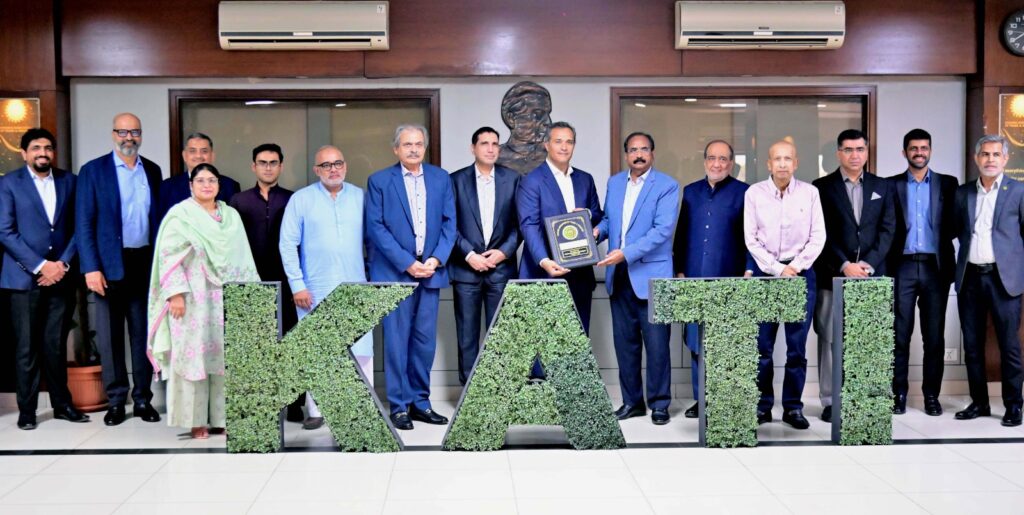
KATI President Muhammad Ikram Rajput presents a shield to K-Electric Board Chairman Shaheryar Chishti
K-Electric Board Chairman Shaheryar Chishti announced the investment during a meeting with industrialists at the Korangi Association of Trade and Industry (KATI).
The company plans to lay new cables and wires, upgrade grids and bifurcate feeders. It will also carry out other infrastructure improvements in industrial areas.
Chishti said Karachi’s industries play a central role in the city’s economy and employment. He stressed that sustained industrial activity remains essential for economic growth.
He said industrial power supply remains a key focus for K-Electric as the company works to improve electricity transmission and distribution services.
K-Electric Targets Infrastructure Improvements
Chishti said K-Electric’s strategy extends beyond power generation. The company also wants to strengthen its generation, transmission and distribution network.
K-Electric currently operates more than 2,100 feeders across its network. More than 70% of these feeders remain exempt from load shedding, according to Chishti.
He added that industrial consumers have faced no load shedding since 2013.
The K-Electric chairman also said the company regularly engages with industrial associations. These include KATI, SITE and Bin Qasim. The discussions aim to identify problems and develop practical solutions.
Industrialists Raise High Energy Costs
KATI President Muhammad Ikram Rajput said Pakistan’s industrial sector faces serious pressure from high electricity and energy costs.
He said rising production expenses have made it harder for Pakistani manufacturers to compete in regional and international markets.
According to Rajput, electricity tariffs now represent a major part of industrial costs. Even a small increase in power prices can raise production expenses and hurt export competitiveness.
He urged the government to review industrial electricity tariffs. He also called for a review of additional charges that increase the cost of electricity bills.
Rajput highlighted capacity payments as another major burden on industry. He said payments for unused electricity generation capacity continue to place pressure on businesses and the wider economy.
He called for structural reforms in the energy sector. He also urged the government and power distribution companies to consult industrialists while developing a competitive electricity pricing system.
Rajput welcomed K-Electric’s Rs15 billion investment. However, he stressed that industrial consumers must see practical improvements from the spending.
Delayed Subsidies Put Pressure on Businesses
KATI Deputy Patron-in-Chief Zubair Chhaya said expensive energy has affected the wider industrial production system.
He also raised concerns over delays in government-announced subsidies and financial support for industry.
Chhaya said industrial units must regularly meet electricity bills and other operating costs. Delayed subsidy payments can therefore create serious cash-flow problems.
He called for long-term planning in the energy sector. Temporary relief measures alone cannot resolve the industry’s challenges, he said.
Chhaya urged policymakers to address power generation costs, capacity payments, transmission losses and other structural problems.
SECP Wins Global Award for Women’s Inclusive Insurance Policy
He said affordable and reliable electricity could encourage new investment. It could also support employment and export growth.
K-Electric Moves Toward Smart Grid
K-Electric CEO Syed Muhammad Taha said the company is introducing new technologies and modern systems in industrial areas.
He said some industrial zones face power-quality problems because residential settlements have expanded around them.
K-Electric plans to address these issues through new feeders and upgraded infrastructure.
Taha also said the company is gradually moving Karachi’s power network toward a smart-grid system. Smart meters and other modern technologies will support the transformation.
He said K-Electric remains in regular contact with industrialists. The company aims to resolve electricity supply and service complaints on a priority basis.
Taha clarified that K-Electric does not control electricity tariffs. However, the company continues to work with relevant institutions on tariff-related concerns.
He also urged consumers to pay electricity bills on time. He asked them to cooperate with the company in identifying electricity theft.
Industrialists Seek Lower Electricity Costs
KATI Standing Committee Chairman Danish Khan called for greater use of renewable energy.
He said Pakistan should expand solar and wind power to help reduce electricity costs.
Khan claimed electricity costs around 8 cents per unit in some regional markets. In Pakistan, he put the cost at around 14 cents per unit.
He said the high cost makes it difficult for Pakistani manufacturers to compete in international markets.
Industrialists, he added, want the electricity tariff reduced to around 9 cents per unit to support economic stability.
Standing Committee Vice Chairman Rehan Javed welcomed K-Electric’s Rs15 billion investment.
He said regular communication between K-Electric and industrialists could help resolve power supply and quality issues more quickly.
Javed also highlighted the debt burden included in electricity prices. He said consumers face an additional Rs20.56 per unit in debt-related costs.
According to Javed, Rs17.33 per unit comes from capacity payments. Another Rs3.23 per unit comes through the PHL surcharge.
He said consumers bear these costs before fuel charges, taxes and transmission expenses are added.
The meeting brought together senior K-Electric officials and representatives of Karachi’s industrial community. Participants discussed electricity reliability, tariffs, power quality, subsidies and the wider energy challenges facing Pakistan’s manufacturing sector.