Spain Train Collision Kills 68, Injures More Than 100 Near Madrid
A Renfe high-speed train struck a stationary Iryo train near Urda, prompting a major rescue operation and a probe into an alleged control-system failure.
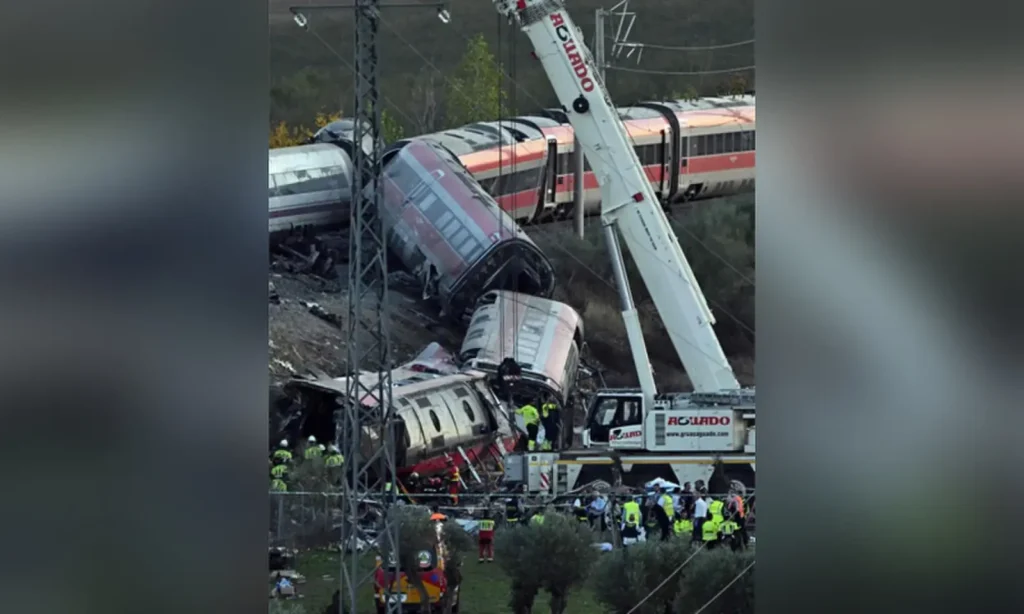
Spain Train Crash near Urda kills at least 68 people and leaves more than 100 injured
URDA, Spain: A collision between two high-speed trains south of Madrid killed at least 68 people and injured more than 100 on Wednesday, October 28, in one of Europe’s deadliest rail disasters in recent decades.
The crash occurred near Urda in the Castilla-La Mancha region, around 130 kilometres south of Madrid. The impact left carriages mangled and scattered down an embankment as emergency crews searched the wreckage for victims.
Regional leader Emiliano García-Page confirmed the death toll, raising it from an earlier figure of 64. Authorities warned that rescuers could discover more victims as they continued their work.
A regional government spokeswoman said 58 injured people were hospitalised, including 15 in critical condition.
Investigation Focuses on Railway Control Decisions
The collision involved a high-speed train operated by Spain’s state-owned Renfe and a stationary train run by private operator Iryo. The crash forced the suspension of services on the main high-speed route linking Madrid with southern Spain.
Transport Minister Óscar Puente said a technical failure in the automatic control system had halted rail traffic along a section of track. He said the Renfe train was subsequently authorised to resume its journey despite the unresolved safety issue.
Puente criticised the decision to restore traffic before the system had returned to normal operation. He said the control centre had sufficient time to identify the error but failed to correct it.
According to the minister, the Renfe train travelled about 25 kilometres before hitting the stationary Iryo train. He said it may have been travelling at speeds of up to 200 kilometres per hour.
Investigators are examining the circumstances surrounding the decision to resume services. Authorities have not yet established final responsibility for the crash.
Survivors Describe Scenes of Chaos
Passengers described a violent impact that threw people from their seats and left luggage, damaged seats and debris scattered throughout the carriages.
Pablo Mejia, 42, told reporters that the collision felt prolonged. He recalled seeing passengers on the floor and on top of one another, with seats ripped out and belongings strewn around the damaged train.
Emergency services deployed firefighters, police, medical teams and other rescue personnel to the scene. The scale of the destruction complicated efforts to reach passengers trapped inside the wreckage.
Second Deadly Train Crash This Year
The disaster has renewed concerns about railway safety in Spain. In January, a separate high-speed train collision near Adamuz killed 46 people.
Prime Minister Pedro Sánchez announced three days of national mourning, beginning on Thursday, October 29. He expressed sympathy for the victims and their families and said authorities would investigate the latest tragedy.
Sánchez also questioned how Spain could experience two deadly high-speed rail accidents within the same year. He said investigators would examine whether negligence or system failures contributed to the latest crash.
Both Sánchez’s Socialist Party and the opposition Popular Party suspended campaign activities following the disaster.
Popular Party leader Alberto Núñez Feijóo called for answers about the condition and management of Spain’s railway infrastructure.
Afghanistan Opium Cultivation More Than Quadruples in 2026, UN Says
Rail Safety Under Renewed Scrutiny
The collision comes about a month before Spain’s scheduled early general election on November 29. The disaster has placed railway safety and infrastructure oversight under renewed public scrutiny.
Authorities continue to investigate the sequence of events that led to the crash. Their findings will be central to determining how the trains came to collide and whether railway procedures or safety systems failed.
The immediate priority remains supporting the victims and their families while rescue teams complete their work and investigators establish the facts behind the disaster.