Binance AI Systems Protect 8 Million Users and Prevent $4.6 Billion in Potential Losses
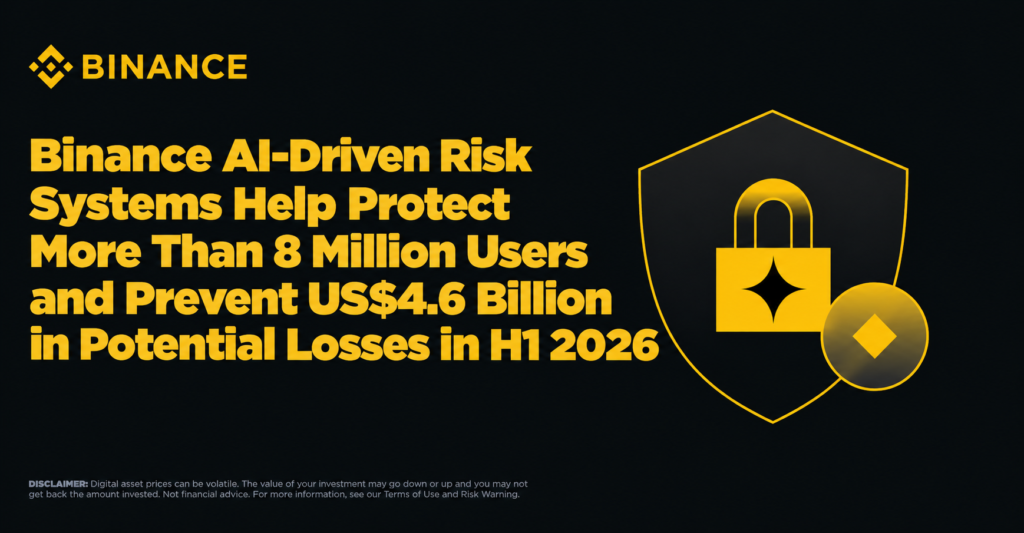
Binance says its AI-driven risk systems helped protect more than 8 million users in the first half of 2026.
Binance says its artificial intelligence-driven risk systems helped protect more than 8 million users and prevented approximately US$4.6 billion in potential losses during the first half of 2026.
The cryptocurrency exchange said its AI systems support security, anti-fraud and compliance operations. The technology monitors risks across trading, account security and transactions.
According to Binance, its systems intercepted millions of scam and phishing attempts during H1 2026. The company also blacklisted more than 42,000 malicious addresses and issued over 14,000 real-time warnings each day.
Binance currently operates more than 100 AI models across its anti-fraud and anti-scam systems. The company develops, trains and supervises these models internally.
Human risk analysts continue to oversee the systems. They set thresholds, review unusual cases and retrain models when new fraud patterns emerge.
AI Handles Most Real-Time Risk Decisions
Binance said AI models now handle 80% to 90% of real-time risk decisions across its fraud controls. The technology also supports around 45% of human review workflows.
Human reviewers remain involved in cases that require additional verification. Their role includes assessing context and handling complex risk decisions.
S.M. Muneer Honoured with Lifetime Achievement Award in Karachi
The company has integrated AI across several stages of the user journey. These include identity verification, account security, payments and transaction screening.
Most risk checks occur automatically in real time. Binance says this approach allows it to protect users at scale while limiting disruption to legitimate activity.
AI Supports KYC and Security Checks
Binance said its AI-enabled Know Your Customer (KYC) review pipelines have achieved up to 100 times greater operational efficiency than manual processes in specific workflows.
Specialists still review higher-risk cases. The company combines automated screening with human oversight to address complex identity and fraud concerns.
Binance uses both proprietary technology and external AI and foundation models. Its internal models focus on risks identified on the Binance platform.
External models support broader reasoning tasks. The company also operates an internal Red Team that tests its security controls against emerging threats.
Binance Chief Security Officer Jimmy Su said these exercises help the company identify weaknesses before attackers exploit them. He added that the process allows Binance to test its controls under realistic conditions.
AI Targets Social Engineering and Scams
Binance said social engineering remains a major risk, particularly in peer-to-peer trading.
Its computer vision models can identify potentially fake proof-of-payment images. The systems examine transaction information and signs of image manipulation.
AI handles large-scale screening and discovery. Human reviewers then examine cases that require deeper validation.
The company feeds findings from new attack patterns back into its models. This creates a continuous process of detection, review and model improvement.
Binance also applies governance throughout the AI model lifecycle. The process covers development, validation, deployment and ongoing monitoring.
AI Expands Compliance Operations
Binance has also introduced AI-assisted tools across its compliance operations. These tools support KYC fraud detection and transaction monitoring.
The company said it has deployed more than 24 AI initiatives across user onboarding, screening escalations and partner due diligence.
AI adoption also extends to Binance’s internal operations. The company said its internal agentic tool has reached approximately 72% uptake across teams.
Binance supports the rollout through employee training, prompt-engineering programmes and structured oversight.
The company said its AI systems follow a privacy-first framework. The framework focuses on data minimisation, purpose limitation and user-rights safeguards.
Binance said it will continue combining AI automation with human expertise as fraud techniques become more sophisticated. The company plans to retrain models, refine risk thresholds and maintain human oversight for complex cases.