
China and US Race to Build New Weapons for Warfare in Space
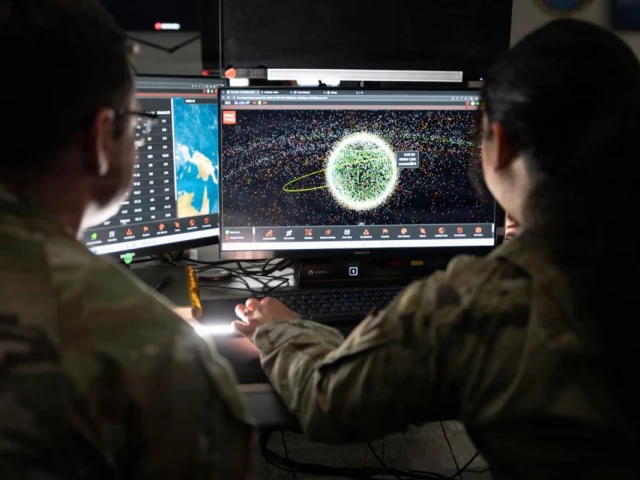
The United States and China are developing advanced military technologies for potential warfare in space.
The United States and China are rapidly expanding their military capabilities in space. Secretive spacecraft, manoeuvrable satellites and orbital weapons are becoming central to preparations for a possible future conflict.
In June, a secretive Chinese unmanned spaceplane released a small satellite hundreds of miles above Earth. The satellite then moved around another Chinese spacecraft before heading back towards the spaceplane, according to US space-tracking company LeoLabs.
Little is known about the mission. However, the operation highlights how quickly military space technology is changing.
The United States operates a similar unmanned spaceplane. Both countries are developing systems that could deploy satellites, inspect spacecraft and potentially support offensive operations in orbit.
A Reuters review of documents, space-tracking data and interviews with current and former military officials shows the growing scale of the competition.
Chinese military-linked researchers are developing satellites designed to pursue and capture other spacecraft. Some research also focuses on extending the fuel supplies of satellites during such missions.
US Space Force Chief of Space Operations General Chance Saltzman said China is rapidly developing capabilities to interfere with or destroy targets.
He described the Chinese threat as “substantial”.
Space is becoming a new battlefield
Satellites have become essential to modern military operations. The wars in Ukraine and the Middle East have demonstrated their importance.
Military forces depend on satellites for communications, navigation and intelligence. These systems also support surveillance and missile defence.
Traditionally, most satellites followed fixed orbital paths. That model is changing.
Anthropic’s AI Ambition Raises a Bigger Question: Who Controls Its Power?
Military planners now increasingly view spacecraft as active platforms. They can potentially disrupt other satellites through jamming, lasers or cyberattacks.
Some systems could also approach and capture enemy spacecraft.
Former US Air Force Air War College professor Everett Dolman warned that losing space capabilities could severely weaken military operations on Earth.
He said disruption could affect everything from surveillance to missile defence.
Spaceplanes create another layer of uncertainty. Their ability to move and deploy satellites means opponents could potentially view them as “space fighters”.
The US and its allies expand orbital operations
The competition is unfolding as Earth’s orbital environment becomes increasingly crowded.
SpaceX operates thousands of Starlink satellites and is developing larger orbital data-centre capabilities. China is building competing satellite networks.
At the same time, US President Donald Trump’s Golden Dome missile-defence programme includes plans involving space-based interceptors.
The United States is also working more closely with allies.
In September last year, US and British space forces conducted a joint orbital operation. A US military satellite moved close to a British satellite while China’s Shiyan 12-01 passed about 83 kilometres below them, according to commercial space-tracking company Slingshot Aerospace.
Several experts with military backgrounds told Reuters that the manoeuvre appeared to send a strategic message to Beijing.
Retired British air force officer Andrew Turner described it as almost certainly a signal of allied unity and capability.
The US and Britain publicly announced the operation. However, they did not disclose the satellite’s proximity to the Chinese spacecraft.
Much of military activity in space remains classified because of its intelligence value.
US Space Command said the mission demonstrated the ability of allies to operate together in space.
Britain’s defence ministry also said space has become increasingly important to military operations.
China’s foreign ministry said it did not have information about the specific operation. Beijing said it opposes the weaponisation of space and supports peaceful use.
However, Chinese officials have also accused Washington of encouraging an arms race.
Washington prepares for space conflict
US Space Command has repeatedly warned that adversaries could target American space assets early in a conflict.
General Stephen Whiting has argued that the United States needs a more active warfighting posture in space.
That approach would involve protecting American satellites while also preparing to threaten hostile systems.
Whiting has supported orbital interceptors and other space weapons.
“We must be well-prepared for conflict in space,” he said at a conference in April.
Western officials identify several potential threats. These include ground-based lasers, electronic jammers, cyberattacks and anti-satellite missiles.
The US, China and Russia also operate manoeuvrable satellites that can approach other spacecraft.
Such satellites could potentially carry weapons. Possible systems include lasers and projectiles.
The United States has accused Russia of developing a satellite-based anti-satellite nuclear capability. Moscow has denied the allegation.
The United Kingdom is also adjusting its military thinking.
Former UK Space Command chief Major General Paul Tedman said militaries increasingly view satellites as weapon systems that must be able to manoeuvre and fight.
China develops ‘hunter satellites’
China is rapidly increasing both its satellite numbers and the complexity of its orbital missions.
Chinese spacecraft have demonstrated what US officials describe as orbital “dogfighting”. The term refers to multiple satellites moving together in close proximity.
Chinese satellites have also demonstrated the ability to capture a defunct spacecraft and move it into another orbit.
Last year, China also conducted what a US Space Force official described as a likely attempt at on-orbit refuelling.
Refuelling could significantly change military operations in space.
Satellites normally carry a limited supply of fuel. Once that fuel runs low, their ability to manoeuvre becomes restricted.
A reliable refuelling capability could therefore allow a spacecraft to remain operational for much longer.
It could also allow a satellite to pursue another spacecraft over an extended period.
Chinese research targets autonomous space operations
Chinese institutions are continuing to develop advanced pursuit technologies.
Patent-related documents show that a manufacturer linked to advanced Chinese military aircraft acquired technology for satellites.
The technology allows spacecraft to calculate fuel-efficient manoeuvres while pursuing another satellite.
Another technology-transfer notice from China’s National University of Defence Technology described a system capable of managing hundreds of satellites simultaneously.
Researchers at another major Chinese university with military links are also studying pursuit satellites.
Some concepts involve multiple spacecraft using nets to capture targets.
These technologies could have civilian applications. However, their potential military use is attracting close attention from Western defence officials.
Chinese institutions and the People’s Liberation Army did not respond to requests for comment.
China’s military newspaper, PLA Daily, has previously argued that control of space is essential to national security and victory in war.
A new era of orbital warfare
The emerging competition is changing the traditional concept of military space power.
The goal is no longer simply to place satellites in orbit.
Future military forces could need spacecraft that can move, inspect, defend, disrupt and potentially attack other satellites.
The United States remains the leading space power. However, China is rapidly developing capabilities that could challenge American advantages.
The competition also involves Russia and an expanding group of military and commercial space operators.
At the same time, Earth’s orbit is becoming increasingly crowded with commercial satellites.
That creates additional risks. Military manoeuvres must take place alongside a growing civilian space economy.
The result is a new strategic environment where a satellite’s movement can carry military meaning.
A spacecraft approaching another satellite could be conducting maintenance. It could also be gathering intelligence or testing an offensive capability.
That uncertainty may become one of the defining features of future space warfare.
As China and the United States expand their capabilities, the competition is moving beyond rockets and satellites.
It is becoming a contest over who can control the orbital environment when conflict reaches space.