
Makkah Defence Pact Could Open New Economic Opportunities for Pakistan
Business leader Mian Zahid Hussain says the Pakistan-Saudi Arabia-Türkiye agreement could strengthen regional security while creating new opportunities in trade, investment and industry
Mian Zahid Hussain highlights the strategic and economic significance of the Makkah Defence Pact
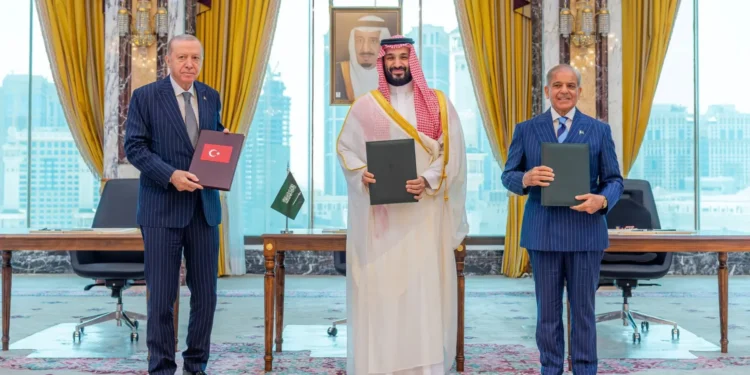
KARACHI, August 17, 2026 — Business leader Mian Zahid Hussain has welcomed the Makkah Joint Defence Agreement between Pakistan, Saudi Arabia and Türkiye, calling it an important step towards regional security, stability and economic cooperation.
Hussain said the agreement, signed in Makkah on August 7, provides that an armed attack against one of the three countries would be treated as an attack against all three.
He described the Makkah Defence Pact as defensive in nature. According to him, the agreement could strengthen collective deterrence while expanding defence cooperation among the three countries.
He also noted that recent statements from Turkish leaders suggest that the framework could eventually expand to include other countries that support regional peace, stability and prosperity.
Three Economies, One Strategic Partnership
Hussain highlighted the economic and demographic scale of the three countries.
Türkiye has an economy of about $1.6 trillion, while Saudi Arabia’s economy stands at around $1.3 trillion. Pakistan’s economy reached about $452 billion in FY2025-26, according to the figures cited by Hussain.
Together, the three economies represent around $3.33 trillion.
Their combined population exceeds 370 million. Pakistan accounts for about 250 million people, Türkiye around 85 million and Saudi Arabia nearly 37.5 million.
Hussain also pointed to their combined defence spending. Saudi Arabia allocates about $83.2 billion annually, Türkiye around $30 billion and Pakistan approximately $12 billion.
Together, the three countries therefore represent a defence budget of nearly $125 billion.
He said the partnership brings together Pakistan’s nuclear capability, Saudi Arabia’s economic strength and Türkiye’s defence technology expertise.
Hussain argued that the combination gives the agreement wider strategic importance beyond military cooperation.
Business Opportunities for Pakistan
Hussain said the agreement could create significant opportunities for Pakistani businesses.
He identified defence engineering, information technology, pharmaceuticals, surgical instruments, textiles, food processing, agriculture, construction materials, logistics, minerals and energy as potential areas for cooperation.
He urged Pakistani companies to seek joint ventures and expand exports into Saudi and Turkish markets.
Hussain also called for Saudi investment and Turkish technology to support export-focused industries in Pakistan.
Joint manufacturing, technology transfer and access to international markets could help Pakistani industries increase production and create employment, he said.
He added that Pakistan should seek a stronger role in emerging defence and industrial supply chains linked to the partnership.
Security Cooperation Could Support Economic Growth
Hussain said Pakistan’s recent military performance had strengthened the country’s strategic credibility.
He referred to Marka-e-Haq and Operation Bunyan-ul-Marsoos as examples of the professionalism and preparedness of Pakistan’s armed forces.
He paid tribute to Field Marshal Syed Asim Munir for what he described as courageous leadership and strategic vision.
Hussain also praised Prime Minister Muhammad Shehbaz Sharif and Deputy Prime Minister and Foreign Minister Senator Mohammad Ishaq Dar for their roles in advancing the agreement.
He said sustained diplomatic efforts had helped bring the agreement to fruition.
Rotary Club of Karachi Celebrates Independence Day With Fellowship Dinner
Calls for a Permanent Economic Framework
Hussain said the agreement’s institutional development could provide a foundation for longer-term cooperation.
Plans for a ministerial-level mechanism and a permanent general secretariat in Saudi Arabia could help maintain coordination among the three countries.
However, he argued that economic cooperation also needs permanent institutions.
He proposed a trilateral economic and investment roadmap involving a permanent business council, investment facilitation mechanism and joint industrial projects.
He also called for technology transfer arrangements, defence production partnerships and stronger links between chambers of commerce in Pakistan, Saudi Arabia and Türkiye.
According to Hussain, these measures could turn the strategic partnership into a broader economic platform.
Focus on Investment, Exports and Jobs
Hussain said the long-term success of the agreement should not be judged only by its security benefits.
He argued that investment, exports, industrial growth, technology transfer and employment should become key measures of its success.
Pakistan, he said, should use its growing strategic importance to secure a lasting economic benefit for businesses and the wider population.
He also said the Federation of Pakistan Chambers of Commerce and Industry (FPCCI) was ready to support stronger economic relations between the three countries.
The Makkah agreement, he added, could become an important platform for closer cooperation if security ties are matched by practical investment, trade and industrial partnerships.
By: Mian Zahid Hussain
Former Minister IT, Sindh
Chairman, FPCCI Policy Advisory Board
President, Pakistan Businessmen and Intellectuals Forum (PBIF)
President, All Karachi Industrial Alliance (AKIA)
Chairman, National Business Group of FPCCI
Chairman, All Pakistan Lubricant Manufacturers Association (APLMA)
Former Chairman, Korangi Association of Trade & Industry (KATI)