
Future of Finance Summit 2026 Highlights Financial Innovation and Reform Push
ICMA Pakistan brings together policymakers, regulators, and financial leaders in Karachi to discuss sustainable economic growth and digital transformation.
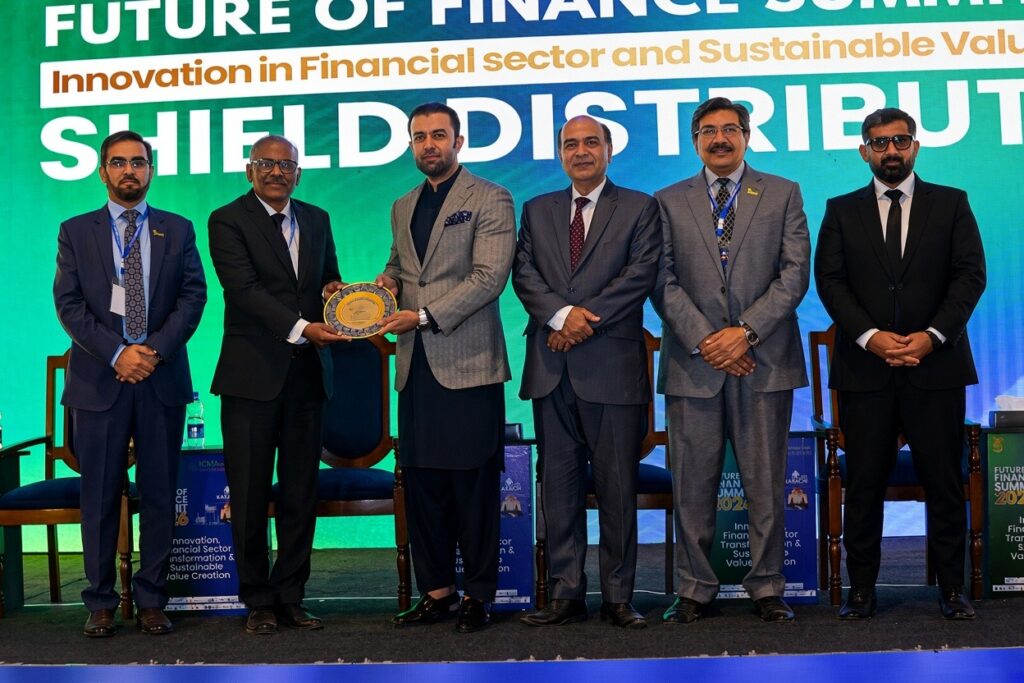
ICMA Pakistan hosts the Future of Finance Summit 2026 in Karachi
ICMA Pakistan Hosts Future of Finance Summit 2026 in Karachi
KARACHI — The Institute of Cost and Management Accountants of Pakistan (ICMA Pakistan) hosted the Future of Finance Summit 2026 – Karachi Edition at the Pearl Continental Hotel, Karachi. The landmark event brought together policymakers, regulators, financial-sector leaders, corporate executives, and professional accountants.
Held under the theme “Innovation in Financial Sector and Sustainable Value Creation,” the conference focused on Pakistan’s evolving financial landscape and the structural reforms required to drive long-term economic stability.
ICMA Pakistan President Azeem Hussain Siddiqui opened the gathering by outlining the institute’s institutional journey, highlighting its contribution to strengthening corporate governance, financial management, and professional skills across Pakistan.
Vice President and Events Organizing Committee Chairman Muhammad Yasin provided an overview of the event, emphasizing key focus areas including capital-market development, digital transformation, financial inclusion, Islamic finance, and sustainable value creation.
Tree Plantation Drive Launched in Sukkur to Build a Greener, Healthier City
Reform Momentum and Private-Sector Economic Growth
Addressing the Future of Finance gathering, Advisor to the Finance Minister Khurram Schehzad stated that Pakistan has successfully transitioned from macroeconomic stabilization toward a sustainable, private-sector-led growth model.
Schehzad attributed this shift to structural reforms, rising investor confidence, and improving economic fundamentals. He pointed out encouraging developments across key indicators:
Fiscal Stability: A contained fiscal deficit and improving sovereign credit outlook.
Foreign Reserves: Significant growth in foreign exchange reserves and external sector stability.
Key Structural Reforms: Comprehensive initiatives across state-owned enterprises (SOEs), energy, taxation, debt management, and digitization.
The finance adviser noted that private-sector credit, capital market activity, and company registrations show positive momentum, attracting both domestic and international investors.
Digital Transformation and Sustainable Value Creation
The conference extensively examined the expanding role of Sukuk and Islamic finance in broadening Pakistan’s investment opportunities. Industry leaders and regulators from the State Bank of Pakistan and the Securities and Exchange Commission of Pakistan discussed the impact of digital technology on modern economic structures.
Speakers emphasized that building a resilient financial system requires robust institutions, responsible innovation, and expanded financial access across all societal segments.
Concluding the address, Schehzad highlighted three pillars for the country’s economic strategy: macroeconomic stability as the foundation, structural reforms as the enabler, and the private sector as the engine of sustainable growth.