Pakistan Expresses Disappointment Over EU GSP+ Report, Defends Reform Record
Foreign Office says the European Union’s assessment overlooks key reforms while reaffirming Pakistan’s commitment to GSP+ obligations and international conventions.
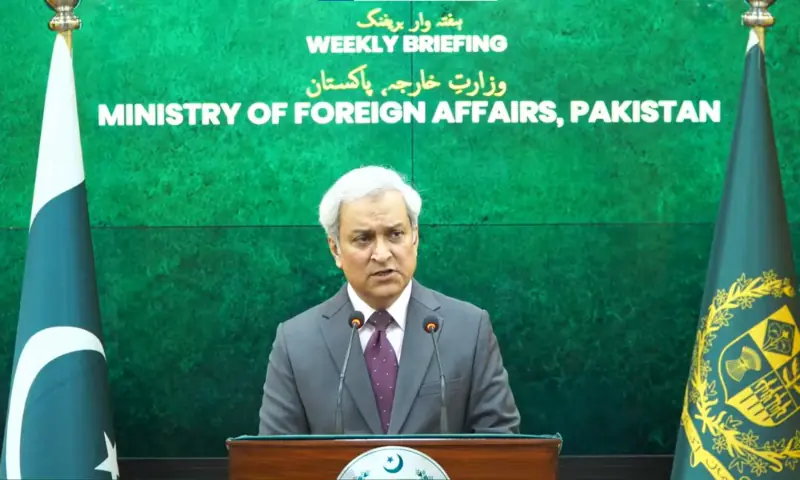
Foreign Office spokesperson Tahir Andrabi addresses the weekly media briefing in Islamabad.
EU GSP+ remained at the centre of Pakistan’s diplomatic engagement on Thursday as the Foreign Office expressed disappointment over the European Union’s latest assessment, arguing that the report did not present a balanced picture of the country’s reform efforts.
Speaking at the weekly media briefing in Islamabad, Foreign Office spokesperson Tahir Andrabi acknowledged the European Commission’s recognition of Pakistan’s legislative progress and continued compliance with the 27 international conventions required under the Generalised Scheme of Preferences Plus (GSP+).
However, Andrabi said the report underestimated the scale of reforms Pakistan had introduced since joining the GSP+ programme in 2014. He argued that the assessment placed disproportionate emphasis on areas where progress remained limited while overlooking broader achievements.
The European Commission’s report, released last week as part of its 2023–2025 global GSP assessment, stated that Pakistan had regressed in several areas and recorded only limited positive progress.
Red Sea: PM Shehbaz Condemns Houthi Attacks on Saudi Oil Tankers, Reaffirms Support to Kingdom
Despite expressing concerns over the report, the Foreign Office described GSP+ as a cornerstone of Pakistan’s economic partnership with the European Union. Andrabi said the preferential trade arrangement continues to support exports, employment, women’s economic participation, poverty reduction and wider economic growth, making it beneficial for both sides.
He reaffirmed Pakistan’s commitment to working closely with the European Commission and other EU institutions while continuing the effective implementation of international conventions under the GSP+ framework.
The spokesperson added that Pakistan’s engagement with the European Union extends beyond trade to include cooperation in development, migration, counterterrorism, regional stability, climate resilience and connectivity.
Pakistan Rejects Amnesty International Report
During the same briefing, Andrabi strongly rejected allegations made in a recent Amnesty International report concerning Pakistan’s military strikes in Kabul on March 16.
He said the report lacked credible evidence and maintained that Pakistan’s military action was carried out solely in self-defence against terrorist targets and logistical support facilities in Afghanistan.
According to the Foreign Office, the operation complied with the principles of necessity, distinction, precaution and proportionality under international law.
Pakistan also urged Amnesty International and the wider international community to focus on what it described as the Afghan Taliban’s continued support for terrorist organisations operating from Afghan territory.
The spokesperson accused the Taliban administration of providing safe havens to groups including the Tehreek-i-Taliban Pakistan (TTP) and the Baloch Liberation Army (BLA), which Pakistan says continue to launch cross-border attacks.
He reiterated that Pakistan reserves the right to take all necessary measures to protect its sovereignty, territorial integrity and the safety of its citizens against terrorism.
Dar to Attend SCO Foreign Ministers’ Meeting
Separately, the Foreign Office confirmed that Deputy Prime Minister and Foreign Minister Ishaq Dar will travel to Kyrgyzstan for the Shanghai Cooperation Organisation (SCO) Council of Foreign Ministers meeting.
Dar will lead Pakistan’s delegation and is expected to meet Kyrgyz President Sadyr Zhaparov and hold several bilateral meetings on the sidelines of the summit.
The Foreign Office said the meeting will focus on regional security, international relations and foreign policy coordination among SCO member states.