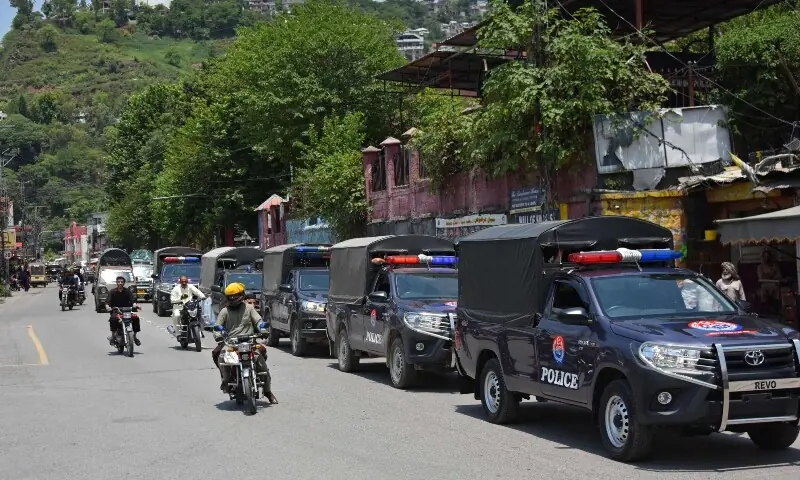
Police and protesters clash during unrest in Rawalakot, AJK. Photo File
The JAAC Protest in Rawalakot turned deadly on Sunday after violent clashes between police and supporters of the recently proscribed Joint Awami Action Committee (JAAC). The unrest left multiple people dead and dozens injured, raising concerns about security and political stability in Azad Jammu and Kashmir (AJK).
The incident has drawn widespread attention because it comes days before a planned protest and amid growing tensions over constitutional reforms and the controversial issue of refugee seats in the AJK Legislative Assembly. Consequently, authorities and political observers are closely monitoring developments.
Xi Jinping Strengthens China-North Korea Alliance During Pyongyang Visit
Rawalakot JAAC Protest Turns Violent
According to police officials, four police personnel were killed and around 20 others were injured during clashes in Rawalakot. A statement issued by AJK Inspector General of Police Liaqat Ali Malik’s office alleged that demonstrators attacked the Combined Military Hospital (CMH) in Rawalakot.
Police stated that the officers were killed by firearms and shotguns. As a result, authorities described the incident as “outright terrorism” and pledged to maintain public order.
Meanwhile, officials confirmed that at least two protesters also lost their lives during the unrest. Dozens more reportedly sustained injuries. However, local residents fear the actual casualty figure may be higher.
CMH Rawalakot Remains Center of Tensions
The latest tensions emerged following the death of a local trader, who was allegedly shot during a confrontation with law enforcement personnel on Friday night.
Initially, the family planned to hold funeral prayers on Saturday. However, they later returned the body to CMH Rawalakot and delayed the burial. They reportedly sought a post-mortem examination before proceeding.
As the situation developed, supporters gathered outside the hospital and continued a sit-in. Subsequently, police attempted to disperse the crowd. Witnesses stated that demonstrators confronted officers, leading to a baton charge and the use of tear gas.
Protesters reportedly responded by throwing stones. The confrontation quickly intensified, further escalating tensions across the area.
JAAC Protest Ban Fuels Public Anger
The deceased trader’s family linked the burial of their relative to the government’s decision to ban the Joint Awami Action Committee.
According to family members, they would not proceed with the burial until authorities withdrew the notification declaring JAAC a prohibited organization. The statement reflects the growing dissatisfaction among supporters regarding the government’s action.
At the same time, administration officials argued that the ongoing sit-in was disrupting hospital operations and causing inconvenience for patients and visitors. They stated that protesters had been urged to disperse peacefully but remained at the site.
AJK Supreme Court Addresses Refugee Seats Dispute
Separately, the AJK Supreme Court issued an advisory opinion concerning one of JAAC’s major demands: the abolition of 12 refugee seats in the Legislative Assembly.
The reference was submitted by AJK President Chaudhry Latif Akbar and sought legal clarification on constitutional questions surrounding the seats and electoral processes.
The court noted that constitutional amendments cannot be imposed through pressure or public demands. Instead, the judges emphasized that any changes must follow established constitutional procedures.
AJK Supreme Court Opinion on Constitutional Changes
Chief Justice Raja Saeed Akram Khan stated that the AJK Constitution remains the supreme law of the region.
According to the advisory opinion, constitutional amendments require democratic legitimacy, legislative deliberation, and broad consensus. Therefore, the court concluded that constitutional reform is not a concession that can be extracted from a government under pressure.
The ruling arrives at a critical moment because JAAC has scheduled another protest while continuing to demand the removal of refugee seats and broader economic reforms.
Government Responds to JAAC Demands
Meanwhile, Minister for Parliamentary Affairs Tariq Fazal Chaudhry said the government has already addressed most of the group’s concerns.
During a press conference, he stated that 35 out of 38 demands raised by JAAC had been fulfilled. Furthermore, he rejected claims that authorities had ignored public concerns.
The government maintains that substantial progress has been made on issues including energy costs and public services. Nevertheless, disagreements over political representation and constitutional reforms continue to fuel tensions.
Rawalakot Violence Raises New Questions
The deadly JAAC Protest has intensified scrutiny of the political and security situation in AJK. While authorities investigate the violence, questions remain regarding accountability, public trust, and the future of constitutional reforms.
Moreover, the latest clashes highlight the challenges facing both the government and protest organizers as they navigate a rapidly evolving crisis. With further demonstrations expected, stakeholders are likely to face increased pressure to pursue dialogue and prevent additional violence.