Trump launches ‘Board of Peace’ charter, vows to bring peace to Middle East
- Trump presents board as a bold new mechanism to secure lasting peace in Gaza and address wider global conflicts.
- Jared Kushner outlines “master plan” for a “New Gaza” to include residential towers and seaside resorts.
- Representatives from 19 countries, mostly Arab and Islamic nations, sign charter during ceremony in Davos.
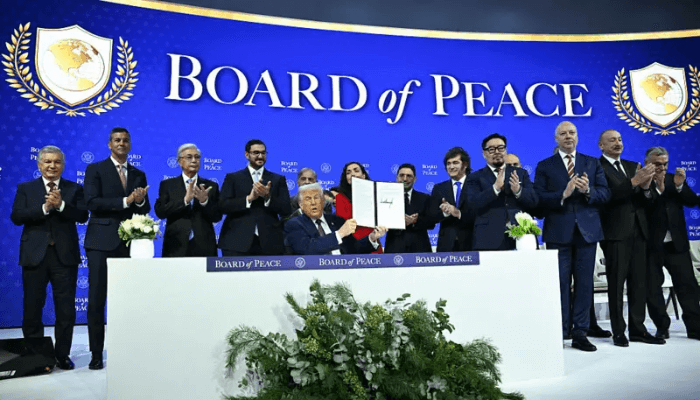
DAVOS: US President Donald Trump formally launched the first charter of his Gaza “Board of Peace” in a signing ceremony during the annual World Economic Forum in Davos, Switzerland, on Thursday.
The body, to be chaired by Trump, is set to oversee the transitional governance and rebuilding of Gaza as the fragile ceasefire agreement enters its second phase, though the president said he wants it to address wider global conflicts.
The ceremony was attended by representatives from 19 countries, mostly Arab and Islamic nations that have signed the charter, including Saudi Arabia’s Foreign Minister Prince Faisal bin Farhan Al-Saud, Jordan’s Deputy Prime Minister and Minister of Foreign Affairs and Expatriates Ayman Safadi, and Qatar’s Prime Minister Sheikh Mohammed bin Abdulrahman Al-Thani.
Egypt said President Abdel Fattah El-Sisi had accepted Trump’s invitation to join but he was not on stage.
Representatives from Morocco, Turkiye and Bahrain were also among the attendees, as regional founding members voiced support for the Trump-led peace effort and pledged to back the board’s mission to bring lasting peace to Gaza after two years of fighting that killed more than 71,000 people and left the enclave in ruins.
After the signing ceremony, Jared Kushner, one of US’ Gaza negotiators and Trump’s son-in-law, presented what he called a “master plan” for Gaza reconstruction to include residential towers, data centres and seaside resorts, a project that could start emerging in three years.
However, he added that disarmament of Hamas, one of ?the most intractable unresolved issues, and the funding for reconstruction in the territory would be essential to advancing to the next phase of the ceasefire.
“If Hamas doesn’t demilitarize, that would be what holds this plan back,” Kushner said.
“The next 100 days we’re going to continue to just be heads down and focused on making sure this is implemented. We continue to be focused on humanitarian aid, humanitarian shelter, but then creating the conditions to move forward.”
He displayed slides that included maps of new settlements in the Gaza Strip and artist renderings of gleaming seafront hotels and apartments captioned “New Gaza,” adding that the plan includes building 100,000 housing units in Rafah.
The Board of Peace, he said, wants to use “free market principles” to shift Gaza’s dependence on foreign aid, Kushner said, also showing a map of the enclave divided into “residential” and “coastal tourism mixed” zones.
During his 20-minute speech, the US president said the board “will be very successful” in Gaza and is committed to ensuring the enclave is “demilitarized, properly governed and beautifully rebuilt.”
He threatened Hamas to disarm or it “will be the end of them.”
He added: “If Hamas doesn’t do what they promised they will do … I think they probably will — but they were born with rifles in their hands.”
Trump concluded the signing ceremony by calling Gaza a “beautiful piece of property,” adding that he is a “real estate person at heart.”
During his speech, he touched on the work his administration has been doing in the region, from weakening Iran to launching anti-Daesh operations in Syria, referring to the charter’s launch as bringing “peace in the Middle East, which no one thought … was possible.”
Speaking about Iran, he pointed to US strikes on Iranian nuclear sites last June, claiming they had “obliterated” Iran’s nuclear capacity. He added that Tehran “does want to talk, and will talk.”
He referred to his Wednesday meeting with Egypt’s El-Sisi in Davos, reiterating that he will exert efforts to end the country’s dispute with Ethiopia over the Renaissance Dam.
The president criticized the UN and said it has “tremendous potential” that it never fulfilled, adding that the board will assist the international organization’s mandate to bring peace to the world.
He said the board would work with UN to achieve “something great for the world.
“Once this board is completely formed, we can do pretty much whatever we want to do, and we’ll do it in conjunction with the UN,” he said in Davos.
“This is not only for the US, it is for the world,” he said, calling the board “one of the most consequential bodies ever created.
He said that the world was “richer, safer and much more peaceful” than it was before he began his second term, noting he helped end eight conflicts in nine months. He added that he is working to end the war in Ukraine soon.
“I think the combination of the Board of Peace with the kind of people we have here … could ?be something very, very unique for the world,” Trump added.
While the US president said that 59 countries have expressed support for his proposed “Board of Peace,” the full membership list remains unclear.
Traditional Western US allies have balked at joining the board. Trump previously said permanent members must help fund the body with a payment of $1 billion each, with allies responding cautiously or declining the invitation. The representatives of the countries on stage with Trump included two close populist allies, Hungary’s Viktor Orban and Argentina’s Javier Milei.
Board members also include US Secretary of State Marco Rubio, the US Gaza negotiators Kushner and Steve Witkoff, and former UK Prime Minister Tony Blair.
Russia said late on Wednesday it was studying the proposal after Trump said Moscow would join. France has declined. Britain said on Thursday it was not joining at present. China has not yet said whether it will ?join.
The board’s creation was endorsed by a UN Security Council resolution as part of Trump’s Gaza peace plan, and UN spokesperson Rolando Gomez said on Thursday that UN engagement with the board would only be in that context.
US Secretary of State Marco Rubio said the board’s focus would be on making sure the plan for peace in Gaza was fulfilled but that it could also “serve as an example of what’s possible in other parts of the world.”

Rafah border opening
In a sign of progress on unresolved elements of the first phase of the truce, the Palestinian technocratic committee leader Ali Shaath said the Rafah border crossing with Egypt, Gaza’s main gateway, would reopen next week.
“Rafah is more than a gate, it is a lifeline and a symbol of opportunity. Opening Radah signals that gaza is no longer closed to the future and to the world,” said Shaath, noting that “there is much more work ahead and none of it is easy.”
The ceasefire in Gaza, reached in October, has sputtered for months with Israel and Hamas trading blame for repeated bursts of violence in which several Israeli soldiers and hundreds of Palestinians have been killed.
Both sides accuse each other of further violations, with Israel saying Hamas has procrastinated on returning a final body of a dead hostage and Hamas saying Israel has continued to restrict aid into Gaza despite an ongoing humanitarian disaster.
Each side rejects the other’s accusations.
Israeli Prime Minister Benjamin Netanyahu accepted an invitation to join the board, the Israeli leader’s office said. Palestinian factions have endorsed Trump’s plan and given backing to a transitional Palestinian committee meant to administer the Gaza Strip with oversight by the ?board.
Even as the first phase of the truce falters, its next stage must address much tougher long-term issues that have bedeviled earlier negotiations, including Hamas disarmament, security control in Gaza and eventual Israeli withdrawal.
Thanks Arab News .