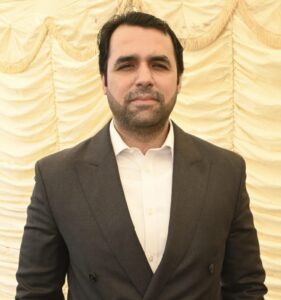
It is the responsibility of the Sindh Health Department to register all government hospitals

Karachi : It is the responsibility of the Sindh Health Department to register all government hospitals and medical centers in the province with the Healthcare Commission, said Khalid Hussain Sheikh, Chairman of the Sindh Healthcare Commission Board.
Sindh Healthcare Commission Board Chairman Khalid Hussain Sheikh has said that it is the responsibility of the Sindh Health Department to register all government hospitals and medical centers in the province with the Healthcare Commission so that the performance of these institutions improves and the public is provided with maximum quality medical facilities. Due to the lack of a system of checks and balances, more than half of the doctors in Sindh remain absent from duty by offering part of their salary to senior officers.
Due to which there is a shortage of doctors in hospitals and medical centers, he was talking exclusively to Daily Ausaf and ABN News in his office at FTC. Dr. Khalid Sheikh said that he has written several letters to the health department to remind them of registration, but so far there has been silence on this and no seriousness has been shown regarding registration. While a letter was written 3 months ago and no significant results were obtained, he said that the establishment of the Health Commission came into effect in 2018 after the enactment of legislation in the province.
Under which, registration of all major hospitals, including Aga Khan Liaquat National and all dental hospitals, clinics, homeopathic clinics, pathological labs and doctors’ offices is mandatory. After registration, the commission issues a provisional license in the first phase and a regular license later, for which a fee is charged. To a question, he said that there is no exemption in the matter of visiting doctors. The Health Commission sealed 10,898 visiting doctors’ centers in the province.
However, after verification, the seals of 4,531 centers were lifted because doctors were present there, but they had temporarily gone somewhere. Later, these centers were allowed to function. To a question, he said that at times, there is recommendation and pressure on various issues, but I work with my team, keeping recommendation and pressure aside. If anyone is angry, I don’t care. He said that the commission received 411 complaints, 262 complaints were resolved and a decision on 149 is yet to be taken. Most of the complaints are related to the negligence of doctors and medical staff in gynecology, surgery, general surgery and other diseases. He said that the commission has provided training to 6355 people. Khalid Sheikh said that to facilitate the registration process, the commission has signed a Memorandum of Understanding (MOU) with the Board of Investment, taking other 9 departments on board on the ClickClick project. After which, online registration facility will also be available.
He said that the commission’s offices have been established in Karachi and five other divisions, including Hyderabad, Mirpur Khas, Nawab Shah, Larkana and Sukkur. Each division has two deputy directors and staff along with two vehicles, so that maximum visits can be ensured. To a question, he said that it is also mandatory for transplant or cosmetic surgery institutions in the city to register. To a question, he said that the commission has the authority to impose a fine of Rs 1 lakh to Rs 5 lakh on institutions or individuals who are involved in wrongdoing and are found guilty of violations, and fines have been imposed. He said that the establishment of the commission was implemented in 2018. The first panel was from 18-19-20, while the second panel was from 21-22-23, in which I was the commissioner and now there is a third panel for 24-25-26, of which I am the chairman. Excellent performance has been shown in the last 4 and a half years, especially in the last one and a half years. No one is allowed to play with the lives of citizens. Till now, we have registered a total of 13,590 institutions, of which 11,951 are private and 1,639 are government. We have issued a total of 1,247 provisional licenses, of which 1,168 are private and 79 are government. 
The total number of regular lines is 118, of which 115 are private and 03 are government-issued. He said that the registration fee for a small organization is Rs. 5,000, while large organizations can register by paying Rs. 25,000. Similarly, small and large organizations can obtain licenses by paying fees for provisional and regular licenses. The regular license is valid for 5 years, after which renewal is mandatory. The aim is to make institutions accountable, and no one should be afraid. To a question, he said that the fees for provisional and regular licenses are determined keeping in mind the number of beds in hospitals and all decisions are made with the approval of the board. He said that the staff members who were found involved in wrongdoing were dismissed from their jobs without any pressure and some people even went to court, but they had to bear the consequences. He said that currently we have a staff of 180 people, including 21 grade Chief Executive Officers (CEOs) to directors and other staff. All officers and employees are recruited on contract.
The contract period is three years. However, if someone is involved in a crime, he is dismissed before the contract is completed according to the clause of the contract. The contract of such employees is renewed after three years if their performance is good. Recruitment to the institution is done through IBA and NTS. Whoever meets the merit is a part of the institution. He said that the salaries of those serving in the commission are higher than those working in the health department. In addition, a provident fund and other facilities are also provided. He said that the establishment of the Health Commission was implemented after the bills were passed by the assemblies in all four provinces. First, the commission was formed in the Punjab Assembly. After reviewing the Punjab commission in Sindh, the commission was established in Sindh. The presence of the commission is improving the health system. He said that citizens also have the responsibility to forward their complaints to the Health Commission, so that those who harm the lives of the public can be dealt with strictly and brought to justice.