

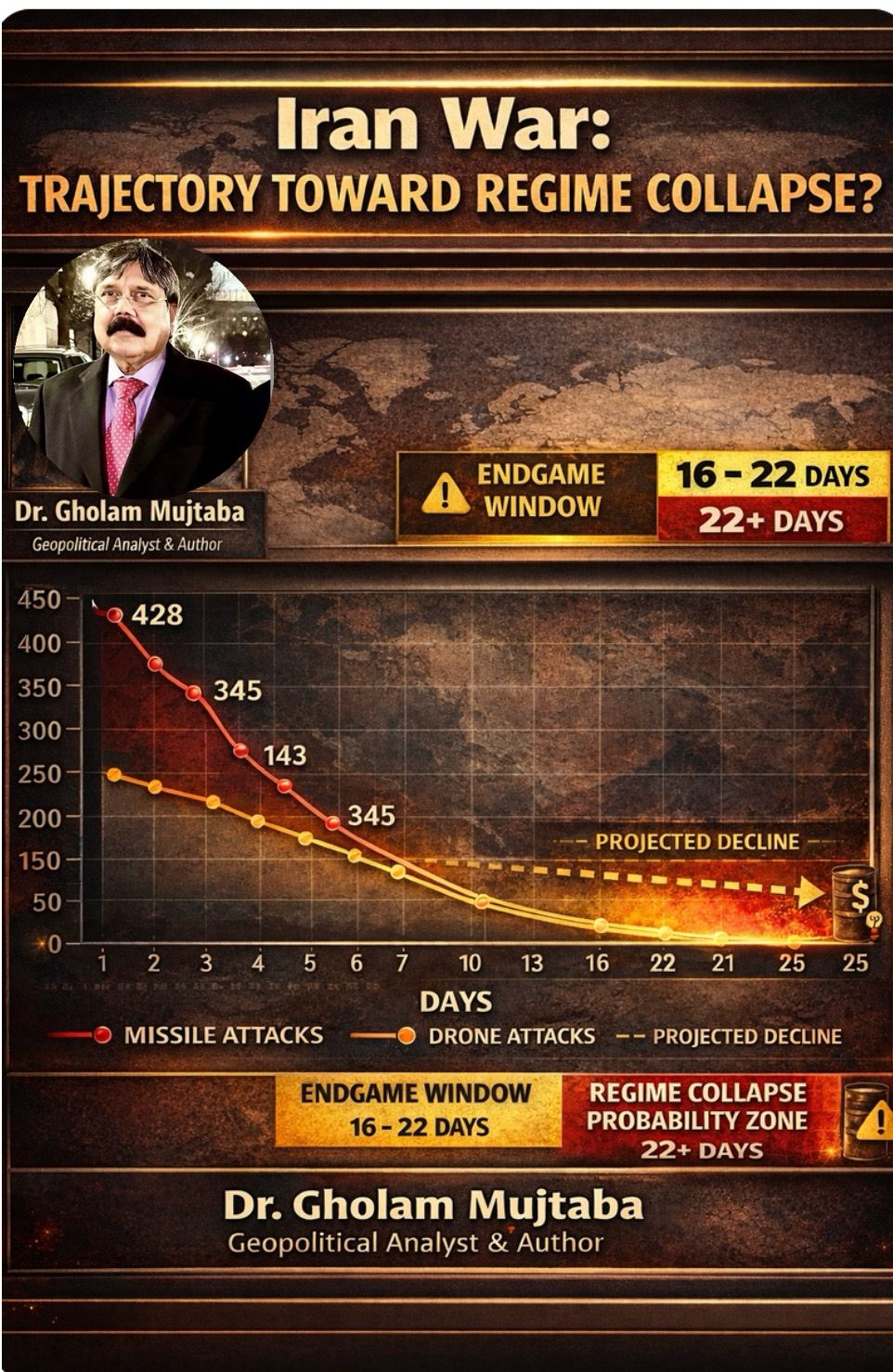
Day-14 of the Iran War: ENDGAME WINDOW – 22 DAYS APPROXIMATELY
The Missile State’s Last Stand — Can the Ayatollahs Survive After Losing the Sky and the Sea?
Strategic Assessment of Iran’s Remaining Options, Missile Arsenal, and the Geopolitical Stakes of Regime Survival.
The ongoing Middle East war has entered a decisive phase. The military balance has shifted dramatically as the United States and Israel continue sustained air operations inside Iranian territory with minimal aerial resistance. Iranian naval assets, large portions of the air force, and significant elements of the country’s air defense network have reportedly been severely degraded after thousands of targets were struck across Iran.
In such circumstances, the strategic question becomes clear: how can Iran sustain its ideological regime once its conventional military capabilities are crippled?
This article analyzes Iran’s remaining military options, the sustainability of its missile-drone strategy, the economic calculus of the war, and the broader geopolitical implications—including the role of President Donald J. Trump, the current President of the United States, whose strategic decisions appear to be shaping the conflict’s trajectory.
1. Collapse of Conventional Iranian Military Power
Modern warfare has once again demonstrated the dominance of air superiority.
According to defense assessments, over 5,000 Iranian military targets have been hit since the war began, including missile launchers, naval facilities, air defense batteries, and command centers.
The consequences are profound:
• Iranian naval operations in the Persian Gulf have been severely restricted
• Iranian air force activity is minimal
• Many surface-to-air missile systems have been destroyed
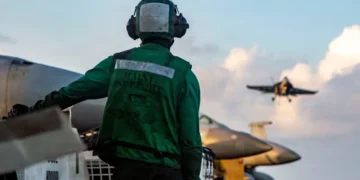
• U.S. and Israeli aircraft now operate over Iranian territory with little resistance.
Without air power or naval dominance, Iran’s strategic doctrine has reverted to what military analysts call “asymmetric saturation warfare.”
This means drones and ballistic missiles have become Iran’s last strategic tool.
2. Iran’s Missile and Drone Arsenal: How Long Can It Last?
Iran has built one of the largest missile forces in the Middle East. Estimates vary, but the approximate scale is known.
Estimated Iranian Arsenal
Weapon Type
Estimated Stockpile
Ballistic missiles
2,500 – 3,000
Cruise missiles
Several hundred
Attack drones (Shahed types)
Thousands
Monthly drone production
Up to ~10,000
Analysts estimate that Iran began the conflict with approximately 2,000–3,000 ballistic missiles capable of striking regional targets.
The drone program is even larger. Iran’s industrial network is believed capable of producing around 10,000 drones per month.
Current Usage Rate
During the first days of the war:
• 428 ballistic missiles were fired in a single day.
• 345 drones were launched simultaneously.
Since then, the rate has sharply declined:
• ~39 missiles per day
• ~143 drones per day
The decline suggests two realities:
1 Launch infrastructure is being destroyed.
2 Iran is rationing its remaining missiles.
Sustainability Projection
If Iran continues firing:
• 40 missiles per day
• 150 drones per day
Then:
Missiles
• 2,000 missiles ÷ 40 per day
? 50 days of sustained fire
Drones
• If producing thousands per month, drone warfare could theoretically continue for several months, although launch platforms may be destroyed faster than production.
Thus, Iran’s strategic endurance may range from 6 weeks to several months, depending on the extent of damage to its launch infrastructure.
3. Iran’s Remaining Strategic Options
With conventional forces degraded, Tehran has three main strategic options.
1. Missile-Drone Attrition Warfare
Iran’s primary strategy is now saturation attacks on:
• Israel
• Gulf states
• U.S. bases
• Oil infrastructure
• Shipping in the Strait of Hormuz.
Since the war began, over 500 missiles and more than 2,000 drones have already been launched.
2. Proxy Escalation
Iran may increasingly rely on:
• Hezbollah
• Iraqi militias
• Houthi forces
• regional paramilitary networks.
Already, Hezbollah has fired hundreds of rockets in coordination with Iran.
3. Strategic Economic Warfare
The most dangerous option remains closure or disruption of the Strait of Hormuz, through which roughly 20% of global oil flows.
Iran has repeatedly threatened to mine the strait or deploy naval suicide drones to disrupt shipping.
Such a move would trigger a massive international naval response.
4. Cost of the War for the United States
Modern high-tech warfare is extremely expensive.
For example:
• A Tomahawk cruise missile costs about $1.5–2 million.
• A Patriot interceptor missile can cost up to $4 million.
• Carrier strike groups cost billions per deployment.
Analysts estimate the United States could expend hundreds of missiles and interceptors in the conflict, testing stockpiles.
If the war lasts six months, the total cost could approach:
$300–$400 billion
in operational expenditures, deployments, and replenishment.
5. Why the U.S. Economy Can Absorb the War
President Donald J. Trump, the current President of the United States, secured enormous economic commitments from Gulf partners.
Key figures include:
• UAE: $1.4 trillion investment framework
• Qatar: approximately $1.2 trillion economic exchange
• Saudi Arabia: about $600 billion in investment commitments
Combined Gulf pledges exceed $3 trillion in economic activity linked to U.S. partnerships.
These investment flows significantly offset the economic impact of prolonged military operations.
Thus, while the war may increase oil prices and cause temporary inflation, the U.S. economy is structurally capable of absorbing the financial burden.
6. Strategic Implications of a Regime Change in Iran
If the Iranian regime collapses, the geopolitical consequences would be historic.
Possible outcomes include:
1 Fragmentation of power inside Iran
2 Rival factions within the Revolutionary Guard
3 Ethnic regional movements
4 Political transition struggles.
Recent precedents—such as Iraq, Libya, Syria, Afghanistan, and Sudan—show that regime collapse often leads to internal power competition.
Iran, with 90 million people and multiple ethnic groups, could face a prolonged transitional phase.
7. Global Strategic Consequences
A regime change in Iran would reshape global geopolitics.
Major consequences could include:
1. Collapse of Iran–China energy alignment
China has been a major buyer of Iranian oil.
A pro-Western Iran would dramatically weaken Beijing’s energy security.
2. Strategic dominance of the United States in the Middle East
Without Iran as a revolutionary power, the balance would shift strongly toward:
• U.S.
• Gulf allies
• Israel.
3. Realignment of global energy markets
Oil routes, investment flows, and security structures across the Gulf could change.
Conclusion
The Iran war has reached a phase where air superiority and strategic attrition are determining the outcome.
Iran’s conventional forces have been severely weakened. Its remaining military leverage lies primarily in:
• ballistic missiles
• drones
• proxy networks.
The sustainability of these tools may extend the conflict for weeks or months—but not indefinitely.
Ultimately, the decisive question will not only be military victory, but political stability after the war.
If the Iranian regime collapses, the Middle East could witness the most significant geopolitical transformation since the fall of Saddam Hussein.
History has shown repeatedly that removing regimes is often easier than building stable governments afterward.
For that reason, the next phase of the conflict may prove even more consequential than the war itself.
Time will remain the ultimate judge.
References
1 Israel Defense Forces reporting on strikes against Iranian military targets – 2026 war coverage.
2 Data on Iranian missile and drone launches during the war.
3 Pentagon estimates of missiles and drones fired by Iran.
4 Estimates of Iranian missile stockpile and production capacity.
5 Analysis of Iranian ballistic missile numbers (~2,000 inventory).
6 U.S. military stockpile and missile expenditure estimates.
7 Gulf investment commitments to the United States exceeding $3 trillion.
8 Reports on Iranian naval drone and mine capabilities in the Strait of Hormuz.
https://medium.com/@greetmujtaba/day-14-of-the-iran-war-endgame-window-22-days-approximately-5f2ae7bb033a (https://medium.com/@greetmujtaba/day-14-of-the-iran-war-endgame-window-22-days-approximately-5f2ae7bb033a)