Pakistan’s Military Credited for Pivotal Role in US-Iran Ceasefire
Web Desk April 8, 2026Islamabad/Washington – Pakistan’s military leadership has emerged as a central force behind the US-Iran two-week ceasefire, demonstrating an unusual model of diplomacy executed through operational credibility rather than traditional channels.
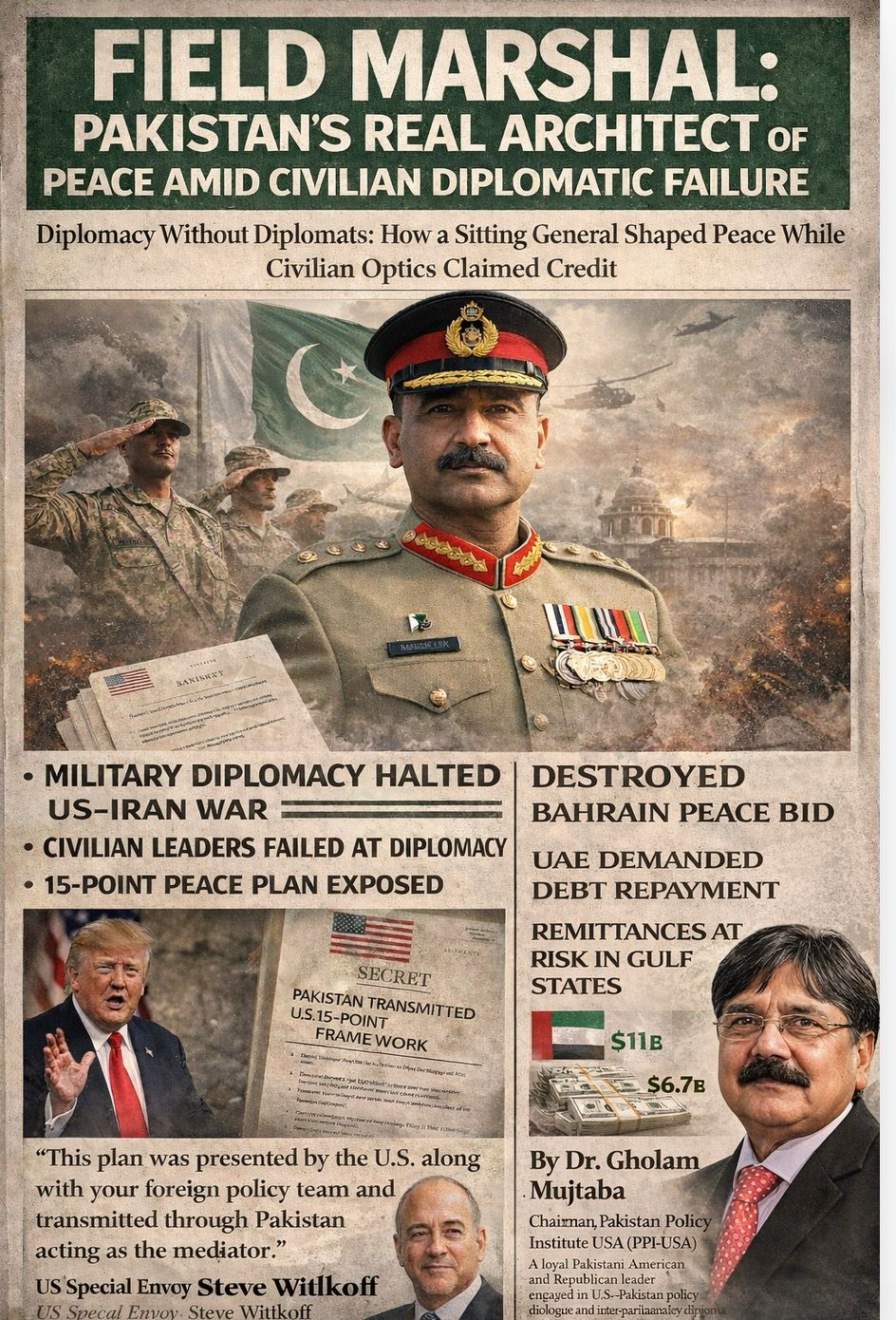
Islamabad/Washington – Pakistan’s military leadership has emerged as a central force behind the US-Iran two-week ceasefire, demonstrating an unusual model of diplomacy executed through operational credibility rather than traditional channels.
While domestic narratives have highlighted civilian-led mediation, analysts say the reality points to Field Marshal Asim Munir’s strategic role in enabling communication and trust between Washington and Tehran.
The ceasefire, announced this week, was built on a 15-point framework drafted by the United States, covering immediate de-escalation, nuclear program rollback, missile restrictions, regional conduct, strategic guarantees, and phased economic incentives. President Donald Trump confirmed that the US had no direct communication with Iran, making Pakistan a crucial intermediary.
“Pakistan transmitted the framework and maintained operational channels that both sides trusted,” said Prof. Dr. Gholam Mujtaba of the Pakistan Policy Institute USA. “The civilian leadership announced the narrative, but the military created the conditions for peace.”
Experts note that while civilian authorities managed optics, some missteps, including ambiguity on GCC resolutions and pressure from UAE financial channels, posed risks to Pakistan’s regional and economic interests. Nevertheless, the military’s proactive engagement has earned international recognition for Islamabad’s stabilizing influence.
The ceasefire pause has provided breathing space for negotiations, and Pakistan is set to host US and Iranian delegations in Islamabad for further talks. Analysts describe this as a rare instance of a sitting general shaping the course of international diplomacy, underscoring Pakistan’s growing role as a regional and global stabilizer.