
FBI Opens Permanent Office in Ecuador
The FBI recently established its first permanent office in Ecuador, strengthening cooperation with Ecuadorian law enforcement to combat transnational crime.
The office, located in the U.S. Embassy in Quito, will support joint investigations with a new unit of Ecuador’s National Police targeting drug trafficking, weapons smuggling, money laundering, and terrorism financing.
The opening comes as Ecuador intensifies efforts to confront organized crime and the United States expands cooperation with partners across the Americas to combat transnational criminal networks. Authorities say Ecuador has become an important logistical hub for drug trafficking routes connecting South America with markets in North America and Europe.
At a March 11 press conference, officials said the move reflects an expansion of longstanding cooperation between U.S. and Ecuadorian authorities.
“The establishment of a permanent FBI presence in Ecuador fits in extremely well with current U.S. policy in Latin America,” said Allen Pack, who leads the FBI’s law enforcement attaché office in Bogota, Colombia. “Ecuador was a key partner in the recent Shield of the Americas Summit, and the Ecuadorian President, [Daniel] Noboa, is widely viewed as being one of the United States’ closest allies in Latin America.”
The FBI’s law enforcement attachés—known as legats—and their suboffices, like the new one in Quito, are located in key cities around the world and are staffed by about 250 special agents and personnel. The Quito office will have a permanently assigned agent to enable closer intelligence sharing and investigative coordination with Ecuadorian counterparts.
The U.S. Drug Enforcement Administration (DEA) and the Department of Homeland Security’s Homeland Security Investigations (HSI) already have personnel assigned to Ecuador. Pack said the addition of an FBI presence will allow the country to better access the full range of support available from U.S. agencies. For the FBI, access to a vetted teams within the Ecuadorian National Police (ENP) will help support the Bureau’s transnational investigations.
“The threat in Ecuador primarily is transnational organized crime, but there are also threats across all of the FBI’s portfolios.”
Allen Pack, law enforcement attaché, FBI Bogota
Vetted teams are specialized units composed of top-tier foreign law enforcement and government officials who have been specially trained and cleared as partners by the FBI.
“The Ecuadorian government is committed to working with the U.S.,” Pack said in an interview. “Providing a ENP team to the premier law enforcement agency in the country further shows their commitment to work jointly with the U.S.”

Local officials said collaboration between the FBI and Ecuador’s National Police will begin immediately, building on previous joint operations targeting organized crime networks.

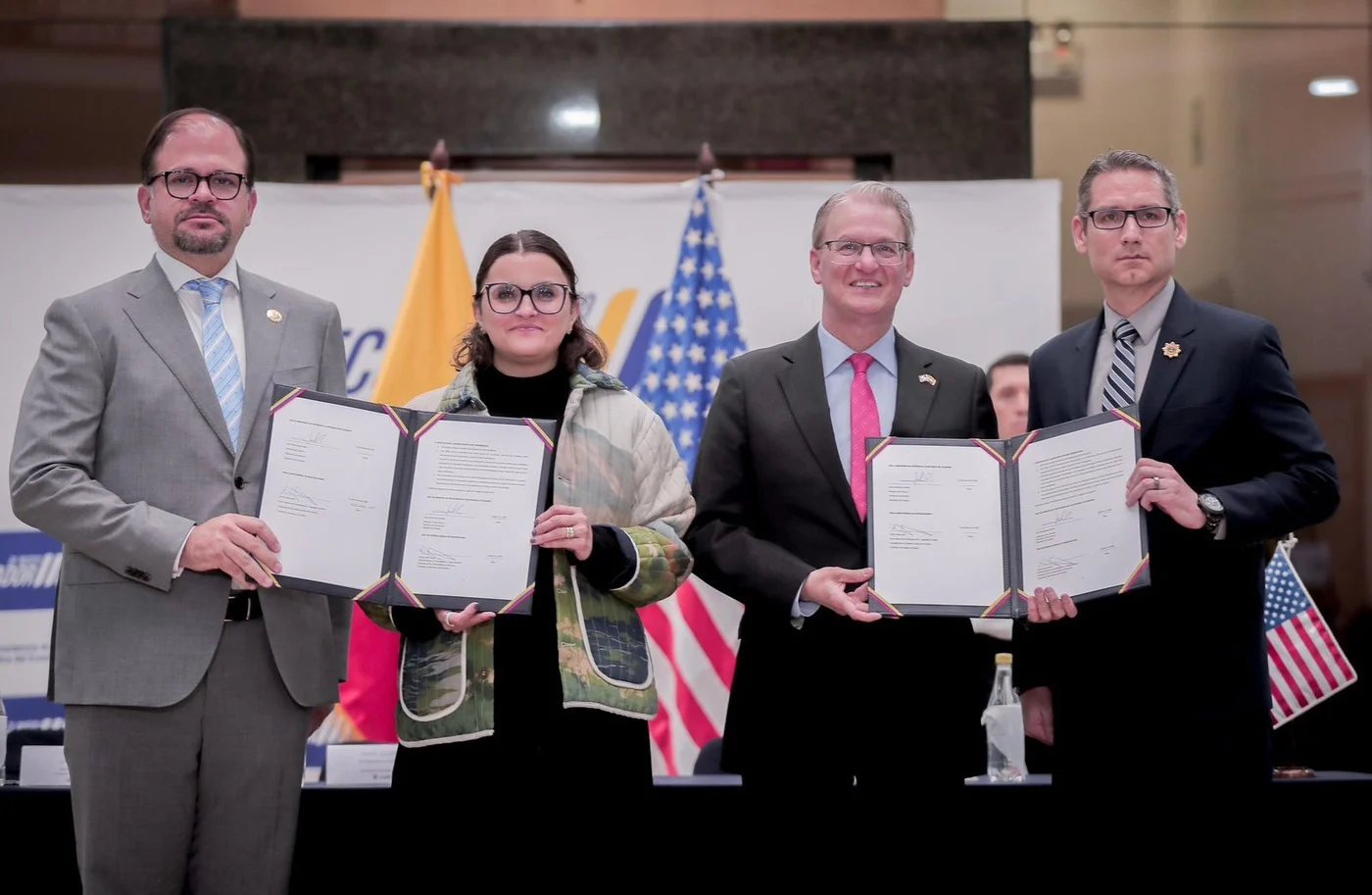
Allen Pack, right, leads the FBI’s law enforcement attaché office in Bogota, Colombia.
Local officials said collaboration between the FBI and Ecuador’s National Police will begin immediately, building on previous joint operations targeting organized crime networks.
“What has changed is that we have FBI agents permanently in Ecuador working with a national police unit that has been set up so that they can work together,” Ecuador Interior Minister John Reimberg said on March 11.
U.S. officials emphasized that the office represents an important step in strengthening operational ties between the two countries. Pack, whose office covers Colombia, Venezuela, and Ecuador, said an assistant legal attaché (ALAT) from the Bureau’s Criminal Division will be assigned to Ecuador and will work with a vetted team there to support investigations into foreign terrorist organizations like “Los Lobos” and “Los Choneros,” which control shipping routes in the region.
Pack said about 70% of the world’s cocaine is shipped from Ecuadorian ports.

“The threat in Ecuador primarily is transnational organized crime, but there are also threats across all of the FBI’s portfolios,” Pack said, citing the Bureau’s counterterrorism, cyber, counterintelligence, and counterespionage missions.
U.S. Embassy Chargé d’Affaires Lawrence Petroni described the opening as “a very important milestone.” Ecuador’s Vice President María José Pinto said the initiative is essential for “better investigating and understanding criminal threats.”
By embedding FBI personnel in Ecuador, investigators from both nations can work more closely on complex international cases—sharing intelligence, identifying criminal networks, and coordinating operations to disrupt transnational threats before they impact communities in the United States and abroad.