ECC Approves Export of 416,000 Tonnes of Sugar Despite IMF Deregulation Condition
Pakistan raises its sugar export quota to 724,000 tonnes this season, while the government faces criticism over continued intervention in the heavily regulated sector.
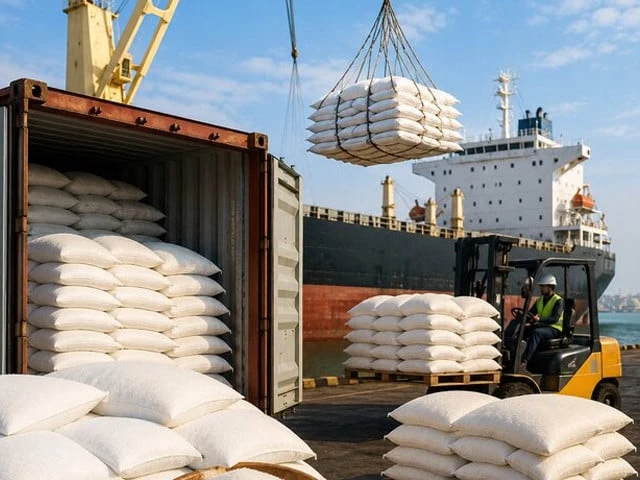
Sugar Exports: ECC approves another 416,000 tonnes despite the IMF’s deregulation condition.
The Economic Coordination Committee (ECC) has approved the export of another 416,000 metric tonnes of sugar, despite Pakistan’s failure to meet an International Monetary Fund (IMF) condition to deregulate the sector.
Minister for National Food Security Rana Tanveer Hussain confirmed the decision to The Express Tribune after Friday’s meeting. He said the sugarcane crushing season was about to begin and the country faced no shortage of sugar.
The latest approval marks the third permission for sugar exports in four months. It brings the total authorised export quantity to 724,000 tonnes for the current season.
The ECC first approved the export of 108,000 tonnes of imported sugar in August. It then allowed another 200,000 tonnes of locally produced sugar in mid-September.
Export approval raises transparency questions
The Cabinet Committee on Export of Sugar had recommended exporting 400,000 tonnes. It also sought an additional quota of 16,000 tonnes for Sindh, taking the total approval to 416,000 tonnes.
However, sources told The Express Tribune that the government had taken an in-principle decision to export 600,000 tonnes months earlier. Officials implemented the decision in two phases to avoid public attention, according to an industry source.
Sources also said Deputy Prime Minister Ishaq Dar had settled the export-related matters before officials presented the summary to the ECC as an additional agenda item.
The summary did not appear on the committee’s regular agenda and was not circulated to the relevant ministries. Although the ECC chairman can allow additional items, this practice limits the opportunity for ministries to examine and comment on proposals.
A meeting participant said Finance Minister Muhammad Aurangzeb, who chairs the ECC, stressed the need to deregulate the sugar sector. However, the committee again approved exports from an industry that remains heavily regulated.
IMF condition remains unmet
The IMF had asked Pakistan to fully deregulate the sugar sector and end the government’s role in sugar exports and imports.
Pakistan has not met this condition. Finance Secretary Imdadullah Bosal reportedly attributed the delay to one province’s refusal to agree to the proposed reforms.
The latest export approval came days before an IMF Executive Board meeting. The board is due to consider Pakistan’s request for a $1 billion fifth loan tranche under its structural reform programme. It will also review a $200 million climate facility request and the Article IV report.
The IMF’s Governance and Corruption Diagnostic Assessment, released in November last year, highlighted links between the sugar industry and state regulators.
The report described the sector as an example of how relationships between economic elites and regulators can influence public benefits at significant cost to society.
Sugar exports generate $1.6 billion in a decade
The government’s draft National Policy for De-regulation of the Sugar Sector says Pakistan exported 3.92 million tonnes of sugar over the past decade. It also imported approximately 565,000 tonnes during the same period.
The draft puts export earnings over the 10-year period at around $1.6 billion.
Sugar remains on the first schedule of the Export Policy Order. This means exporters need federal government permission to ship the commodity abroad.
The policy draft acknowledges extensive government intervention in the sector. These controls include zoning rules, administered prices and discretionary trade restrictions.
According to the document, such policies have distorted market incentives and contributed to volatile production and prices. They have also left sugar mills operating at roughly 60% of their installed capacity.
Saudi Arabia Intercepts Three Ballistic Missiles Fired Towards Riyadh
Pakistan ranks as the world’s seventh-largest producer of refined sugar. The country has 79 sugar processing mills, mainly located in Southern Punjab, Northern and Central Sindh, and Southern Khyber-Pakhtunkhwa.
Average annual production stands at around 6.13 million tonnes. Production reached 5.8 million tonnes last year, with an estimated value of Rs1.1 trillion.
However, annual domestic consumption stands at approximately 6.3 million tonnes, according to the policy draft.
Sugar prices and import duties
Retail sugar prices have remained volatile. The draft says prices increased by an average of around 16% annually over the past five years, with occasional peaks approaching 28%.
Pakistanis consume an average of 14.76kg of sugar per person each year. The Ministry of Industries estimates annual household spending on sugar at around Rs2,302 per person. This represents approximately 3.91% of an average household’s annual budget.
Although the government does not explicitly prohibit sugar imports, high tariffs discourage foreign supplies.
The Ministry of Industries estimates effective protection against sugar imports at 55%. The charges include 20% customs duty, 6% additional customs duty, 18% sales tax, 3% additional sales tax and 6% income tax.
Imports also attract a provincial cess of 0.85%.
ECC relaxes export financing conditions for SMEs
Separately, the ECC relaxed conditions for small and medium enterprises (SMEs) seeking long-term concessional export loans.
The committee waived the initial export requirement and environmental compliance conditions under a Rs50 billion financing allocation.
The Finance Ministry said newly established businesses need time to set up production facilities, develop overseas markets and secure export orders. It said an immediate requirement to generate 80% of sales from exports could prevent otherwise viable SMEs from accessing financing.
An Access to Finance meeting had decided to earmark an initial Rs50 billion from a Rs350 billion financing envelope for SME borrowers under the long-term financing scheme.
Under the revised conditions, eligible SMEs no longer need to meet the initial requirement of generating 80% of sales through exports. However, they must achieve exports equal to at least 50% of projected total sales within four years.
The ECC also granted Long Term Export Financing Facility (LTEGFF) borrowers a four-year exemption from compliance with the Pakistan Green Taxonomy. The exemption will apply to disbursements during the transition period, until full implementation of the framework.
All other LTEGFF conditions, including eligibility requirements, will remain unchanged, the ministry said.