China’s Humanoid Robots Outpace Humans in Beijing Half-Marathon Showcase
Dozens of advanced humanoid robots demonstrated striking improvements in speed, balance, and autonomous navigation during a half-marathon race in Beijing on Sunday, highlighting rapid progress in China’s robotics industry.
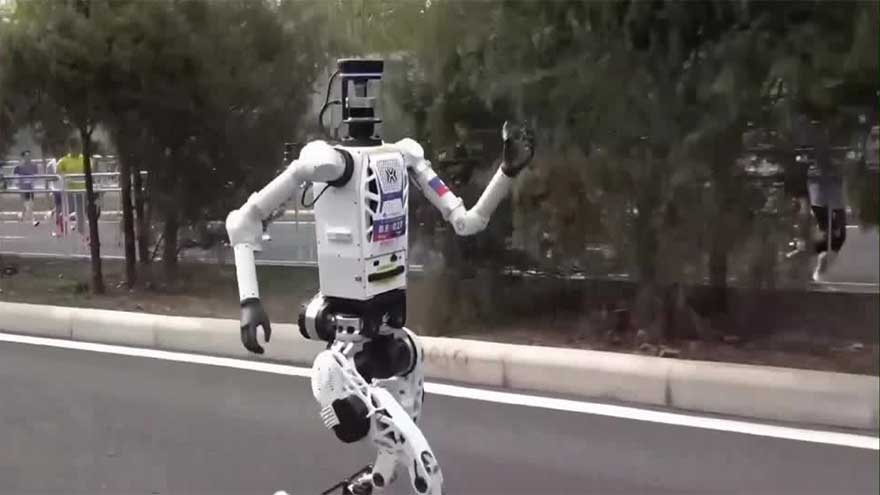
Dozens of advanced humanoid robots demonstrated striking improvements in speed, balance, and autonomous navigation during a half-marathon race in Beijing on Sunday, highlighting rapid progress in China’s robotics industry.
“God of Chaos” Asteroid Apophis to Pass Extremely Close to Earth in 2029, NASA Says
The event, organized in Beijing, featured more than 100 robot entrants running alongside 12,000 human participants on parallel tracks. Unlike last year’s inaugural edition—where most robots failed to complete the course—this year’s machines showed far greater stability and efficiency.
The winning robot, developed by Honor, completed the 21-kilometer race in 50 minutes and 26 seconds, a time faster than the men’s half-marathon world record set by elite human athletes. Teams from Honor secured all top three positions, with fully autonomous navigation systems enabling the robots to run without remote control assistance.
Engineers said the winning model used human-inspired biomechanics, including leg lengths designed to mimic elite runners, along with advanced cooling systems adapted from smartphone technology.
Nearly half of the participating robots completed the course autonomously, marking a major improvement over previous iterations where remote control was heavily relied upon. Spectators and experts described the performance as a clear sign of China’s accelerating progress in embodied artificial intelligence and robotics engineering.
While the showcase drew attention for its athletic feats, experts cautioned that humanoid robots still face major challenges before widespread commercial adoption. Current limitations include fine motor skills, real-world perception, and adaptability in complex industrial environments.
China continues to heavily invest in robotics through subsidies and policy support, aiming to become a global leader in next-generation manufacturing and AI-driven automation. The sector has also been featured prominently in national showcases, reflecting its strategic importance in the country’s technological ambitions.