Kaspersky Finds Barcode Scanner Vulnerabilities That Could Threaten Warehouse Security

Barcode Scanners: Kaspersky identifies potential cybersecurity risks in warehouse devices.
Kaspersky cybersecurity experts have identified vulnerabilities in widely used barcode scanners that could expose warehouse networks and e-commerce supply chains to cyberattacks. The findings highlight how seemingly ordinary warehouse equipment can provide attackers with an entry point into critical business systems.
Global e-commerce sales have nearly doubled since 2019, surpassing $6 trillion. As a result, disruptions to warehouse operations and delivery networks can cause significant financial and reputational damage.
Kaspersky Security Services researchers examined several potential attack routes targeting warehouse infrastructure. Their investigation uncovered a vulnerability in a barcode scanner model from a major manufacturer that could allow attackers to access warehouse networks through the device’s wireless connection.
How Attackers Could Exploit Barcode Scanners
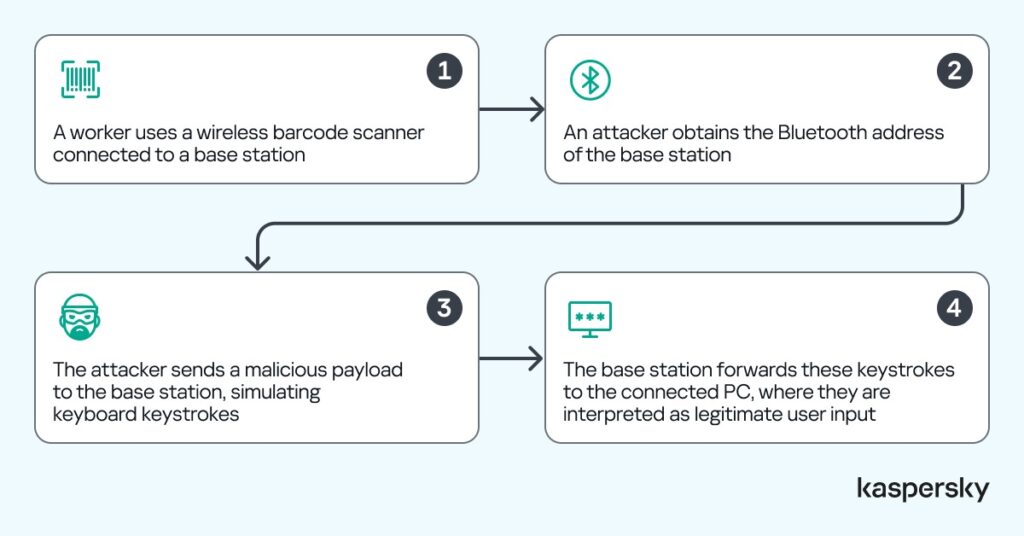
A typical wireless barcode scanner communicates with a base station connected to a workstation or another business system. According to Kaspersky, the lack of authentication between the scanner and its base station creates a potential security weakness.
AI Tool Predicts Cancer Patients’ Survival Chances from a Facial Photograph
Researchers found that attackers could exploit the wireless link to gain an initial foothold on a computer within a warehouse network.
In a hypothetical attack, an attacker could obtain the base station’s Bluetooth address by passively monitoring Bluetooth traffic. The attacker could then establish a connection and send a malicious payload that simulates keyboard keystrokes.
The base station would forward those keystrokes to the connected computer. The computer could interpret them as legitimate user input, potentially allowing the attacker to execute unauthorized commands.
Kaspersky observed similar attack patterns across devices from multiple vendors, suggesting that the risk may extend beyond a single scanner model.
Risks Extend to Warehouse Management Systems
Researchers warned that attackers could potentially use similar techniques against other warehouse devices, including portable data terminals and thermal printers. These devices could provide access to critical infrastructure, such as Warehouse Management Systems (WMS).
The findings underscore the cybersecurity challenges facing modern logistics and retail operations, where interconnected devices support everything from inventory tracking to order fulfilment.
“Modern retail and logistics are profoundly digital, from enterprise-wide management platforms down to every device in a worker’s hands,” said Sergey Sidorov, Head of Industrial Security Services at Kaspersky.
He warned that connected technologies at any level could become entry points for attacks capable of disrupting an entire operational ecosystem. Sidorov urged warehouse operators and the wider retail industry to make cybersecurity a priority across all layers of their operations.
Kaspersky Recommends Stronger Warehouse Security
Kaspersky experts recommend several measures to reduce the risk of attacks targeting warehouse infrastructure:
Verify new devices: Assess every device before connecting it to the corporate network.
Secure wireless interfaces: Disable unused Bluetooth connections and enforce strong authentication wherever supported.
Segment networks: Restrict communication between network segments to essential connections.
Apply security updates: Keep device firmware, software and Warehouse Management Systems up to date.
Limit account permissions: Give users and systems only the access they need.
Review attack paths: Regularly assess infrastructure to identify vulnerabilities and potential routes attackers could exploit.
Security Assessments and Industrial Protection
Kaspersky offers industrial security assessments designed to identify weaknesses in industrial control systems (ICS), operational technology (OT) and network-connected devices. These assessments examine system configurations, access paths and vulnerabilities to help organizations understand and address operational risks.
Its Kaspersky Industrial Cyber Security (KICS) platform also helps industrial organizations, including logistics companies, improve visibility across their infrastructure and strengthen protection while minimizing disruption to operations.
The research highlights the importance of securing every connected device in a warehouse, including equipment that businesses may not traditionally consider a cybersecurity risk.