
Pakistan Rejects India’s ‘Operation Sindoor’ Narrative, Calls Documentary a Distortion of History
Pakistan’s military spokesperson challenges India’s account of the 2025 conflict, questioning its chronology, claims of victory and portrayal of the end of hostilities
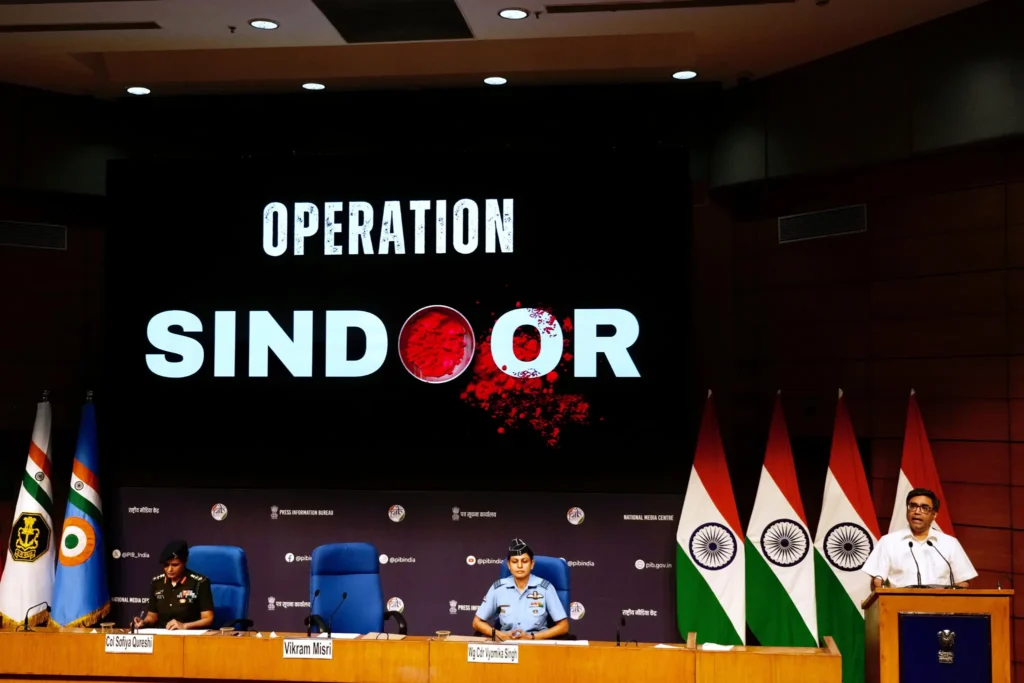
Pakistan challenges India’s portrayal of Operation Sindoor and the 2025 military confrontation.
ISLAMABAD: Pakistan has rejected an Indian documentary’s portrayal of Operation Sindoor, accusing its producers of selectively presenting events and attempting to recast the outcome of the 2025 military confrontation between the two countries.
In a strongly worded statement, Pakistan’s military spokesperson said the documentary used dramatised reconstructions, edited interviews and emotional narration to present what Islamabad described as a domestically appealing version of events.
The statement argued that the production contained contradictions over the timeline of the Pahalgam incident, the subsequent military action and the eventual cessation of hostilities.
Pakistan said the documentary failed to provide an objective account of the confrontation and instead sought to portray India’s military actions as an unequivocal success.
Pakistan Questions Documentary’s Timeline
A central criticism concerned the documentary’s attempt to connect an April 16, 2025 address by Pakistan’s army chief with the Pahalgam incident on April 22.
Pakistan’s statement described the alleged connection as an attempt to construct a conspiracy around events that occurred only days apart.
It also questioned India’s account of the alleged perpetrators of the Pahalgam attack.
According to the statement, India later claimed that three alleged perpetrators were identified and killed on July 28, 2025 — 82 days after Operation Sindoor.
Pakistan argued that this timeline raises questions about India’s description of the May 7 military operation as punishment for those responsible for Pahalgam.
“If the alleged perpetrators were eliminated on 28 July, India must explain who it claims to have punished on 7 May,” the statement said.
Islamabad Rejects ‘100 Per Cent Mission Success’ Claim
Pakistan also challenged the documentary’s claim of “100 per cent mission success”.
The statement said Pakistani forces had successfully responded to Indian military action during what it described as Marka-e-Haq.
Pakistan claimed its armed forces shot down eight Indian military aircraft during the confrontation.
It further said Pakistan subsequently launched Operation Bunyanum Marsoos, using precision-guided rockets and missiles, air force precision munitions, loitering munitions and artillery against 26 military targets.
According to Pakistan’s account, the targets included facilities allegedly involved in attacks against Pakistani citizens and entities Islamabad accused of supporting terrorism.
The claims form a central part of Pakistan’s argument that the military outcome was significantly different from the portrayal presented in the Indian documentary.
Documentary’s Own Claims Questioned
Pakistan also pointed to what it described as contradictions within the documentary itself.
The statement said Indian military officials acknowledged Pakistani missile, drone and air activity during the confrontation.
It also referred to engagements along the Line of Control and the activation of Indian air-defence systems.
Pakistan argued that such admissions were difficult to reconcile with the documentary’s repeated portrayal of India achieving a decisive victory.
The statement said the documentary’s account of the conflict therefore raised questions about the extent to which the production reflected military realities.
Dispute Over How Fighting Ended
The statement also challenged the documentary’s portrayal of the end of hostilities.
According to Pakistan, the documentary itself acknowledges that military action ended following communication between the Directors General of Military Operations of the two countries.
The statement said the cessation of hostilities was therefore not consistent with the portrayal of an entirely unilateral Indian victory.
Pakistan also noted the role of the United States in facilitating the cessation of hostilities, arguing that an agreed end to military action should not subsequently be presented as evidence of unconditional victory.
DG ISPR Holds Special Session With Over 6,150 Students in Summer Internship 2026
Pakistan Says It Will Defend Its Sovereignty
Pakistan accused India of attempting to reshape the historical record through what it described as a highly dramatised production.
The statement argued that cinematic reconstruction could not change the chronology of events or erase the military engagements and losses recorded during the confrontation.
More than 100 words into the article, Operation Sindoor remains at the centre of a competing narrative between India and Pakistan over the events and military outcome of the 2025 conflict.
Pakistan said it had no need to manufacture a separate narrative, arguing that operational developments, diplomatic exchanges and subsequent statements by both sides provide the basis for assessing what happened.
The statement concluded by reaffirming Pakistan’s commitment to regional peace and stability.
At the same time, Islamabad said its armed forces remained prepared to defend the country’s sovereignty, territorial integrity and national interests.
Pakistan warned that any future military action would receive a strong response.