
Finance Minister Visits: Aurangzeb Meets Arif Habib Group to Discuss Economy and Investment
Meeting focuses on economic reforms, capital markets, private investment, construction, REITs and Pakistan’s long-term growth strategy.
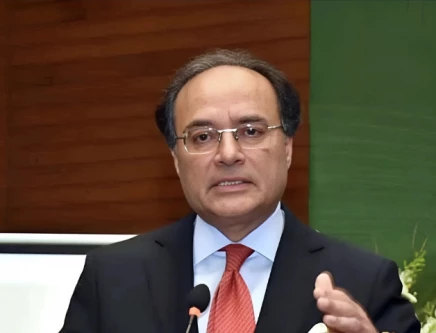
Finance Minister Muhammad Aurangzeb meets the leadership of the Arif Habib Group in Karachi.
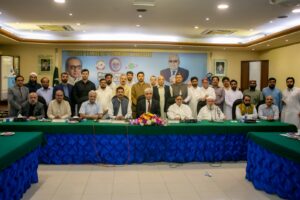
KARACHI, July 6, 2026: Finance Minister Senator Muhammad Aurangzeb visited the Arif Habib Group’s head office, where he met business leaders to discuss Pakistan’s economic outlook, capital markets, investment climate and the government’s ongoing reform agenda.
The meeting brought together the leadership of the Arif Habib Group and leading entrepreneurs, who acknowledged the government’s efforts to stabilise the economy during a challenging period. Participants noted progress in reducing inflation to single-digit levels, lowering policy rates, improving fiscal and external sector indicators, strengthening foreign exchange reserves and restoring investor confidence.
The discussion also recognised Pakistan’s progress under the International Monetary Fund (IMF) programme and the improvement in the country’s sovereign ratings outlook as key milestones in rebuilding economic confidence and supporting long-term growth.
Participants highlighted the strong performance of Pakistan’s capital markets since Senator Aurangzeb assumed office in March 2024. They noted that the benchmark KSE-100 Index had climbed from around 65,000 points to more than 180,000 points, while FY2026 delivered an annual return of about 43.5%. Market capitalisation also exceeded Rs20 trillion, and the revival of initial public offerings (IPOs) reflected growing corporate and investor confidence.
PIA Privatization: Arif Habib Says Airline Will Return to Profit in First Year
While welcoming the direction of the Federal Budget, participants called for additional measures to encourage private investment, create jobs and increase government revenues. They identified the Special Investment Facilitation Council’s (SIFC) priority sectors—including agriculture, mining, infrastructure and information technology—as key drivers of Pakistan’s next phase of economic growth.
The construction sector received particular attention during the meeting, with participants describing it as one of the fastest ways to stimulate economic activity. They said increased construction could generate employment, support allied industries, raise government revenues and strengthen economic growth without placing significant pressure on the current account.
The meeting also discussed the potential to unlock the government’s land assets through public-private partnership (PPP) models, allowing land to be contributed as equity for housing and infrastructure projects. Participants said this approach could accelerate development while attracting greater private sector investment.
The discussion further highlighted the role of Real Estate Investment Trusts (REITs) in mobilising domestic capital into productive sectors. As a pioneer in Pakistan’s REIT market, the Arif Habib Group reaffirmed its commitment to working with the government to expand investment opportunities, support infrastructure development, create employment and promote sustainable economic growth.
Speaking on the occasion, Arif Habib, Chairman of the Arif Habib Group, said the restoration of macroeconomic stability had created a strong foundation for future growth. He said the next priority should be converting that stability into higher investment, stronger employment and sustained economic expansion through collaboration between the government and the private sector.
Senator Muhammad Aurangzeb thanked the Arif Habib Group for its contribution to Pakistan’s economy and capital markets. He reaffirmed the government’s commitment to preserving macroeconomic stability, implementing structural reforms and improving the investment climate through continued engagement with the private sector.
The meeting concluded with both sides expressing their commitment to strengthening cooperation between policymakers and businesses to deepen Pakistan’s capital markets, encourage productive investment, expand employment opportunities and support long-term economic growth.