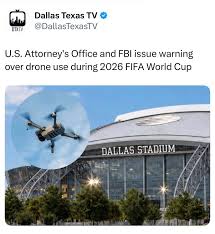
U.S. Attorney’s Office and FBI Issue Warning Over Use of Drones During 2026 FIFA World Cup
The information below is intended to raise awareness among the public at large, help to ensure the safety of fans, and also serve as a deterrence.
During the 2026 FIFA World Cup, the Federal Aviation Administration (FAA) has imposed a Temporary Flight Restriction over multiple locations in the Dallas-Fort Worth Metroplex. These temporary flight restrictions temporarily restrict all aircraft – airplanes, helicopters, and unmanned aircraft systems (UAS, more commonly known as “drones”) – from flying over a specific geographic area.
On each match day, a temporary flight restriction will be in effect over AT&T Stadium in Arlington, Texas. AT&T Stadium will be known as “Dallas Stadium” during the 2026 FIFA World Cup. The flight restriction will span a 3-nautical-mile radius from AT&T Stadium, up to 3,000 feet, and will take effect 3 hours before the start of each match and will conclude 3 hours after the end of each match.
During the FIFA Fan Festival, taking place from June 11, 2026, through July 19, 2026, a temporary flight restriction will be in place over Fair Park in Dallas, Texas, for each day of the Fan Festival. The flight restriction will span a 1-nautical-mile radius from the Dos Equis Pavilion in Fair Park, up to 1,000 feet, and will be in effect 1 hour before the start of the festival each day and 1 hour after the festival concludes each day.
While these temporary flight restrictions are in place, the flying of any drone or other aircraft or UAS will be forbidden unless prior approval is obtained from the FAA. Violators will be subject to federal prosecution, imprisonment, fines, and/or forfeiture of their drone or UAS.
To avoid committing criminal federal violations, all drone pilots are reminded and warned of their responsibility to:
1. Register and label your drone and obtain a Part 107 pilot’s license from the FAA before operating your drone in any flight-restricted airspace;
2. Register and label your drone and obtain a Part 107 pilot’s license before operating your drone in any capacity other than as a FAA-designated recreational pilot (including when flying for commercial purposes or for footage that may be monetized);
3. Obtain a TRUST certificate from the FAA to be carried with you at all times that you are piloting your drone for recreational purposes only; and
4. Familiarize yourself with airspace classifications and restrictions (including temporary flight restrictions and Notices to Airmen or “NOTAMs”) before piloting your drone for any purpose to avoid flying in any flight-restricted airspace, or, if necessary, to seek permission and approval before flying in any flight-restricted airspace.