Pakistan Urges Sustained Iran-US Ceasefire as Regional Tensions Continue
ISLAMABAD: Deputy Prime Minister and Foreign Minister Ishaq Dar on Monday underscored the importance of maintaining the ceasefire between the United States and Iran, warning that any collapse of existing understandings could further destabilize the region.
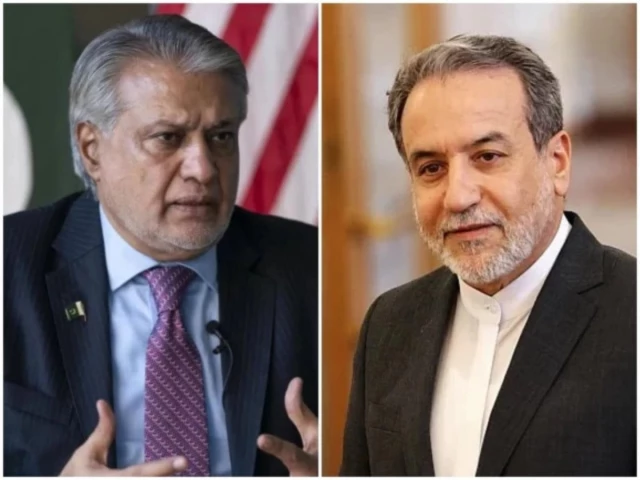
ISLAMABAD: Deputy Prime Minister and Foreign Minister Ishaq Dar on Monday underscored the importance of maintaining the ceasefire between the United States and Iran, warning that any collapse of existing understandings could further destabilize the region.
Trump Says Iran Talks Continue at ‘Rapid Pace’ Despite Reports of Negotiation Pause
During a telephone conversation with Iranian Foreign Minister Abbas Araghchi, Dar discussed the evolving regional situation and stressed the need to preserve diplomatic progress achieved through recent ceasefire efforts.
According to Pakistan’s Ministry of Foreign Affairs (MOFA), both leaders reviewed current developments and agreed to remain in close contact.
“Foreign Minister Dar conveyed Pakistan’s serious concern and emphasized the importance of ensuring that the ceasefire is sustained in order to prevent any breakdown of existing understandings,” the ministry said in a statement.
The conversation took place amid renewed uncertainty surrounding negotiations between Washington and Tehran. Earlier in the day, Iranian state media reported that Iran’s negotiating team had suspended indirect exchanges with the United States through mediators following attacks in Lebanon, where the ongoing conflict involving Israel and Hezbollah has intensified regional tensions.
However, US President Donald Trump later stated that discussions with Iran were continuing at a rapid pace and claimed that Israel had agreed not to deploy troops to Beirut.
Iran Seeks Pakistan’s Continued Diplomatic Support
According to MOFA, Araghchi expressed serious concern over recent developments, including alleged Israeli ceasefire violations in Lebanon and reports of possible military action targeting parts of Beirut.
The Iranian foreign minister praised Pakistan’s role in regional diplomacy and requested Islamabad to continue its efforts to facilitate de-escalation and support the maintenance of the ceasefire.
“Foreign Minister Araghchi appreciated Pakistan’s constructive role in regional diplomacy and requested Pakistan to continue using its good offices to help facilitate de-escalation in the current situation and support efforts to maintain the ceasefire,” the statement said.
Iran’s Mehr News Agency also reported that Araghchi held a separate telephone conversation with Pakistan’s Chief of Defence Forces and Chief of the Army Staff, Field Marshal Asim Munir.
Dar Holds Talks with Egyptian Foreign Minister
In a separate development, Foreign Minister Dar spoke with Egyptian Foreign Minister Badr Abdelatty to discuss the latest regional developments.
According to MOFA, both leaders emphasized the importance of sustained diplomatic engagement to promote peace, stability, and dialogue during a critical period for the region.
The two ministers agreed to remain in close contact and continue consultations on matters of mutual concern.
Pakistan’s Role in Regional Diplomacy
Pakistan has emerged as a key diplomatic facilitator between Washington and Tehran, positioning itself as a neutral intermediary amid heightened tensions between the two countries.
The conflict escalated in February 2026 following US and Israeli strikes on Iranian military infrastructure. Iran responded with retaliatory actions across the region and temporarily closed the Strait of Hormuz, triggering significant disruptions in global energy markets.
As tensions intensified, Pakistan played a central role in diplomatic efforts aimed at preventing further escalation. On April 8, Islamabad successfully brokered a conditional two-week ceasefire between the United States and Iran.
US President Donald Trump publicly acknowledged Pakistan’s role in securing the truce, crediting Prime Minister Shehbaz Sharif and Field Marshal Asim Munir for helping facilitate the agreement. Iranian Foreign Minister Abbas Araghchi also praised Pakistan’s diplomatic efforts and support for regional stability.
Building on the ceasefire, Pakistan hosted formal talks between US and Iranian delegations at Islamabad’s Serena Hotel on April 11 and 12.
The US delegation was led by Vice President JD Vance and included senior officials Steve Witkoff and Jared Kushner, while Iran’s delegation was headed by Parliament Speaker Mohammad Bagher Ghalibaf.
The negotiations lasted approximately 21 hours and reportedly achieved progress on several issues. However, significant differences remained over the future of the Strait of Hormuz and Iran’s nuclear programme. As a result, the talks concluded without a formal agreement or signed memorandum.
Diplomatic efforts are expected to continue as regional stakeholders seek to preserve the ceasefire and prevent further escalation across the Middle East.