

Astronomers Discover Oldest-Known Quasar, Dating Back 630 Million Years After Big Bang
Named Dún Aonghasa, the ancient cosmic object contains a black hole 360 million times the Sun’s mass, challenging theories of early black hole growth
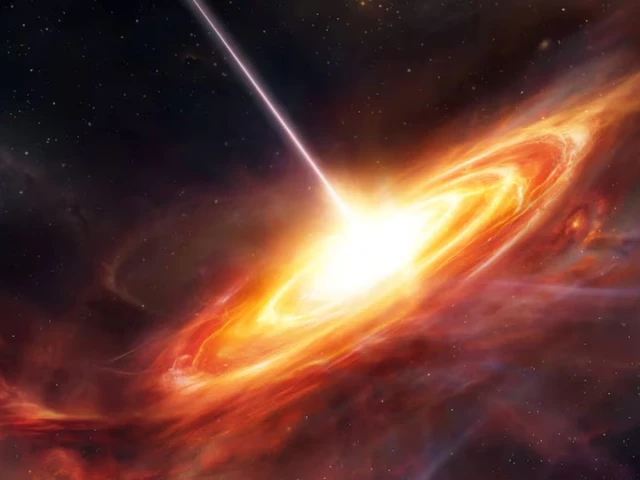
An artist's impression of Dún Aonghasa, the oldest-known quasar powered by an enormous black hole.
Astronomers have discovered the oldest-known quasar, dating back more than 13.1 billion years. The discovery offers a rare glimpse into the early universe and raises new questions about how supermassive black holes grew so quickly.
The quasar formed about 630 million years after the Big Bang. At that time, the universe was less than 5% of its current age.
The discovery sets a new record. It dates about 40 million years earlier than the previous oldest-known quasar, reported in July.
Astronomers named the object Dún Aonghasa, after an ancient stone fort in Ireland. The fort stands on a cliff overlooking the Atlantic Ocean.
A giant black hole powering the quasar
A quasar is the extremely bright centre of a galaxy. It draws its energy from a supermassive black hole at its core.
The newly discovered black hole has a mass about 360 million times that of the Sun.
Julien Wolf of the European Southern Observatory in Germany led the research. He said the finding shows how rapidly some objects developed in the early universe.
Black holes have extremely strong gravitational fields. Their gravity is so powerful that even light cannot escape.
Bellingham Inspires Real Madrid Comeback in 5-1 Champions League Rout of PSV
The European Space Agency’s Euclid space telescope first detected the quasar. Researchers then studied it using several ground-based and space-based telescopes.
Silvia Belladitta, a co-author of the study, explained how quasars produce their extraordinary brightness.
Gas, dust and other matter fall towards the central black hole. This material forms a swirling structure known as an accretion disk.
Friction and intense gravitational forces heat the disk to extreme temperatures. It then releases enormous amounts of energy. As a result, the quasar can outshine its entire host galaxy by hundreds or thousands of times.
This brightness allows astronomers to observe quasars across billions of light-years. Their study also helps scientists understand how the first galaxies formed and evolved.
The newly identified black hole is about 90 times more massive than the supermassive black hole at the centre of the Milky Way.
A discovery from a transformative era
The quasar dates to a major period in the universe’s development.
After the Big Bang, the cosmos cooled into a dark, neutral fog of hydrogen gas. The first stars and galaxies eventually began to form and shine.
Their radiation gradually cleared the hydrogen fog. This process made the universe transparent to light for the first time.
Scientists call this period the epoch of reionisation. The process was still underway when Dún Aonghasa and its host galaxy were forming.
Belladitta said the discovery challenges current understanding of black hole growth. The object had already reached an enormous mass within a relatively short period after the Big Bang.
How did the black hole grow so quickly?
Researchers are considering two possible explanations for the black hole’s rapid growth.
One theory suggests it began as a smaller black hole. It may have formed after the death of a star from the universe’s first generation.
However, observations suggest that its current feeding rate may be too slow to explain how it reached such a large mass so quickly.
Another possibility is a process known as direct collapse.
Under normal conditions, large gas clouds cool and break into smaller clumps. These clumps eventually form stars.
But certain conditions can prevent the gas from fragmenting. Instead, much of the material flows towards the centre and builds an enormous star. That star can then collapse into a massive black hole.
Wolf said this process could create a black hole far heavier than one formed from the remains of a typical first-generation star.
More ancient quasars may await discovery
Astronomers believe the Euclid telescope could identify even older quasars in the future.
Theoretical models suggest that the first quasars may have appeared between 270 million and 470 million years after the Big Bang.
Belladitta said Dún Aonghasa is currently the most distant quasar observed. However, she added that even more distant examples may still be waiting to be discovered.
The findings could help scientists refine their understanding of the first galaxies and the origins of supermassive black holes.