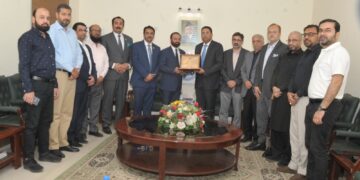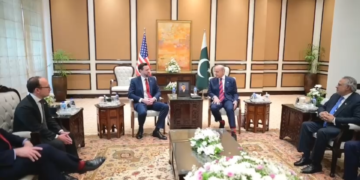


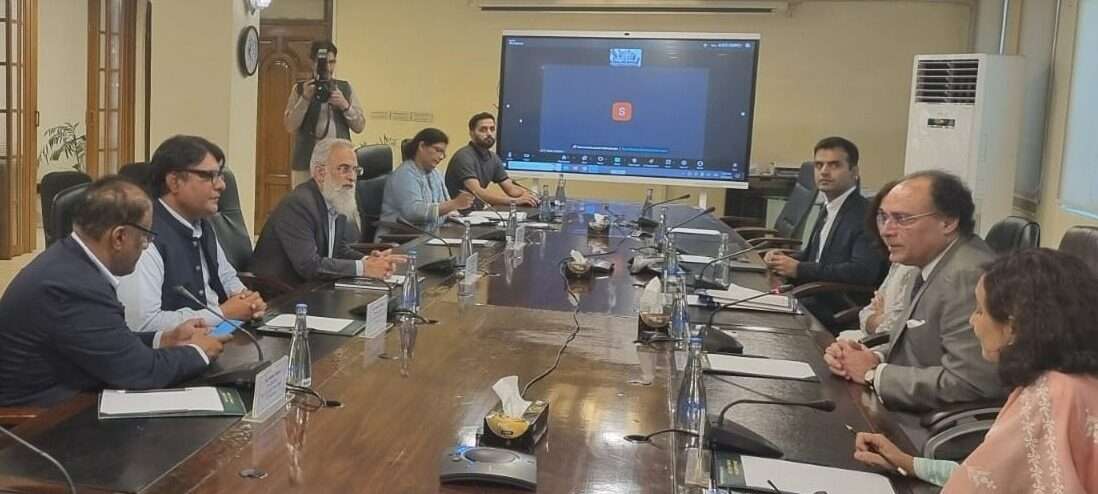
A delegation of the Rice Exporters Association of Pakistan led by Acting Chairman Haseeb Ali Khan is meeting with Federal Finance Minister Senator Muhammad Aurangzeb.
By MASOOD AHMED SIDDIQUI
Karachi: A delegation of the Rice Exporters Association of Pakistan (REAP) led by Acting Chairman Haseeb Ali Khan met with Federal Finance Minister Senator Muhammad Aurangzeb to present the demands of rice exporters. On this occasion, Member Customs Policy FBR and Member IR Policy, former REAP Chairmen Chaudhry Samiullah Naeem, Faisal Ghareeb, Shahid Tawalha, Adnan Sheikh, Rana Faisal Shabbir, and other members were also present.
Haseeb Ali Khan informed the Finance Minister that rice exporters have exported 5.9 million tons of rice worth USD 3.88 billion during the current financial year. This is a significant increase of 78% in value and 65% in volume compared to last year. He emphasized that members of the Rice Exporters Association of Pakistan are also involved in the export of sesame seeds and maize, which have collectively surpassed USD 800 million in the current financial year. Maize exports have increased by 200%, while sesame seed exports have increased by 150% compared to last year.
He stressed that all these export sectors are developing under the private sector without any government subsidy and support (no subsidy on electricity/fuel). Rice, maize, and sesame seeds have emerged as cash crops with significant profits for farmers, and exporters have participated in backward farm integration, resulting in a significant increase in exports.
He expressed serious concerns about changing the current final tax regime for the rice export sector to a hybrid tax regime (1% minimum tax and 1% advance tax). This would be extremely detrimental to our exports and would discourage exporters as rice, maize, and sesame seeds already have very low profits, barely 2-3%. This can be verified from the balance sheets of international commodity traders as well as local traders. The previous 1% tax on income was equivalent to 30% tax. With the current tax system and super tax regime, the tax on commodity income has reached a ceiling of 60%. He said that FBR audits could open the way for corruption/harassment/kickbacks, and we cannot leave our members and exporters at the mercy of the FBR. Such a policy will create an unequal playing field among exporters and will significantly increase the cost of trade.
He said that rice/maize/sesame seed exporters are very worried and are only fulfilling previously promised orders and are not ready to take future orders due to fears of tax audits and recovery notices exceeding profits. This discouragement will indirectly affect the farmers who were preparing for a bumper rice crop (11 million tons plus) and a sesame seed crop (350,000 tons). Additional mark-ups, high electricity costs, and 2% additional tax with FBR audits will make exports uncertain, and exports may fall to USD 2.5 billion in the coming financial year. With an average sectoral profit of 3%, the rice sector has paid an additional PKR 12.5 billion in taxes. To save the liquidity of exporters, their refund claims should be paid as soon as possible. FBR has rarely issued income tax refunds/withholding tax refunds to rice exporters in the past. Such high taxes will make us non-competitive in the international market where we are already facing stiff competition. They demanded that the sales tax refund claims of rice exporters be paid on a priority basis as the rice industry is already struggling due to the additional financial burden. They expressed the desire that for commodity trade, the (1%) FTR is the best system, and the imposition of additional taxes will reduce exports, causing a loss of valuable foreign exchange and revenue to the country.