Japan Prepares Mars Moons Mission to Collect Samples and Explore Origins of Life
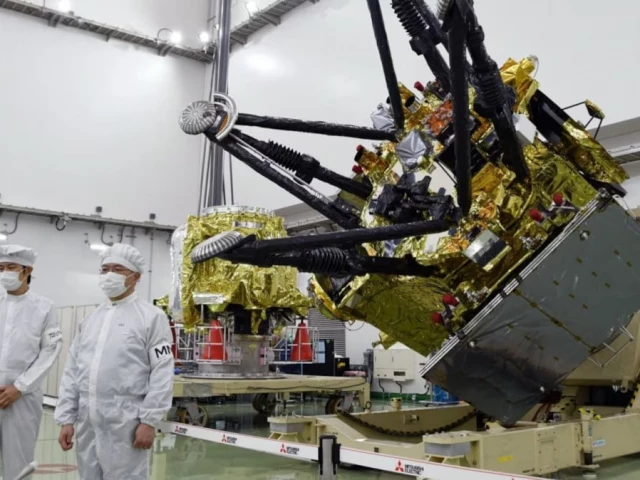
Japan’s MMX mission aims to collect samples from Phobos and investigate the origins of Mars’s moons.
Japanese scientists are preparing a major space mission to explore Mars’s two moons and bring samples back to Earth. The Martian Moons eXploration (MMX) mission aims to investigate the origins of Phobos and Deimos while examining materials that could help explain how the Solar System formed and how life-supporting conditions developed on rocky planets.
The unmanned spacecraft is being developed by the Japan Aerospace Exploration Agency (JAXA), in collaboration with international space agencies, universities and technology companies.
According to JAXA’s launch plan cited in the report, an H3 rocket carrying MMX is scheduled to lift off from the Tanegashima Space Centre at 4:41 am Japan time on Tuesday.
MMX Mission Targets Phobos
The spacecraft is expected to reach the Martian region around August next year, according to the supplied report. It will study Phobos, one of Mars’s two moons, before attempting a landing and collecting at least 10 grams of surface material.
Microsoft Withdraws From Nscale Data Centre Deal in the UK
The mission is designed to operate in the Martian system for approximately three years. During this period, it will also observe Deimos, the second moon of Mars, although it will not land there.
Before the main spacecraft attempts to collect samples, a small rover named IDEFIX will examine the surface and help identify suitable conditions for landing. The rover’s name comes from the French name for the dog belonging to comic-book character Asterix.
Project manager Yasuhiro Kawakatsu described the planned sample collection as a major milestone in space exploration. He said the mission would represent the first round trip to the Martian system.
Scientists Seek Clues to the Origins of Mars’s Moons
One of MMX’s main objectives is to determine how Phobos and Deimos formed. Scientists are considering two leading explanations.
The giant impact hypothesis suggests that a celestial body struck Mars, sending material into orbit that eventually formed the moons. The alternative capture hypothesis proposes that the moons are asteroids captured by Mars’s gravitational pull.
Samples from Phobos could help scientists determine which explanation is more likely. The findings may also improve understanding of how water, volatile substances and organic compounds reached the inner Solar System.
French astrophysicist Patrick Michel, who is involved in the IDEFIX project, said these processes may have contributed to the development of habitable environments on rocky planets.
If the moons preserve material from the early Solar System, researchers could gain valuable insights into the ingredients that helped make life possible on Earth.
Mission Could Support Future Human Exploration
Beyond scientific research, MMX aims to improve understanding of the challenges involved in travelling to and returning from the Martian region.
JAXA has said the mission will investigate whether Phobos could serve as a natural staging point for future Mars exploration. Its findings could help researchers identify the technical requirements for eventual crewed missions.
However, operating around Mars presents considerable engineering challenges. Phobos has extremely weak gravity, which makes landing, collecting material and departing the moon difficult.
The spacecraft must also travel close to Mars and escape the planet’s strong gravitational field on its return journey.
Kawakatsu described this challenge as entering deep into a gravitational “well” and then finding a way out.
Japan Builds on Previous Space Achievements
Japan has substantial experience in robotic space exploration and sample-return missions.
In 2020, JAXA’s Hayabusa2 spacecraft returned approximately 5.4 grams of material from the asteroid Ryugu. The mission demonstrated Japan’s ability to collect and deliver extraterrestrial samples to Earth.
Japan also achieved a lunar landing with its Smart Lander for Investigating Moon (SLIM) in 2024. Although the lander tipped over after touchdown, it continued transmitting scientific data and survived several lunar nights.
The MMX mission will build on these experiences while tackling the more demanding task of travelling to the Martian system and returning samples.
China Also Plans a Mars Sample-Return Mission
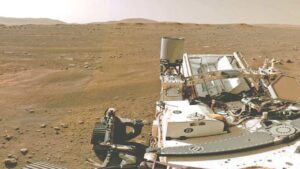
The international race to bring Martian material back to Earth continues. NASA’s Perseverance rover has collected samples on Mars, but returning them to Earth has faced major funding and planning challenges.
China, meanwhile, has announced plans for its Tianwen-3 mission, targeting a launch around 2028 and a possible sample return as early as 2031.
Samples collected directly from Mars could provide evidence about the planet’s geological history and potential habitability. However, material from Phobos could offer a different scientific perspective because it may contain a mixture of moon material and debris originating from Mars.
By examining these samples, scientists hope to improve their understanding of the evolution of Mars, the early Solar System and the conditions that may have helped life emerge on Earth.