India Protests: Police Clash With Student-Led Demonstrators as Parliament March Sparks Tensions
Thousands gathered in New Delhi demanding action over examination paper leaks and education reforms as police blocked a march towards Parliament.
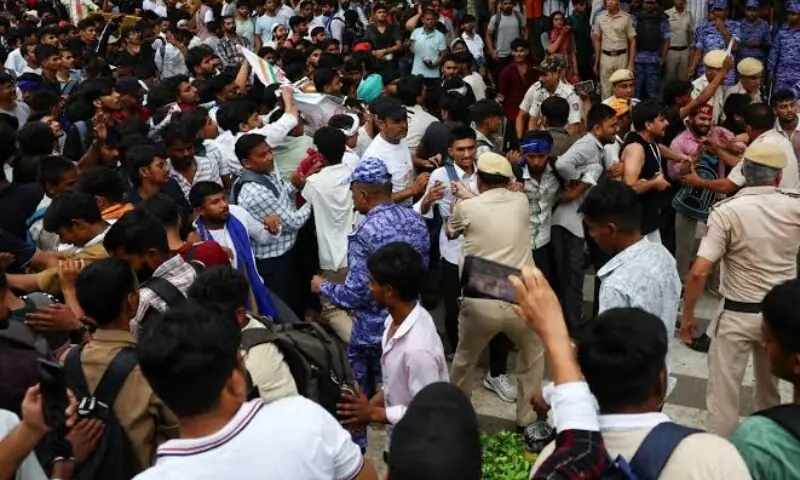
Students gather near Parliament during a protest over examination paper leaks in New Delhi.
India Protests intensified on Monday after police confronted thousands of demonstrators attempting to march towards Parliament in New Delhi, despite authorities refusing permission for the protest.
The student-led Cockroach Janta Party (CJP) movement has emerged as one of the biggest public challenges to Prime Minister Narendra Modi’s government during his third term, attracting millions of supporters online before expanding into a nationwide campaign.
Tensions escalated after police moved hunger-striking activist Sonam Wangchuk to a hospital on Saturday. The decision prompted thousands of supporters to gather overnight at Jantar Mantar, the capital’s main protest site, ahead of Parliament’s monsoon session.
Delhi Police said discussions were held with CJP representatives but no agreement had been reached before the planned march. Officials estimated that around 10,000 protesters had assembled by Monday morning.
Digital Skills: China to Train 300,000 Pakistani Youths Annually, Says Ahsan Iqbal
Authorities deployed large numbers of police and paramilitary personnel around the protest area, creating a heavy security presence near Parliament.
Television footage showed police using batons against some protesters in barricaded areas, although Delhi Police denied using excessive force and said officers handled the demonstration professionally.
Despite the confrontation, many protesters marched peacefully through rainy conditions while chanting slogans demanding the resignation of Education Minister Dharmendra Pradhan and Prime Minister Narendra Modi.
CJP spokesperson Saurav Das said movement leaders remained open to negotiations with the government despite the ongoing tensions.
The movement began after the alleged leak of question papers for India’s national medical entrance examination in May, affecting more than two million students and forcing authorities to conduct the examination again.
Many demonstrators said repeated examination paper leaks had damaged confidence in the country’s education system.
Student Adi Nathan, who travelled from Meerut, said he joined the protest to demand an end to examination fraud and paper leaks.
Another protester, Mohammed Tabrez, who travelled from Uttar Pradesh, said young people wanted authorities to eliminate corruption in competitive examinations and restore fairness to the education system.
Meanwhile, Sonam Wangchuk outlined conditions for ending his hunger strike in a handwritten message shared on X from the hospital.
He said he would end the fast if the government accepted responsibility for failures in the education system and examination paper leaks, or if protesters were allowed to present their concerns before Parliament with assurances that lawmakers would address the issue.
Wangchuk added that he would also end his hunger strike if leaders from different political parties met him in hospital and committed to pursuing education reforms.
Founded by activist Abhijeet Dipke, the Cockroach Janta Party initially gained momentum on social media, attracting around 22 million Instagram followers within days before receiving support from several opposition parties.
Analysts say the movement reflects growing frustration among India’s youth over unemployment, repeated examination paper leaks and concerns about transparency in recruitment and education.
According to government data, India’s unemployment rate stood at 3.1% for people aged 15 and above in 2025. However, unemployment among those aged 15 to 29 reached 9.9%, rising to 13.6% in urban areas compared with 8.3% in rural regions.