DG ISPR Links Terror Wave in KP to ‘Political–Criminal Nexus’ and Indian Backing
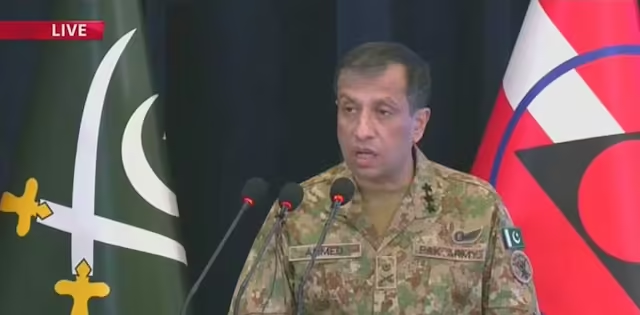
PESHAWAR: Director General Inter-Services Public Relations (DG ISPR) Lt General Ahmed Sharif Chaudhry has blamed a “political–criminal nexus” and Indian involvement for the recent surge in terrorism in Khyber Pakhtunkhwa (KP). He revealed that around 30 suicide bombers involved in attacks over the past two years were Afghan nationals, suggesting India is exploiting Afghanistan to fuel terrorism against Pakistan.
Speaking at a press conference at Corps Headquarters Peshawar, the DG ISPR said that certain political elements are spreading false narratives to undermine counterterrorism efforts, which not only mislead the public but also dishonor the sacrifices of Pakistan’s armed forces.
Lt Gen Ahmed Sharif Chaudhry emphasized that this “political–criminal alliance” continues to destabilize KP, while similar efforts have failed to gain ground in Sindh and Punjab. He warned that the state, armed forces, and law enforcement agencies will adopt a zero-tolerance policy toward anyone aiding militant groups, regardless of status or influence.
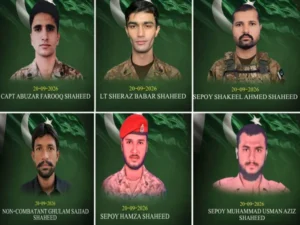
Providing operational details, the military spokesperson said that in 2024, security forces conducted 435 intelligence-based operations (IBOs) in KP, while in 2025 so far, 10,115 operations have been carried out, resulting in the elimination of 917 terrorists. He added that 577 personnel were martyred in 2024, while 516 lives have been lost this year.
The DG ISPR attributed the persistence of terrorism to incomplete implementation of the National Action Plan (NAP), political polarization, and external interference — especially India’s alleged role in using Afghan soil against Pakistan. He also cited Afghanistan’s harboring of militants and the spread of advanced U.S.-supplied weapons left behind after the American withdrawal.
Lt Gen Ahmed Sharif lamented governance failures and weak policy enforcement that, he said, have allowed terrorists to regroup. He reminded that the 2014 and 2021 national security decisions called for repatriation of Afghan refugees and registration of seminaries under NAP, but both remain largely unimplemented.
Highlighting the current security situation, he said that 70% of recent counterterrorism operations have been carried out in KP, showing the province remains the main target of militants. Concluding his remarks, the DG ISPR stressed the need for unity, decisive political will, and collective responsibility to eradicate terrorism, echoing the Army Chief’s statement that “our institutions are compensating for governance failures with their blood.”
In a recent interview with Bloomberg, Lt Gen Ahmed Sharif reiterated that Pakistan’s defense strategy focuses on effective and indigenous technological development. He clarified that Pakistan is not engaged in an arms race with India, noting that its defense budget is only a fraction of India’s.