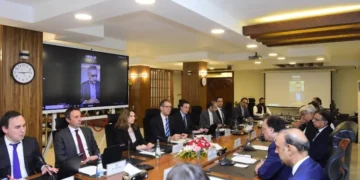


Karachi, February 11, 2025: National Accountability Bureau (NAB) Chairman, Lieutenant General (Retired) Nazir Ahmed Butt, has revealed significant fraudulent activities concerning land in Sindh. He disclosed that in Karachi alone, documents for 7,500 acres of land have been falsified, leading to corruption amounting to Rs. 3,000 billion. He stated, “If we open these files, it will cause a great upheaval.” He expressed regret that for the past 40 years, the Lyari Development Authority (LDA), Karachi Development Authority (KDA), and Malir Development Authority (MDA) have failed to hand over possession to their allottees. He assured that if ABAD (Association of Builders and Developers) provides solid evidence, action will be taken against those responsible. He emphasized his awareness of the builders’ and developers’ issues and affirmed NAB’s support, urging ABAD to consider NAB as their ally.
The Chairman of ABAD highlighted that in the past five years, 85,000 buildings have been constructed illegally in Karachi. He criticized the Sindh government for selling land to favored individuals instead of conducting transparent auctions and called for the introduction of a land grant policy.
These statements were made during a visit by the NAB Chairman and his team to ABAD House. The event was attended by ABAD Chairman Muhammad Hassan Bakhshi, Senior Vice Chairman Syed Afzal Hamid, Vice Chairman Tariq Aziz, Southern Region Chairman Ahmed Owais Thanvi, NAB Sindh Director General Javed Akbar Riaz, and other officials. Chairman Nazir Ahmed Butt further stated that the issue of Karachi’s land is more significant than the Kashmir issue. He acknowledged the numerous problems faced by builders in Karachi and assured that NAB stands with them. He mentioned that reforms have been made in NAB’s laws and that the system has been updated to determine which cases should now be filed. He urged ABAD to provide evidence of the 85,000 illegal buildings in Karachi so that they can either be demolished or regularized based on ABAD’s recommendations.
He revealed that in the past eight months, NAB has recovered 1.8 million acres of agricultural land in Sindh, valued at Rs. 4,000 billion, and handed it over to the Revenue Department. He noted that previously, anyone could file a complaint against anyone, but after assuming office, reforms have reduced the volume of complaints from 4,500 to 150-200. Approximately 21,000 complaints filed before 2022 have been dismissed. He assured that if any NAB officer unlawfully harasses someone, strict action will be taken upon receiving a complaint. He acknowledged being aware of all the issues faced by builders. The NAB Chairman pointed out the lack of a proper record-keeping system for land in Sindh, with various land departments operating without interlinking. He announced that significant action will soon be taken regarding land records in Sindh. He instructed the NAB Director General to report on the oversight of Karachi’s master plan. He also mentioned the establishment of a regional NAB office in Gwadar to address ongoing land corruption there, with cases involving land worth approximately Rs. 3,000 billion. He noted that in the past three months, three factories have been set up in Gwadar’s industrial area and that NAB is initiating a one-window operation. A new policy is being formulated for Pakistan’s real estate sector, emphasizing that all transactions should be conducted through banks.
 Earlier, ABAD Chairman Muhammad Hassan Bakhshi presented numerous complaints against provincial and municipal institutions to the NAB Chairman. He highlighted the absence of a land auction policy in Sindh, with lands being sold to favored individuals. He suggested that introducing a land grant policy could generate Rs. 500 billion in revenue for the Sindh government. He criticized the rampant corruption in the Malir Development Authority, Lyari Development Authority, and Karachi Development Authority, noting that citizens’ investments are stuck in small residential schemes under these authorities. He emphasized ABAD’s efforts to collaborate with NAB to find solutions to these issues and highlighted that the beautiful buildings in Karachi are a result of ABAD’s endeavors. He stressed that builders and developers rely heavily on land. He called for action against the Director Generals of the time during which illegal constructions took place in Karachi.
ABAD’s Patron-in-Chief, Mohsin Sheikhani, proposed that land transactions be subject to verification by NAB. He advocated for the digitization of land records in Sindh to eliminate corruption, pointing out that the manipulation of land records has become widespread. He suggested that third-party services be employed for digitization, as corrupt institutions are digitizing their records themselves


ADVERTISEMENT