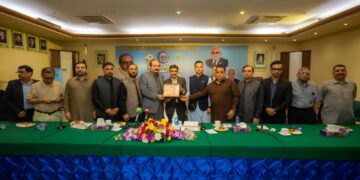


Sahiwal, May 8, 2025 – The Trade Development Authority of Pakistan (TDAP) hosted a pivotal seminar titled “Seizing Global Market Opportunities: Revitalizing Pakistan’s Sorghum Exports to China” at the Maize and Millet Research Institute, Sahiwal. The event united agricultural scientists, trade experts, farmers, and policymakers to strategize the revival of sorghum cultivation, positioning Pakistan to capture a share of China’s $2.6 billion sorghum import market, which demands over 9 million tons annually for livestock feed, baijiu production, and biofuels.
Moderated by Ms. Hina Tahir, Deputy Director (AFD), TDAP, the seminar addressed Pakistan’s opportunity to fill the void left by an 81.8% decline in U.S. sorghum exports to China in January 2025, driven by trade tensions. Mr. Athar Hussain Khokhar, Director General (AFD), TDAP, underscored sorghum’s potential as a $500 million export commodity within a decade. “Pakistan’s sorghum production has plummeted by 89% since 1994, from 438,200 hectares to 46,697 hectares in 2023, yielding just 38,645 tons. Revitalizing cultivation in Punjab’s marginal lands like Thal and Cholistan can transform this drought-resistant crop into an economic powerhouse,” he stated.
Dr. QamarShakil, Principal Scientist at Ayub Agricultural Research Institute, emphasized adopting high-yield hybrid seeds and mechanized farming to boost yields from 0.8 tons/ha to global standards of 3.26 tons/ha, aligning with China’s demand for high-starch, low-tannin varieties. Mr. Muhammad Saeed, Director of the Maize & Millet Research Institute, highlighted the need for robust seed supply systems to expand cultivation. Mr. Ghulam Qadir, Trade & Investment Counsellor from Beijing, noted China’s diversification from U.S. suppliers, with 80% of its 8 million-ton imports used for livestock feed and the $100 billion baijiu industry. Ch. Shahbaz Akhtar, Director of Agriculture Extension, Sahiwal, advocated for awareness campaigns and enhanced extension services to mobilize farmers.
The seminar identified challenges, including the lack of a sanitary and phytosanitary (SPS) protocol with China’s General Administration of Customs (GACC), weak post-harvest infrastructure, and limited export-grade varieties. Proposed solutions included technological partnerships with Chinese institutions like the Chinese Academy of Agricultural Sciences, modernizing supply chains with cold storage, and leveraging the China-Pakistan Economic Corridor (CPEC) for cost-effective exports. TDAP emphasized showcasing Pakistan’s 30–40% lower-priced sorghum at trade fairs like the China International Agricultural Trade Fair.
With sorghum’s adaptability to water-scarce regions and CPEC’s logistical edge, Pakistan is poised to diversify its export portfolio beyond textiles. TDAP, with Ms. Hina Tahir as the focal person, committed to supporting awareness campaigns and training through Punjab’s extension services. Strategic investments could mirror Pakistan’s sesame export success, potentially yielding $1 billion annually within five years, enhancing economic growth and rural development.