


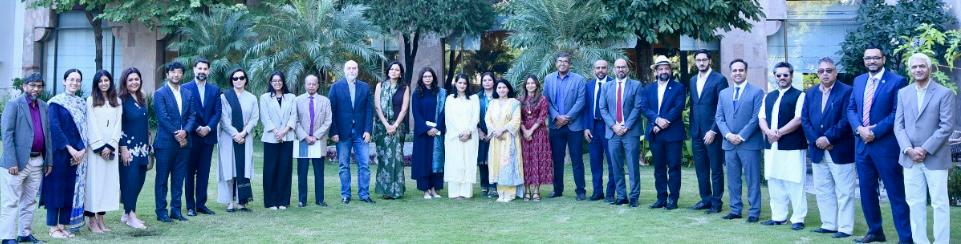
ISLAMABAD, November 6, 2025: Policymakers, innovators, and development experts from across South Asia convened in Islamabad today for a high-level regional dialogue titled “South Asia in the Global DPI Moment: Opportunities & Challenges.” Co-hosted by Globesight and Bangladesh’s Centre for Policy Dialogue (CPD), the roundtable brought together representatives from Pakistan, Nepal, Bangladesh, and Sri Lanka to exchange insights on building inclusive, secure, and interoperable Digital Public Infrastructure (DPI) systems.
Home to nearly two billion people, South Asia stands at the heart of a digital revolution, yet more than 1.1 billion South Asians remain offline. The dialogue spotlighted the urgent need for people-centered digital systems that drive financial inclusion, expand access to essential public services, and ensure that no one is left behind in the digital transformation.
Senior representatives from the State Bank of Pakistan, NADRA, Asian Development Bank, World Bank, Ministry of Digital Economy (Sri Lanka), Nepal Bank, and Bangladesh Bank shared country perspectives and emphasized the need for collaborative policymaking and partnerships across South Asia to realize the full potential of digital public infrastructure. Speakers highlighted the importance of developing digital ecosystems to drive financial inclusion, enhance service delivery, and support regional integration.
Opening the event, Mahrukh Shahid from Globesight, emphasized the importance of regional collaboration:
(Countries must collaborate and share to accelerate successful implementation and adoption of DPI initiatives for scalable, inclusive systems that strengthen digital connectivity and economic integration.”)
Representing the Centre for Policy Dialogue (CPD), Dr. Fahmida Khatun, Executive Director, added: “DPI provides an opportunity for higher employment, improved livelihoods, and innovation as it strengthens the quality of services, productivity, and improves governance.”
The roundtable focused on critical components of DPI, including digital identity, payments, data
exchange, and other foundational digital systems that form the backbone of digital economies.
Participants discussed technical implementation, governance, adaptability, and equity, and reflected on regional best practices, challenges, and opportunities for greater cooperation.
Participants reaffirmed their commitment to advancing inclusive, interoperable, and resilient DPI
systems across the region, anchored in shared learning, people-first design, and long-term Cooperation.
Anum Hamid from State Bank of Pakistan said “Raast has been crucial in ensuring interoperability. We have 46 million registered Raast IDs along with interoperable mobile wallets which has helped expand the network of digital payments. The Bank is now moving government payments and expanding Rasst from Person to Person to Person to Merchant payments under the leadership of the Prime Minister.”
UpulAbeysiriwardana, Advisor to the Ministry of Digital Economy from Sri Lanka said that Sri Lanka is taking the solutions to the grassroots level as it has understood that high-level interventions won’t solve problems. It is also engaging the private sector in implementation on a wider scale.
The regional dialogue forms part of an ongoing effort to foster cross-country learning and collaboration in South Asia’s rapidly evolving digital landscape. By convening thought leaders and practitioners from public and private sectors, the event served as a platform to explore practical pathways toward an equitable and sustainable digital public infrastructure.