

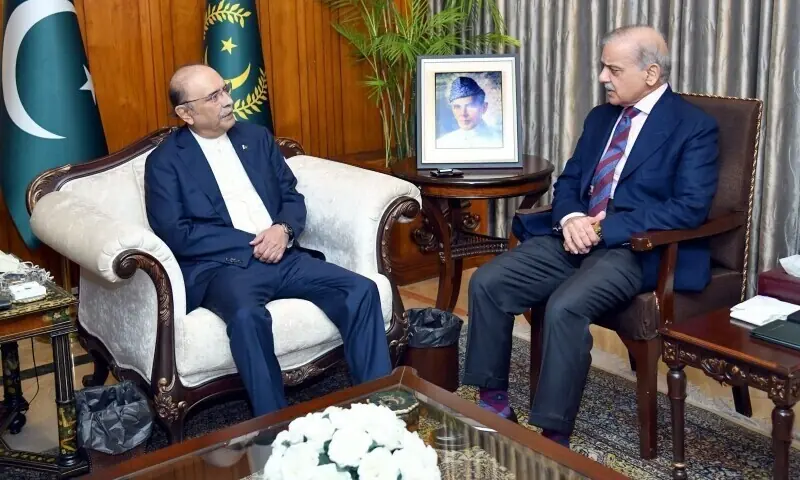
ISLAMABAD — President Asif Ali Zardari and Prime Minister Shehbaz Sharif held a high-level meeting on Monday to review Pakistan’s fuel supply situation amid a global energy crisis, assuring that sufficient stocks are available and plans are underway to secure future needs.
According to a statement from the President’s House, President Zardari directed that all possible measures be taken to ease the burden of rising fuel and energy prices on the common citizen, particularly for essential goods and services. Leaders from all provinces, as well as Gilgit-Baltistan and Azad Jammu & Kashmir, participated in the consultative session at Aiwan-e-Sadr.
The president emphasized coordinated decision-making across economic management, energy planning, food security, and security preparedness. Public awareness campaigns to reduce fuel consumption, promote public transport, and encourage shared mobility were also highlighted as part of a broader demand-management strategy.
The meeting noted that proposals to raise oil prices had repeatedly been rejected by the prime minister. Funds saved through government austerity measures—including cuts to development budgets and grounding 60% of official vehicles—are being redirected toward public relief.
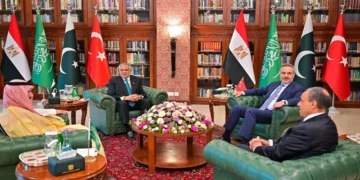
Foreign Minister Bashir Dar briefed participants on outcomes from the four-nation ministerial talks in Islamabad with Saudi Arabia, Turkiye, and Egypt, aimed at de-escalating the Iran–US–Israel conflict. Discussions also addressed the potential reopening of the Strait of Hormuz to shipping and Islamabad’s readiness to host high-level Iran-US talks “in the coming days.”
The meeting further reviewed Pakistan’s petroleum reserves, supply chains, and the implementation of austerity measures, while provincial proposals on “smart lockdowns” and subsidies for motorcycle and rickshaw drivers were also considered. The plan for nationwide smart lockdowns aims to target public activity and workplace operations, sustaining economic activity while reducing fuel and electricity demand amid surging international crude oil prices, which have recently crossed $100 per barrel.
Officials cautioned that Pakistan’s heavy dependence on imported fuel makes the economy particularly vulnerable to external shocks, with rising oil costs expected to strain foreign reserves and widen the current account deficit.