


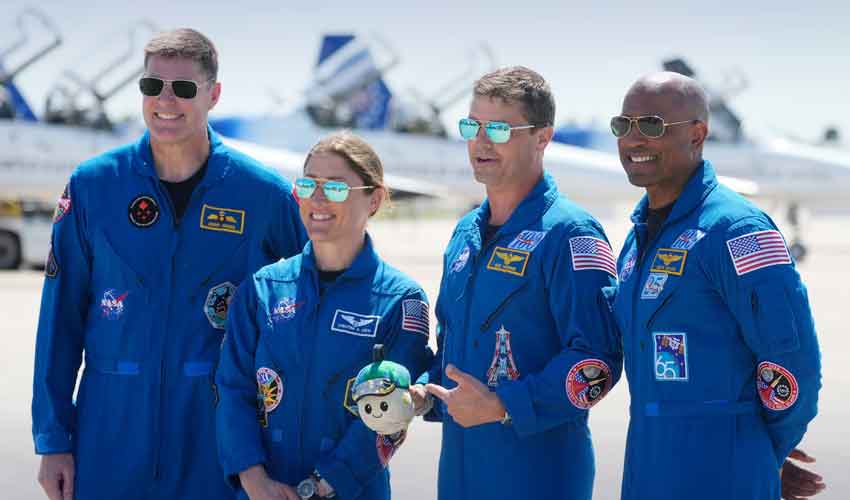
NASA is preparing to launch the first crewed mission to the moon in over five decades with its Artemis II mission, a critical step in the United States’ renewed effort to lead global lunar exploration amid rising competition from China.
OpenClaw AI Tool Gains Global Attention with Real-Life Task Automation
Three American astronauts — Christina Koch, Victor Glover, and Reid Wiseman — along with Canadian astronaut Jeremy Hansen, are set to lift off aboard NASA’s Orion capsule and Space Launch System rocket on Wednesday for a 10-day test mission around the moon. The flight will take the crew farther into space than humans have ever gone before.
Artemis II is the first crewed test in NASA’s Artemis program, which aims to re-establish regular human flights to the moon, with the first landing under the initiative expected in 2028 at the lunar south pole. Since 2012, the program has cost at least $93 billion.
NASA astronauts describe the moon as a “stepping stone” for further exploration of the solar system and Mars. “Answering the question of whether we are alone starts at the moon,” said Koch. “The question is not whether we should go, but whether we should lead or follow.”
The mission also marks the first time a Canadian astronaut will reach lunar vicinity. Hansen’s participation stems from a 2020 NASA-Canadian Space Agency agreement, recognizing Canada’s long-term contributions to space robotics.
NASA is relying heavily on commercial partnerships, including Boeing, Northrop Grumman, Lockheed Martin, SpaceX, and Blue Origin, to build spacecraft, landers, and mission systems. Analysts anticipate that commercial lunar activities could generate revenues of $127 billion by 2050, though government funding will continue to drive early lunar operations.
The Artemis II crew will test life-support systems, crew interfaces, navigation, and communications, building on the 2022 uncrewed Artemis I mission. Liftoff is scheduled for April 1, with backup windows extending to April 6.
Artemis III, planned for 2027, will feature Orion docking with NASA’s lunar landers — Blue Origin’s Blue Moon and SpaceX’s Starship — before astronauts descend to the moon’s surface. Artemis IV is expected to achieve NASA’s first crewed lunar landing under the revamped timeline, following program adjustments by new NASA administrator Jared Isaacman.
Through these missions, NASA aims to not only expand human presence on the moon but also set operational standards for future multinational and commercial lunar activities.