

KARACHI : In a significant move to enhance collaboration, the Karachi Chamber of Commerce & Industry (KCCI) and the Lahore Chamber of Commerce & Industry (LCCI) have agreed to strengthen their cooperation for Pakistan’s economic revival.
During a meeting at KCCI on Saturday, President KCCI Rehan Hanif and President LCCI Faheem ur Rehman Saigol said that Pakistan has great potential despite facing serious challenges, but warned that poor policies and neglect of the private sector could make the economic situation worse.
Vice Chairmen Businessmen Group Anjum Nisar and Jawed Bilwani, President KCCI Muhammad Rehan Hanif, Senior Vice President KCCI Muhammad Raza, Vice President KCCI Muhammad Arif Lakhani, Former Presidents KCCI Abdullah Zaki, Iftikhar Ahmed Sheikh, Junaid Esmail Makda, Shariq Vohra, Former President FPCCI Nasir Hayat Magoon, Former SVP FPCCI Suleman Chawla, Chairman Karachi Cotton Association Khuwaja Muhammad Zubair, KCCI Executive Committee Members and other notables attended the meeting.
President LCCI Faheem ur Rehman Saigol said that despite facing numerous challenges, Pakistan’s economy continues to survive only because of its immense potential, as the country is blessed with abundant natural and human resources not found elsewhere in the region. However, he lamented that the real problem lies in the mismanagement of these resources.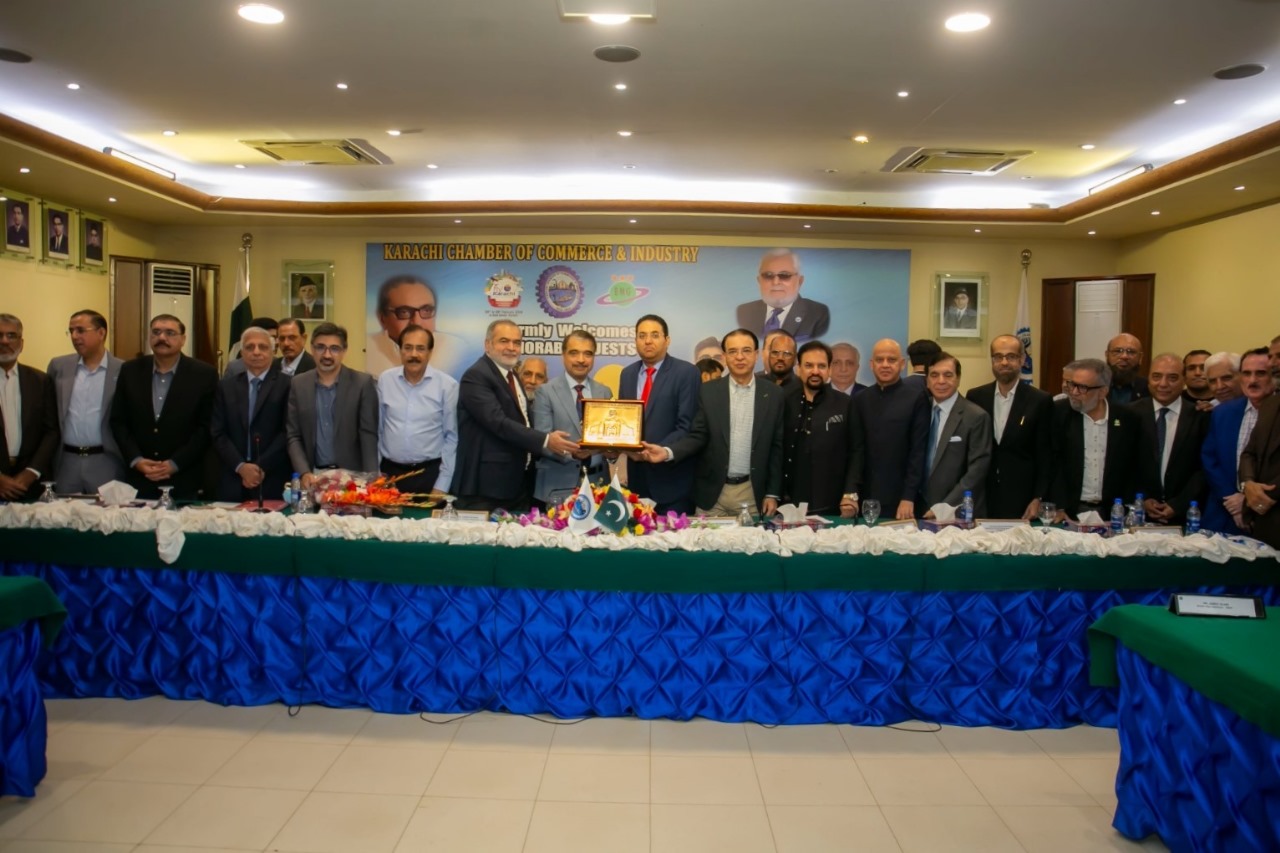
Vice Chairman Businessmen Group Jawed Bilwani and President Karachi Chamber of Commerce and Industry Rehan Hanif presenting crest to President Lahore Chamber of Commerce and Industr Faheem ur Rehman Saigol during his visit to KCCI on Saturday. Vice Chairmen BMG Anjum Nisar Senior Vice President KCCI Muhammad Raza, Vice President KCCI Muhammad Arif Lakhani, Former Presidents KCCI Abdullah Zaki, Iftikhar Ahmed Sheikh, Junaid Esmail Makda, Shariq Vohra, Former President FPCCI Nasir Hayat Magoon, Former SVP FPCCI Suleman Chawla, Chairman Karachi Cotton Association Khuwaja Muhammad Zubair, KCCI Executive Committee Members and others are also seen in the picture.
“Despite all odds, we, the business community, continue to sit together at Chambers of Commerce to deliberate on the challenges being faced by trade and industry because we firmly believe in the vast potential of our country,” he said. “With a population of 240 million, Pakistan has a huge consumer market. However, instead of promoting local industries and encouraging import substitution, our policies have raised the trade deficit”
He explained that the main purpose of his visit to KCCI was to ensure that the business communities of Karachi and Lahore are on the same page. “Our strength lies in securing a rightful share in policymaking. Legislation must be framed in consultation with the business community, which is the actual stakeholder and best understands how tax collection can be effectively achieved,” he said.
President LCCI invited KCCI’s Office Bearers to visit LCCI at the earliest opportunity, stating that such an exchange would help establish a historic and much-needed liaison between the two leading chambers of the country. “Only through a unified voice can we hope to get our issues effectively resolved,” he affirmed.
Vice Chairman BMG Anjum Nisar emphasized that a unified stance by the Karachi and Lahore Chambers would carry tremendous weight and compel the government to seriously address the legitimate concerns of the business community. He pointed out that these two major chambers collectively represent over 90 percent of Pakistan’s economic activity, and their combined voice cannot be ignored.
He urged the government to immediately resolve the critical issues affecting trade and industry, particularly the severe shortages and soaring costs of essential utilities such as water, gas, and electricity. “The government must focus on creating an enabling business environment that fosters entrepreneurship and industrial growth, similar to the model successfully adopted by countries like Vietnam,” he remarked. “Policies that discourage investment and trigger capital flight must be replaced with measures that inspire confidence, attract investment, and sustain economic activity.”
Speaking on the occasion, Vice Chairman BMG Jawed Bilwani underscored the importance of unity between the Karachi and Lahore Chambers in tackling the shared challenges confronting businesses across Pakistan. He emphasized that when KCCI and LCCI stand together and raise a collective voice, the federal government in Islamabad will have no choice but to take notice and respond to their legitimate demands. “If we remain sincere, principled, and truthful in advocating for our cause, we will undoubtedly earn the trust and support of the people”, he asserted while referring to last year’s strike call which was fully supported by LCCI and other Chambers as well as trade bodies and commercial markets associations.
Expressing concern over the worsening economic situation, Jawed Bilwani noted that despite official claims of recovery, the country’s economic crisis continues to deepen. “Circular debt is once again on the rise, and capacity payments are increasing, yet industrial demand for energy is declining, not only in Karachi but also in Lahore and other cities”, he observed. “This shrinking energy consumption clearly reflects reduced industrial activity, which raises a fundamental question that how can there be talk of economic revival when production itself is contracting?”
President KCCI Rehan Hanif, in his remarks, emphasized the need for forging a strong and united front among KCCI and LCCI to collectively address the challenges confronting trade and industry. “The time has come for KCCI and LCCI to stand shoulder to shoulder and speak with one powerful voice,” he stressed. “Only then can we ensure that policymakers truly listen to the concerns of the business community and implement solutions aligned with our collective vision for economic revival.”
Calling attention to long-standing bottlenecks, Rehan Hanif urged LCCI to work closely with KCCI on resolving the 20-year-old dispute over industrial land at Port Qasim. He also underscored the urgent need to revisit impractical measures such as e-invoicing and e-bilty systems, which are causing operational disruptions instead of facilitating ease of doing business.
Discussing the adverse impact of Section 7E of the Income Tax Ordinance 2001, he said the provision, introduced through the Finance Act 2022, imposes a one percent tax on the fair market value of immovable property as deemed income. “This policy is driving investment away and fueling capital flight,” he cautioned. “If it is doing more harm than good, the government must have the courage to withdraw it for the greater economic benefit of the country.”