

Pakistan’s Strategic Location Between Asia, Europe and Africa Is a Key Advantage; Blue Economy Is
Vital for Economic Growt, President Muhammad Ikram Rajput.
KATI Delegation to Work with KPT on Multiple Projects; Port Digitalization and Improved Cargo
Handling Facilities Needed, Zubair Chhaya, Zahid Hamid
Karachi: Federal Minister for Maritime Affairs Junaid Anwar Chaudhry has called upon local industrialists and investors to actively partner with the Karachi Port Trust (KPT) in launching development-oriented projects, particularly in the fisheries and blue economy sectors. Addressing members and industrialists at the Korangi Association of Trade and Industry (KATI), the minister said that KATI members could jointly form consortiums to establish modern fish processing plants, adding that Pakistan currently has confirmed export orders of 25,000 tons of tuna fish for this year.
On the occasion, KATI President Muhammad Ikram Rajput, Acting Patron-in-Chief Zubair Chhaya, Senior Vice President and Standing Committee Chairman Zahid Hamid, Vice President Talha Ali, KITE CEO Saleem-uz-Zaman, former chairmen and presidents Junaid Naqi, Sheikh Umer Rehan, Syed Farrukh Mazhar, and Rashid Siddiqui, along with Karachi Port Trust Chairman Rear Admiral (R) Shahid Ahmed,Kanwar Qutabuddin and other industrialists and members were also present.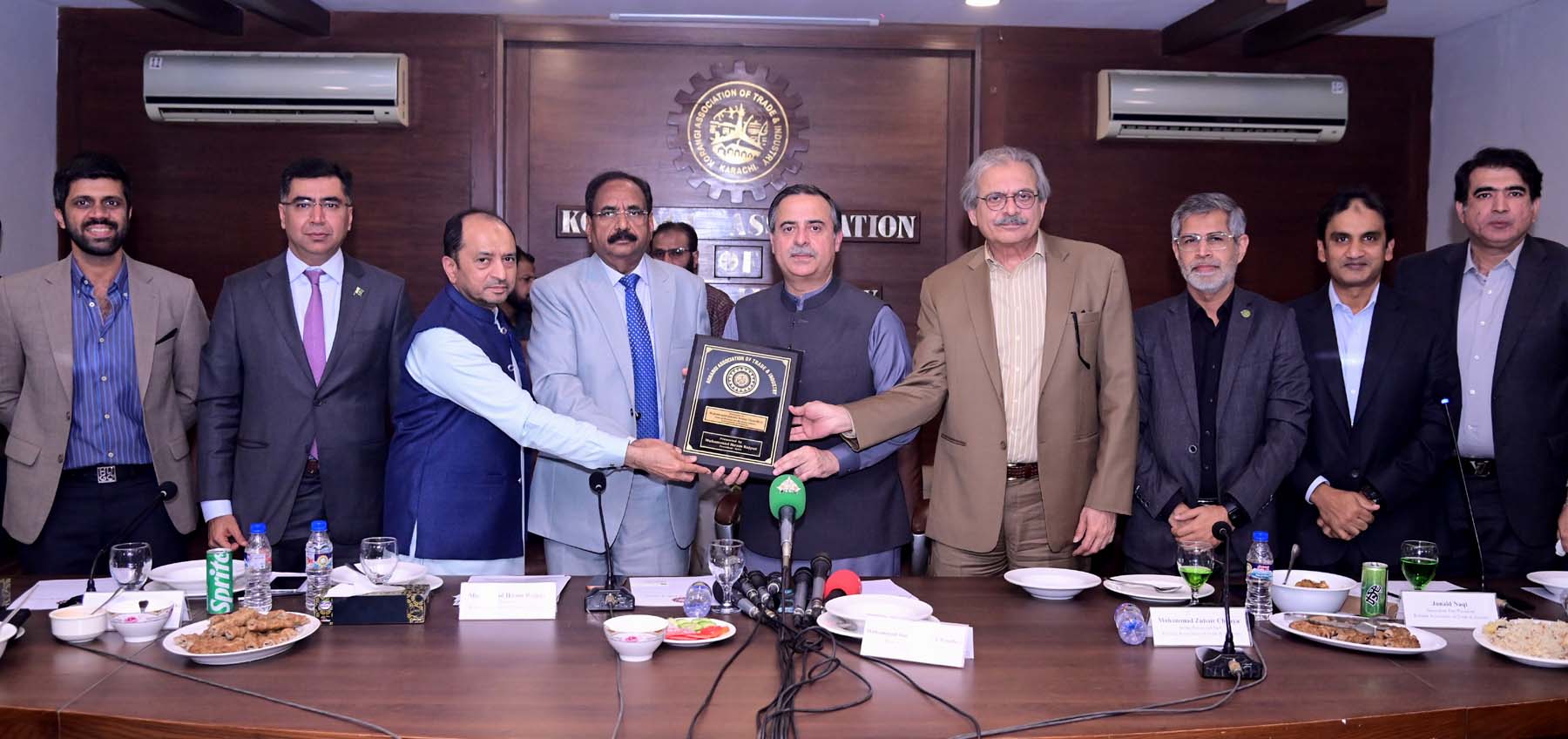
KATI President Muhammad Ikram Rajput and Acting Patron-in-Chief Zubair Chhaya
present a shield to Federal Minister for Maritime Affairs Junaid Anwar Chaudhry, while Zahid Hamid,
Talha Ali, Saleem-uz-Zaman, Junaid Naqi, Sheikh Umer Rehan, and Rear Admiral (R) Shahid Ahmed are
also present
The minister disclosed that 180 acres of KPT land have been successfully cleared of encroachments, creating significant opportunities for new development projects, industrial units, and processing plants.
He said the reclaimed land can now be utilized for value-added initiatives that support exports, employment generation, and economic growth.
Speaking at the event, Junaid Anwar Chaudhry said Prime Minister Shehbaz Sharif and Chief of Army Staff Field Marshal Asim Munir are committed to seeing Pakistan emerge as a prosperous and developed country. He stated that upon assuming charge of the Ministry of Maritime Affairs, indiscriminate action was taken against encroachments on KPT land, and the focus has now shifted toward development and investment-led growth.
The federal minister emphasized that while the ministry can initiate projects on a self-help basis, the government wants the business community to take the lead in capitalizing on these opportunities. “If the government earns ten rupees from a project, the business community can earn eighty rupees from the same initiative,” he remarked, underscoring the importance of private sector participation. He assured KATI members that the doors of the Ministry of Maritime Affairs remain open to the business community and that any viable proposals would receive full cooperation.
He further stated that if KATI or its members present better or alternative project proposals, the ministry would extend complete support. Highlighting the importance of the blue economy, Junaid Anwar Chaudhry said he would personally pursue initiatives proposed by the business community, rather than delegating them solely to the maritime secretary or the KPT chairman.
The minister also announced progress on long-pending ferry services, revealing that licenses have now been issued. He said countries such as Iran and Yemen have shown interest in launching ferry services from Pakistan, and for the first time, licenses are being issued within seven days, reflecting improved efficiency. He added that strengthening the blue economy is a top priority of the ministry, and effective steps are being taken to revive the fisheries sector.
Earlier, KATI President Muhammad Ikram Rajput highlighted Pakistan’s strategic geographical location
between Asia, Europe, and Africa, which positions the country as a critical hub for international trade
and maritime activity. He said Pakistan’s two major deep-sea ports, Karachi Port and Gwadar Port have
the capacity to handle the world’s largest vessels, a facility that many global ports lack.
He described the blue economy as a comprehensive model that supports economic growth, job
creation, food security, and environmental sustainability. “With wise planning and sustainable
strategies, the blue economy can ensure prosperity not only for the present generation but also for
future generations,” Rajput said.
The KATI president also pointed out the significance of Pakistan’s fisheries sector, which provides
employment and income opportunities. However, he noted that Pakistani seafood faces restrictions in
certain international markets due to compliance issues. He said that if the government and stakeholders
work together to remove these barriers, the fisheries sector alone could generate over one billion
dollars in trade.
Rajput further noted that Pakistan’s maritime zones contain oil and gas reserves that could help meet
the country’s energy needs. He urged the government to develop exploration projects to discover and
utilize these resources for economic benefit.
Acting Patron-in-Chief Zubair Chhaya stressed that the Ministry of Maritime Affairs should prioritize
close collaboration with the private sector to promote industry and trade. He called for effective and
practical measures to resolve issues faced by Korangi industrialists, particularly those related to logistics,
export costs, and port operations.
He emphasized that policy-making should be based on consultation, trust, and partnership, adding that
sustainable industrial growth in Pakistan is only possible when the government and private sector work
together under a shared vision. Zubair Chhaya announced that a KATI delegation would engage with KPT
to develop a joint roadmap for new projects and initiatives. He also urged collective efforts by the
government and stakeholders to remove obstacles hindering the promotion and export of Pakistani
seafood worldwide.
Senior Vice President and Standing Committee Chairman Zahid Hamid called for further improvements
in port digitalization and cargo handling facilities to ensure faster, easier, and more cost-effective access
to global markets for industrialists. He said that the blue economy offers a critical framework for utilizing
marine resources in a manner that supports economic development while ensuring environmental
protection.
Zahid Hamid noted that Pakistan is fortunate to have a coastline stretching over 1,000 kilometers, along
with valuable marine resources. He said that with proper planning, significant growth can be achieved in
fisheries, maritime trade, tourism, and energy sectors.
The event was also addressed by KPT Chairman Rear Admiral (R) Shahid Ahmed, along with Sheikh Umer
Rehan and Muslim Muhammadi, who shared insights on port operations and future maritime
development.