

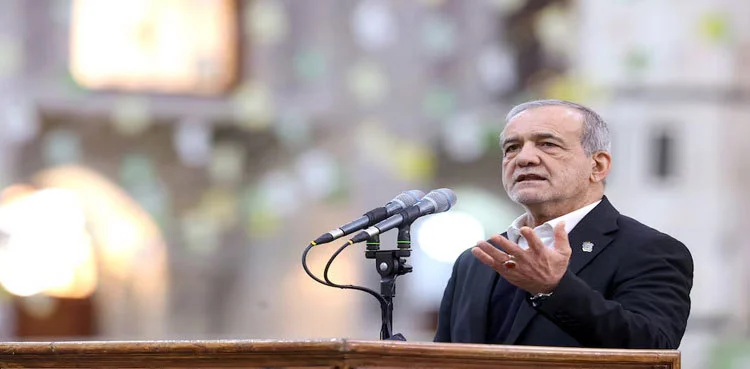
Masoud Pezeshkian has said that Iran harbors no hostility toward ordinary Americans, urging a distinction between governments and citizens amid heightened tensions with the United States.
Iran Launches Fresh Missile Strikes on Israel as Trump Says War Nearing End
In a letter addressed to the American public, reported by Press TV, Pezeshkian said portraying Iran as a threat was “neither consistent with historical reality nor with present-day observable facts.”
Addressing those seeking clarity “amid a flood of distortions and manufactured narratives,” the Iranian president described his country as a historically non-aggressive power. He stated that Iran, despite its regional influence, has never pursued expansionism or colonial ambitions in modern history, asserting that it has only acted to defend itself against external aggression.
Pezeshkian emphasized that the Iranian people hold no ill will toward citizens of other nations, including those in the United States, Europe, and neighboring countries. He described this principle as deeply rooted in Iran’s culture rather than a temporary political stance.
He also argued that the perception of Iran as a global threat is shaped by geopolitical interests, suggesting it is used to justify military presence, sustain arms industries, and exert control over strategic markets.
“In such an environment, if a threat does not exist, it is invented,” he said.
The president pointed to the extensive US military presence around Iran as a source of regional tension, describing Iran’s military posture as defensive. He added that recent US actions from regional bases demonstrated the risks associated with such deployments.
“What Iran has done—and continues to do—is a measured response grounded in legitimate self-defense, and by no means an initiation of war or aggression,” he stressed.
Pezeshkian also referenced historical grievances, including US involvement in Iran’s past political developments, support for former regimes, backing of Iraq during the 1980s war, and the imposition of sanctions.
Despite these challenges, he said Iran has made significant progress, noting improvements in literacy rates—now exceeding 90%—as well as advances in technology, healthcare, and infrastructure since the 1979 Islamic Revolution.
He concluded that such achievements represent “measurable realities” that stand apart from what he described as misleading narratives about the country.