

• Chairman launches a Rs72 bn Indus University Hospital project
• Sindh govt grants to Indus Hospital reach to Rs8bn: Murad Shah
KARACHI (Dec 25): Chairman Pakistan Peoples Party (PPP), Bilawal Bhutto Zardari, today inaugurated the Indus University Hospital, a landmark healthcare project that, upon completion over the next three years, will become Pakistan’s largest free-of-cost hospital with a projected capacity of 1,350 beds.
The inauguration ceremony was attended by Sindh Chief Minister Syed Murad Ali Shah, cabinet ministers, Chief Secretary Asif Haider Shah, Secretary Health Rehan Iqbal Baloch, IHHN Board Chairman Abdul Karim Paracha, board members Khalid Khanani and Salim Razaq Tabani, respected donors and other distinguished guests.
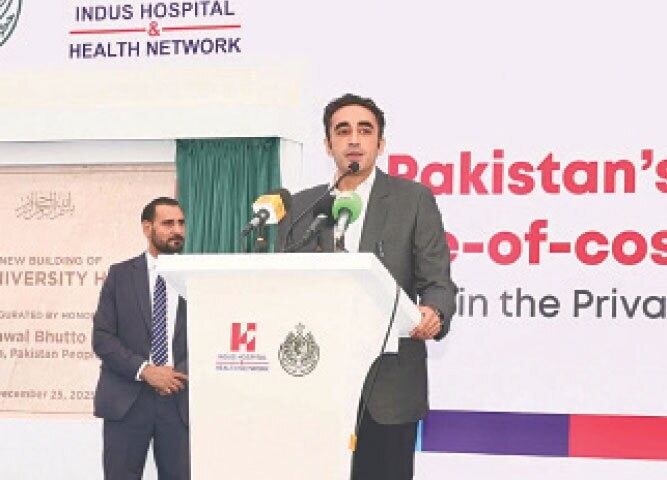
Speaking on the occasion, Chairman PPP Bilawal Bhutto Zardari said the Indus University Hospital project represents a major step toward strengthening Pakistan’s healthcare infrastructure and expanding access to quality medical services for those who cannot afford treatment. He added that, once completed, the hospital would significantly contribute to improving healthcare outcomes for the people of Karachi.
The Indus University Hospital is designed to meet Karachi’s growing healthcare needs. Upon full completion, the facility will offer comprehensive, free-of-cost healthcare services across a wide range of specialities, benefiting millions of patients annually.
During the visit, Chairman Bilawal Bhutto Zardari toured the newly inaugurated facilities alongside the senior leadership of Indus Hospital & Health Network (IHHN). The inaugurated section includes modern emergency and outpatient services, advanced diagnostic facilities, internationally benchmarked operating theatres, and patient-centred infrastructure developed in line with global healthcare standards. Further construction and service expansion will be completed over the next three years.

Addressing the ceremony, Sindh Chief Minister Syed Murad Ali Shah said his government remains fully committed to providing free, affordable and quality healthcare to the people through strong public–private partnerships, citing the Indus Health Network as one of the most successful models in the province.
Recalling the early days of the Indus Hospital, Murad Ali Shah said that when Dr Faisal Bari first approached him, he had been serving as provincial revenue minister for only a few months. “Dr Bari requested a grant of Rs250 to 400 million and invited me to visit the hospital. A few days later, I came to see the facility and met several old friends from my college and school days who were volunteering their professional services,” he said. He added that he requested the then chief minister to approve the grant, which was sanctioned immediately. “The initial funds were used for land acquisition. That is how this journey began, and since then, the work has continued to expand,” he said.
The chief minister noted that the Sindh government provided a grant of Rs300 million to Indus Hospital in the early years, which has gradually increased to Rs8 billion in the current year. “This grant is being paid. Every time I visited Indus, I met Dr Bari – this is probably my seventh or eighth visit, and whenever he made a request, I felt encouraged to fulfil it,” he remarked.
Murad Ali Shah said the Sindh government later invited Indus Health Network to partner with it, starting from a small hospital in Badin. “That partnership began in Badin and never stopped growing. Even today, we cannot imagine replacing Indus there,” he said, adding that the Jamshoro Regional Blood Centre was also handed over to the Indus Network, which now has the capacity to supply around 20,000 blood bags across the region.
He said the partnership gained further momentum after 2018, particularly when Dr Azra Fazal Pechuho became the provincial health minister. During the COVID-19 pandemic, he said, Indus Hospital played a crucial role. “When the first COVID patient arrived, one of my earliest calls was to Dr Faisal Bari. On their advice, we expanded testing capacity. At a time when only 60 to 70 tests were being conducted daily at other facilities, Indus scaled it up to 1,000 tests per day and then increased it further within weeks,” he said.
The chief minister acknowledged that the post-COVID period had a severe impact on the economy and donor support, but said the Sindh government stood by Indus Hospital. “Indus Health Network is not working alone – the Sindh government is also part of this network,” he said.
Sharing patient statistics, Murad Ali Shah said around 30 per cent of patients at Indus Hospital come from Landhi and Korangi, 20 per cent from other parts of Karachi, while nearly 50 per cent arrive from outside Karachi, including large numbers from Balochistan and Punjab. “This demonstrates that the healthcare work done in Sindh is far ahead of other provinces, and we achieved this with the support of our partners,” he added.
Mr Shah said the government has expanded its public–private partnership network with Indus Health Network in areas such as tuberculosis control and rabies prevention, and more initiatives are planned. “Today, this is a 1,350-bed hospital, which is still expanding, with a medical college also coming up,” he said.
The chief minister also announced plans to further strengthen healthcare services in Badin by linking the entire district to a main hospital and improving taluka headquarters hospitals in partnership with Indus Health Network. “We will begin work on this from the first week of the coming year,” he said.
Concluding his address, Murad Ali Shah reiterated that providing free or affordable quality healthcare is the responsibility of governments. “Those who support us in these noble efforts are our partners, and these partnerships will continue until we ensure free, quality healthcare for our people,” he said, thanking the Indus Health Network for hosting the ceremony.
Chairman IHHN Board of Directors, Mr Abdul Karim Paracha, expressed deep appreciation for the Government of Sindh’s support in advancing healthcare services for the people of the province.
President Indus Hospital, Dr Abdul Bari Khan, termed the project a transformative development for Pakistan’s healthcare system. He acknowledged the Sindh Government’s continued cooperation and emphasised that, upon completion, the Indus University Hospital would set a new benchmark for accessible, world-class healthcare in the country.
CEO Indus Hospital & Health Network, Professor Syed Zafar Zaidi, said the Indus University Hospital represents the evolution of a vision rooted in compassion, dignity and patient-centred care, bringing care, education and research under one roof.
Under its mission to provide free, high-quality healthcare without discrimination, Indus Hospital & Health Network continues to expand its services, ensuring that the completed Indus University Hospital becomes a cornerstone of Pakistan’s healthcare system in the years ahead.
Indus University Hospital, being constructed for Rs72billion and planned for completion over the next three years, will be spread over a 20-acre campus with 3.52 million sq. ft. of built-up area. Its inpatient capacity will be 1,350 beds upon completion.
It is based on an integrated care model, providing comprehensive primary, secondary and tertiary care services free of cost, and will include 36 international-standard operating theatres.
The hospital has planned centres for cancer care, medical innovation and research, with academic–clinical integration linked to a health sciences university with seven colleges.
Advertisements