

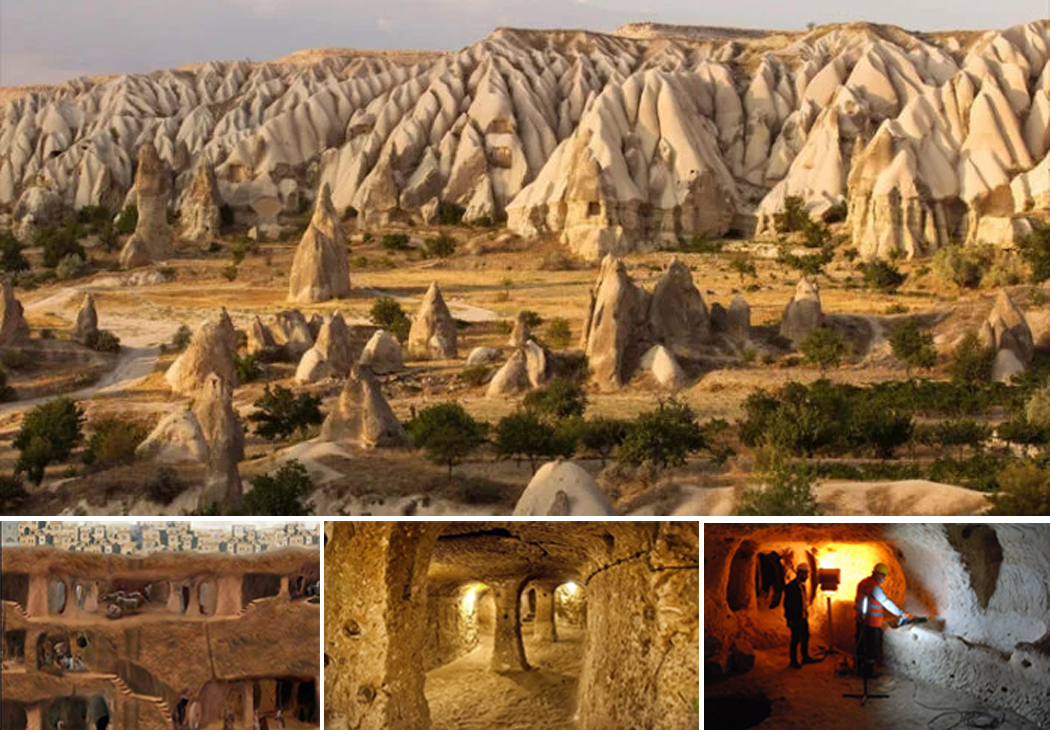
ANKARA : Turkey’s 6-story underground city that can surprisingly shelter more than 20,000 people for several months at a time. Turkey is a country famous for its archeology, but the district of Derinkuyu is even more unique in that it contains the remains of a vast underground city that is approximately 2,500 years old. This underground city, known today as Derinkuyu, whose ancient name was Elingobo, is a miraculous city built below the surface of the earth that has been hidden for centuries. The city is six stories high, extends 200 feet below the ground, and includes dozens of tunnels. It was once home to 20,000 people at one time. According to the British Broadcasting Corporation (BBC), Derinkuyu, the world’s largest excavated underground city, was in almost continuous use by its inhabitants for thousands of years. The city was home to a complete civilization, complete with tunnels, chambers, granaries, stables, synagogues, and even schools. According to experts, the city was used at various times for thousands of years and was occupied by Phrygian, Persian, and Byzantine Christians. There is a network of stairs and platforms that descend floor by floor, and there are also small and large corridors that connect different parts of the city. During the Greco-Turkish War in the 1920s, the inhabitants of Cappadocia left the area and moved to Greece, after which the city was completely deserted. Interestingly, this underground city was discovered in 1963 by a local man, when his chickens began disappearing through a crack formed during house renovations. Upon excavation, a dark tunnel was revealed, which turned out to be the entrance to this vast city. It was later discovered that there were more than 600 such entrances inside private homes. The most amazing aspect of this city was its modern ventilation system. More than fifty air wells provided fresh air throughout the city, while a 55-meter-deep well met the water needs. In the 12th century AD, local Christians took refuge in this city to escape Mongol invaders and other wars. Later, after the First World War, the Christians were expelled from here and the city became uninhabited. According to the report, in 1963, the Turkish Antiquities Authority took over the site and then tunnels and underground structures were discovered here. This is why in 1985, UNESCO declared Cappadocia a World Heritage Site. 50 years ago today, this city was opened to tourists and is now considered one of the most important and historical archaeological sites in Turkey.


ADVERTISEMENT