Pakistan’s US Imports Rise 45.44% as Export Growth Remains at 4.44% Mian Zahid Hussain
Business leader urges stronger economic diplomacy, improved market access and targeted export promotion to protect Pakistan’s trade surplus with the United States.

US Trade Mian Zahid Hussain calls for stronger Pakistani exports and improved access to American markets.
Pakistan’s imports from the United States increased by 45.44% year on year during the first quarter of FY2026-27, while export receipts grew by just 4.44%, raising concerns about the country’s narrowing bilateral trade surplus.
Mian Zahid Hussain, President of the Pakistan Businessmen and Intellectuals Forum and All Karachi Industrial Alliance, has urged the government to adopt a comprehensive strategy to expand Pakistani exports to the US.
He said stronger economic diplomacy, improved market access and greater industrial production could help Pakistan increase foreign exchange earnings and protect its trade surplus.
Trade Surplus Narrows as US Imports Accelerate
Citing the State Bank of Pakistan’s October 2026 report, Hussain said Pakistan’s export receipts from the US reached $1.716 billion during July–September 2026, up 4.44% from approximately $1.64 billion a year earlier.
Meanwhile, imports from the US surged 45.44% to $659.2 million, compared with $453.3 million in the corresponding period last year.
He noted that imports increased by approximately $206 million, while export receipts grew by around $73 million.
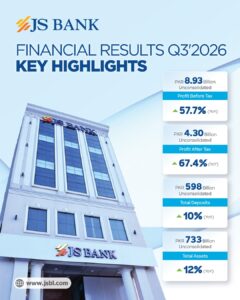
JS Bank Reports 67% Growth in Profit After Tax to Rs4.3 Billion in 9M 2026
Consequently, Pakistan’s bilateral trade surplus declined from approximately $1.19 billion to $1.06 billion, representing a reduction of around 11%.
Hussain said the widening gap between import and export growth required immediate attention. He urged policymakers to prioritise export expansion, industrial competitiveness and employment generation.
Pakistani Products Have Room to Expand US Market Share
Hussain highlighted several product categories in which Pakistan could increase its presence in the American market.
Citing the World Bank’s World Integrated Trade Solution (WITS), he shared the following 2025 trade figures:
- Cotton jerseys and pullovers: US imports totalled $7.35 billion, while Pakistan supplied approximately $502.3 million.
- Cotton bed linen: US imports reached $1.18 billion, with Pakistan accounting for $246.8 million.
- Cotton towels and household linen: US imports stood at $2.01 billion, including $512.4 million supplied by Pakistan.
- Medical and surgical instruments: US imports under the broad category of other medical, surgical and veterinary instruments reached $22.27 billion. Pakistan supplied approximately $121.8 million.
- Milled rice: US imports totalled $1.56 billion, while Pakistan supplied just $33.1 million.
He said Pakistani manufacturers could capture a larger share of these markets through improved product quality, international certification, better packaging and stronger marketing efforts.
He also urged relevant institutions to help medical instrument manufacturers understand US registration requirements and develop realistic export targets based on their production capabilities.
Diplomatic Engagement Should Support Economic Diplomacy
Hussain appreciated Pakistan’s diplomatic efforts to reduce tensions between the United States and Iran amid the conflict’s impact on global energy supplies and maritime trade.
He said stronger diplomatic engagement with Washington also offered an opportunity to advance Pakistan’s economic interests.
He urged the Ministry of Commerce and Ministry of Foreign Affairs to use high-level engagements to seek better market access, lower tariff barriers and wider business opportunities for Pakistani exporters.
He added that diplomatic progress should translate into new export orders, investment and employment opportunities for local industries.
Business Bodies Urged to Develop Joint Export Strategy
Hussain called on the Ministry of Commerce, Trade Development Authority of Pakistan (TDAP), Pakistani trade missions and the Federation of Pakistan Chambers of Commerce and Industry (FPCCI) to jointly develop a strategy for expanding exports to the US.
He recommended greater participation by small and medium-sized enterprises in international exhibitions, direct buyer engagements and business meetings.
However, he said export promotion must go hand in hand with practical support for businesses.
He urged authorities to ensure timely tax refunds, adequate financing and reliable maritime services. These measures, he said, would help exporters meet delivery schedules and honour commitments to international buyers.
Hussain concluded that sustainable trade relations with the United States should deliver more than diplomatic goodwill. They should also generate investment, technology transfer, higher industrial production and employment opportunities in Pakistan.