
FIFA Crisis Deepens as Confederations Consider Challenge to Gianni Infantino
UEFA, AFC and CONCACAF are weighing an unprecedented no-confidence move against FIFA president Gianni Infantino after a controversial investment plan triggered a governance crisis
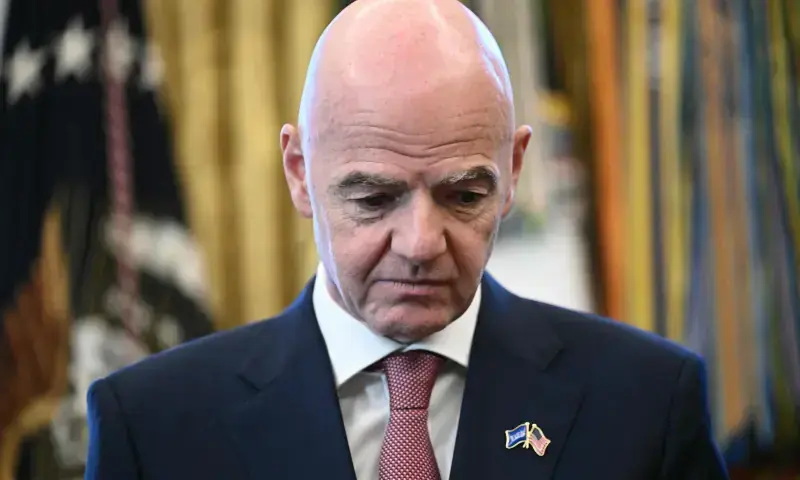
Gianni Infantino faces growing pressure as FIFA's leadership crisis intensifies
Confederations Weigh No-Confidence Vote
A growing FIFA crisis is threatening to reshape the leadership battle at world football’s governing body, with UEFA, the Asian Football Confederation (AFC) and CONCACAF considering whether to seek a vote of no confidence against president Gianni Infantino, according to senior figures familiar with the discussions.
The possible challenge follows the collapse of Infantino’s proposal to sell private investors a minority stake in a new FIFA commercial entity that would have controlled the commercial rights to the World Cup. The plan triggered criticism from several powerful football confederations, which accused FIFA’s leadership of failing to provide adequate transparency and consultation.
The discussions are significant because there is no known precedent in FIFA’s 122-year history for its Congress to hold a no-confidence vote against a sitting president.
One person familiar with the talks said Infantino now faced a choice between stepping aside before the next election or confronting a formal challenge. The source spoke anonymously because of the sensitivity of the discussions.
Under FIFA’s statutes, the FIFA Council can call an Extraordinary Congress. Such a meeting must also be convened if at least one-fifth of FIFA’s 211 member associations submit a written request identifying the issues they want considered.
Any Extraordinary Congress would have to be convened within three months, with each participating member association holding one vote. However, FIFA’s statutes do not specifically establish a procedure for removing the president through a no-confidence motion.
FIFA said it would not support or facilitate any process concerning the presidential election that conflicts with its statutes, democratic procedures or established governance framework.
UEFA has also called for a thorough review of FIFA’s leadership and governance, while saying that no option should be excluded. CONCACAF referred to an earlier joint statement with UEFA and the AFC, which accused FIFA’s leadership of a fundamental breach of trust.
Infantino Retains Support
Despite the pressure, Infantino continues to have significant support within FIFA. He has confirmed his intention to seek another term at the FIFA Congress scheduled for March 2027, while Africa’s football confederation CAF remains supportive of his leadership.
The political challenge has also exposed divisions inside FIFA. The organisation apologised to member associations over mistakes in handling the private investment proposal, while six Arab football associations, including Qatar and 2030 World Cup co-host Morocco, publicly backed Infantino.
FIFA leadership subsequently reaffirmed its support for the president following a crisis meeting in Morocco earlier this month.
For Infantino’s opponents, however, forcing a no-confidence vote carries its own risks. A failed challenge could demonstrate that he still commands enough support among FIFA’s 211 members and could strengthen his position ahead of the 2027 presidential election.
Investment Plan Triggers Wider Crisis
The controversy began after plans emerged for private investors to acquire a minority stake in a new FIFA commercial company. The entity would have controlled valuable commercial rights linked to the World Cup, FIFA’s flagship competition.
FIFA expects revenues of more than $15 billion during its 2023-2026 cycle, with a substantial share generated during the 2026 World Cup year.
UEFA, AFC and CONCACAF opposed the investment proposal and criticised the way it was developed. Their concerns have centred on transparency, consultation and governance.
The crisis intensified further following the departure of FIFA Chief Operating Officer Kevin Lamour. Lamour had criticised the investment plan and alleged that FIFA employees had been misled about a project he described as being driven by one individual. FIFA did not provide a reason for his departure.
FIFA Vice President Sandor Csanyi subsequently withdrew his support for Infantino, describing Lamour’s departure as the “final straw.”
US-Canada Tariffs Push Trade Relations to New Breaking Point
Support Remains for Infantino
Infantino’s opponents still face major obstacles before they can mount a successful challenge.
No rival has publicly declared a candidacy ahead of the November 18 nomination deadline. Meanwhile, Infantino continues to receive backing from influential parts of FIFA’s membership.
CAF president Patrice Motsepe said Africa continued to support Infantino and argued that FIFA members should ultimately decide his future through the election process.
The abandoned investment proposal had promised member associations access to as much as $20 million in one-off funding for infrastructure, coaching, national teams, competitions, grassroots football and women’s football.
Fleetwood Haiya, president of the Football Association of Malawi, said those seeking to challenge Infantino should publicly explain what they would offer football associations.
Clubs Add Pressure
The debate is therefore no longer limited to FIFA’s governing bodies. European clubs are also applying pressure.
European Football Clubs (EFC), chaired by Paris Saint-Germain president Nasser Al-Khelaifi and representing more than 800 clubs, is reportedly aligned with UEFA and others seeking changes to FIFA’s governance.
EFC has warned that its members could consider refusing to participate in future men’s and women’s Club World Cups unless concerns over governance and the relationship between FIFA and clubs are addressed.
Although clubs do not have a vote in FIFA’s presidential election, they possess substantial sporting and commercial influence.
Former International Olympic Committee marketing chief Michael Payne said even a narrow electoral victory for Infantino might not resolve the organisation’s divisions if major football powers remained opposed to his leadership.
The dispute has so far not prompted any major FIFA sponsor to publicly criticise Infantino. But Payne said sponsors were increasingly questioning how FIFA could combine a highly successful World Cup with a leadership crisis immediately afterwards.
The growing opposition suggests that the controversy over the investment proposal has developed into a much broader dispute about FIFA’s governance, transparency and relationship with football’s most powerful confederations and clubs. With the 2027 presidential election approaching, the pressure on Infantino may now become one of the defining political battles in world football.